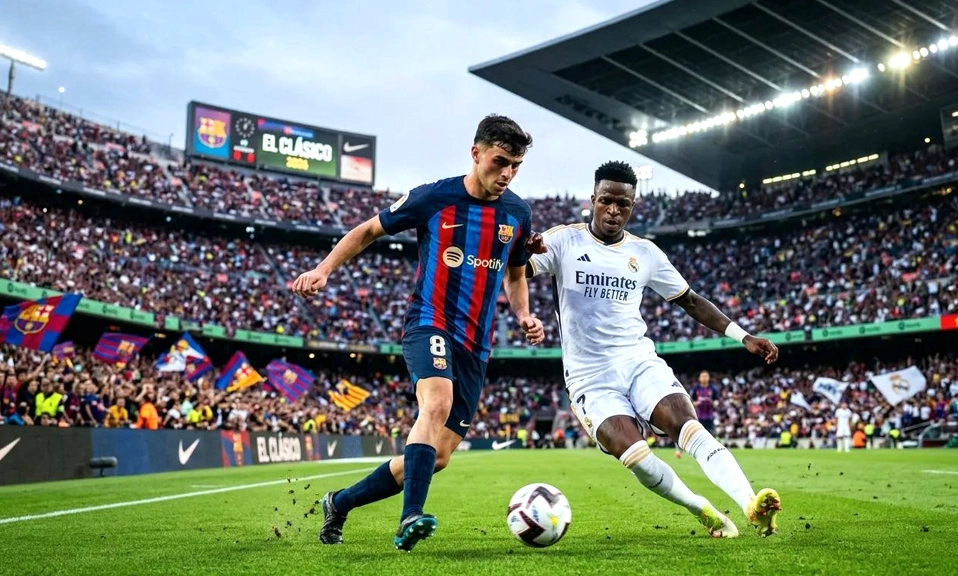
On the surface, it is a football match. Two teams, twenty-two players, ninety minutes, a ball. But anyone who has stood in the stands of Camp Nou or the Santiago Bernabéu, or watched from a bar in Buenos Aires or a living room in Lagos, knows that El Clásico is something else entirely. It is a clash of identities, a proxy for political conflict, a stage for history, and a global spectacle that transcends the sport that gave it life.
The rivalry between Barcelona and Real Madrid is not just the biggest match in club football. It is the biggest match in any sport, anywhere. And the reason is simple: El Clásico is not about football. It is about everything else.
A Rivalry Forged in Politics and History
To understand El Clásico, you have to go back further than the modern era of global television and billionaire transfers. You have to go back to the Spanish Civil War and the dictatorship of Francisco Franco.
During Franco’s regime, from 1939 to 1975, regional identities were suppressed. The Catalan language was banned in public life. Catalan institutions were dismantled. The autonomous government of Catalonia was abolished. In this context, FC Barcelona became something more than a football club. It became a refuge for Catalan identity, a place where the language could be spoken, the flag could be displayed, and a distinct culture could survive.
Real Madrid, meanwhile, was seen by many as the team of the establishment—the club of the capital, the club of the regime, the club that represented a unified, centralized Spain. This narrative is not entirely fair to Real Madrid, which had its own complicated relationship with the dictatorship, but it became the dominant story. It is the lens through which generations of fans have viewed the rivalry.
Two moments in the 1940s and 1950s cemented the rivalry’s political dimensions.
The first was the 1943 Copa del Generalísimo semifinal. Barcelona had won the first leg 3-0 at Les Corts. Before the second leg in Madrid, the story goes, the Barcelona dressing room was visited by a figure from the regime who reminded the players of the political reality. Barcelona lost the second leg 11-1. The result remains the most lopsided in the history of the fixture and a permanent scar in the Catalan collective memory.
The second was the Di Stéfano saga. In 1953, both Barcelona and Real Madrid were pursuing Alfredo Di Stéfano, the Argentine forward who would become one of the greatest players of all time. Barcelona believed they had secured his signing. But through a complex and controversial set of negotiations, Di Stéfano ended up at Real Madrid, where he became the cornerstone of the most dominant team in European football. For Barcelona fans, it was proof that the establishment would always find a way to win.
“Més que un club” – More Than a Club
Barcelona’s motto, Més que un club, is not a marketing slogan. It is a statement of identity. The club is owned by its members, not by a single billionaire or a corporation. It has been a vehicle for Catalan self-expression for over a century. The Camp Nou has been a site of political protest, from the Franco era to the 2017 independence referendum, when the club played a match behind closed doors as a protest against police violence at polling stations.
Real Madrid, by contrast, represents a different kind of identity: Spanish centralism, the capital, the establishment. The Bernabéu has been the stage for the Spanish national team’s successes and the site of royal visits. The club’s history is intertwined with the Spanish state in ways that Barcelona’s is not.
This does not mean every Barcelona fan is a Catalan independence supporter, or every Real Madrid fan is a Spanish nationalist. The reality is far more nuanced. But the symbolism is real, and it is felt by people who have never set foot in either stadium. El Clásico is a Rorschach test for identity. What you see in it depends on who you are and where you come from.
The Global Spectacle
And then there is the football itself. El Clásico has been blessed with some of the greatest players ever to play the game. Di Stéfano, Cruyff, Maradona, Ronaldo, Romário, Figo, Ronaldinho, Messi, Ronaldo, Benzema, Modrić, Xavi, Iniesta. The list is endless.
The match is watched by an estimated 650 million people worldwide. It is the most-watched club football match on the planet, broadcast in over 180 countries. The global audience is a testament to the power of the rivalry, but it is also a source of tension. As the match has become a global brand, there are those who worry that the political and cultural dimensions are being smoothed over for international consumption, that the rivalry is being reduced to a product.
But the politics keep returning. In 2017, the match was played behind closed doors. In 2019, the fixture was moved from Barcelona to Madrid because of political unrest in Catalonia. The Spanish anthem is routinely booed at the Camp Nou. Players like Gerard Piqué, who has spoken openly about his Catalan identity and his support for independence, have been booed by Spanish national team fans. The rivalry is not just a historical artifact. It is a living, breathing conflict that continues to shape the present.
Class, Culture, and Identity
Beyond the political dimension, El Clásico is also a clash of class and culture. Barcelona is a cosmopolitan, Mediterranean city, a hub of art, design, and trade. Real Madrid is the capital, the seat of government, the center of the Spanish state. The rivalry maps onto a broader tension between center and periphery, between the cosmopolitan and the centralized, between the regional and the national.
This is not just an abstract idea. It is felt in the stands, in the songs, in the flags, in the language spoken in the streets around the stadiums. It is felt by the Catalan-speaking fans who sing “Els Segadors” before matches, and by the Madrid fans who wave Spanish flags. It is felt by the immigrants who have made Barcelona their home and adopted the club as their own, and by the working-class communities in Madrid who see Real Madrid as a symbol of aspiration and excellence.
El Clásico is also a stage for the expression of regional pride, and for the performance of identity. The match is a ritual, a moment when the abstract idea of “Catalonia” or “Spain” becomes tangible, visible, audible. It is a moment when people who feel their identity is under threat can assert it, collectively, in front of millions.
The Modern Clásico: Commerce vs. Sentiment
The modern El Clásico is a multi-billion-dollar enterprise. Television rights, sponsorship deals, merchandise sales, tourism. The match is a global product, marketed to audiences who have no connection to Catalonia or Madrid, who tune in to see Messi or Ronaldo or Benzema or Lewandowski.
This commercialization has changed the rivalry in significant ways. The political edge has been softened by the need to appeal to a global audience. The clubs themselves have become global brands, with fan bases in Asia, Africa, and the Americas that dwarf their local support. The players are international superstars, often with no deep connection to the cities they represent.
But the sentiment remains. The Camp Nou still erupts when the team scores against Real Madrid. The Bernabéu still roars when Barcelona is beaten. The political symbols are still there, even if they are sometimes overshadowed by the spectacle. The rivalry is still felt, deeply, by the people who live it every day.
El Clásico is bigger than
football because it is a container for everything football cannot hold. It is a vessel for history, for politics, for identity, for culture, for class, for regional pride, and for the human need to belong to something larger than oneself. It is a match that matters to people who do not care about football, because it is about something more than football.
It is the story of a country’s unfinished business, played out on a pitch every few months. It is the story of two cities, two identities, two ways of being Spanish. It is the story of a rivalry that has survived dictatorship, democracy, globalization, and commercialization, and emerged stronger for it.
When Barcelona and Real Madrid meet, the world stops to watch. Not because of the football, though the football is often sublime. But because of what the match represents. It is a clash of narratives, a collision of histories, a moment when sport becomes something else entirely.
That is why El Clásico is bigger than football. It is football, and so much more.