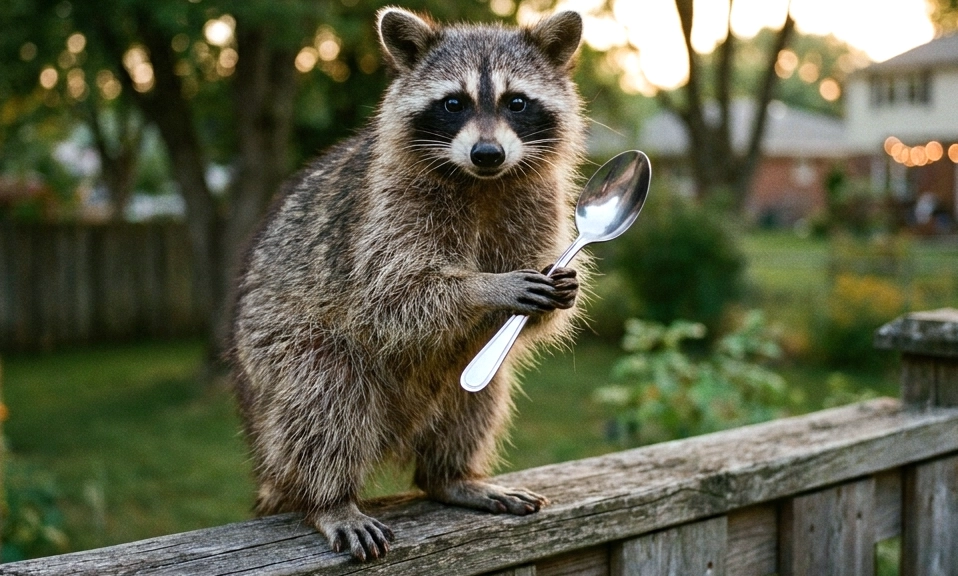
They have the masked faces, the nimble hands, and the mischievous intelligence. They can open latches, solve puzzles, and remember solutions for years. They are already living in our cities, raiding our bins and charming our back gardens. And now, a growing number of scientists and animal behaviorists are asking a question that sounds like the setup to a joke but might be deadly serious: could raccoons become the dogs of the future?
It’s a tantalizing idea. The raccoon (Procyon lotor) is one of the few wild mammals that has not just tolerated human expansion but actively thrived on it. In the suburbs of North America, they are as common as stray cats. In Japan, where they were introduced as pets in the 1970s and subsequently escaped or were released, they have become an invasive species with a population estimated in the tens of thousands. They are smart, adaptable, and—crucially—they already seem to be domesticating themselves.
But is the raccoon really a candidate for man’s best friend 2.0? Or is this a fantasy that misunderstands both the animal and the nature of domestication itself?
The Case For: A Brains-and-Brawns Package
The argument for raccoon domestication rests on several compelling traits.
They are problem-solvers of the highest order. In a famous 1908 study, raccoons learned to solve a complex locking mechanism by observing a human. More recent research has shown they can learn to associate symbols with food rewards, remember solutions for up to three years, and even pass knowledge to their offspring. Their dexterity is legendary—they can open jars, unlatch doors, and turn doorknobs. A raccoon’s brain-to-body ratio is comparable to that of a domestic cat, and their intelligence is often described as “dog-like” or “primate-like”.
They are already synanthropic. Unlike wolves, which had to be actively tolerated by humans to begin the domestication process, raccoons have moved into our cities without invitation and made themselves at home. They den in attics, forage in bins, and cross roads with a confidence that suggests they consider themselves residents, not intruders. Some researchers argue that this is the first step of a natural domestication process—a “self-domestication” driven by the animals that are bold enough to approach humans and clever enough to exploit our waste.
They are adaptable. Raccoons are native to North America but have been introduced to Europe and Asia, where they have established thriving populations. They can survive in forests, marshes, mountains, and cities. Their diet is equally flexible—they eat everything from fruit and insects to fish, frogs, and discarded fast food. This adaptability is the raw material of domestication: a species that can adjust to new environments can adjust to living with humans.
The Russian experiment. The most famous domestication experiment in modern science—the Russian farm fox study—proved that selecting animals for tameness alone can produce a suite of domesticated traits in just a few decades: floppy ears, curly tails, piebald coats, and puppy-like behavior in adulthood. If raccoons were subjected to a similar selective breeding program, some scientists believe they could become genuinely domestic animals within 20 to 30 generations.
The Case Against: The Reasons It Probably Won’t Work
For every reason to believe raccoons could become dogs, there is a reason to believe they won’t—or at least, that the process would be far more complicated than it sounds.
They are, by nature, solitary. Wolves and dogs are pack animals. Their social structure is what made them trainable: a dog sees a human as a pack leader, a partner, a member of its social group. Raccoons are largely solitary and territorial. They do not form hierarchical packs, and they do not naturally defer to a leader. “It may be difficult for them to bond with humans as dogs do,” said Dr. Sarah Benson-Amram, a behavioral ecologist at the University of British Columbia who has studied raccoon cognition. “They’re solitary animals, they don’t form strong social bonds in the wild, and they can be aggressive when cornered”.
They are wild animals, not pets. Raccoons may look cuddly, but they have sharp teeth and claws, and they are capable of inflicting serious damage. They are also carriers of rabies, roundworm, and other diseases. In many jurisdictions, keeping a raccoon as a pet is illegal. Even where it is legal, the animals often become destructive and unmanageable as they mature. “People think they’re getting a cute little bandit, but they’re getting a wild animal that will tear apart their house,” said one wildlife rehabilitator.
They don’t have the genetic raw material. Dogs have been domesticated for at least 15,000 years—some estimates suggest 30,000. In that time, humans have selected for traits like tameness, trainability, and social attunement. Raccoons have never been subjected to that process. They are, in evolutionary terms, exactly what they have always been: highly intelligent, opportunistic omnivores with a talent for survival and a deep suspicion of anything that isn’t food. “You can’t just take a wild animal and expect it to become a pet,” said Dr. Marc Bekoff, a professor emeritus of ecology and evolutionary biology at the University of Colorado, Boulder. “Domestication is a long, slow process that involves profound genetic changes. It’s not something you can fast-track”.
They may already be too smart. The intelligence that makes raccoons such appealing candidates for domestication is also what makes them difficult to domesticate. A wild animal that is clever enough to outwit humans is not an animal that easily submits to human authority. “They’re problem-solvers, and they’re stubborn,” Benson-Amram said. “They’re not going to do what you want them to do just because you want them to do it”.
The Middle Path: Tolerated, Not Tamed
There is a third possibility—one that is neither full domestication nor complete separation. It’s the path that cats took, and it may be the path that raccoons are already following.
Cats were never fully domesticated in the same way dogs were. They were tolerated, encouraged, and eventually selectively bred, but they retained much of their wild independence. They live in our homes, but they do not defer to us. They hunt, they roam, and they retain the instincts of their ancestors.
Raccoons could follow a similar path. They are already living in our cities, eating our food, and learning to navigate our world. They are not pets, but they are becoming something more than wild animals. They are becoming neighbors—a species that occupies a niche between wild and domestic, tolerated and occasionally fed, but never fully tamed.
“Raccoons are not going to become dogs,” said Dr. Suzanne MacDonald, a psychologist at York University who has studied raccoon behavior in Toronto. “But they might become something like urban foxes or feral cats—animals that live alongside us, that we see every day, that we occasionally interact with, but that remain, in their hearts, wild”.
Could raccoons
become the dogs of the future? The honest answer is: probably not, and probably not in the way that dog lovers might hope.
The biological and behavioral barriers are substantial. Raccoons are solitary, aggressive, disease-carrying wild animals with no evolutionary history of cooperation with humans. They are not trainable in the way that dogs are trainable, and they are not affectionate in the way that dogs are affectionate. A raccoon that cuddles up to you is probably looking for food, not for companionship.
But the question itself reveals something important about our relationship with animals. We want to believe that domestication is a choice—that any animal, given enough time and love, could become a companion. The raccoon is a test case for that belief. It is smart enough, adaptable enough, and already living among us. If any wild animal could make the leap, it would be the raccoon.
And yet, the raccoon also reminds us that domestication is not a gift we can bestow on any animal we choose. It is a process, a partnership, a slow dance that takes thousands of years. The raccoon may be brilliant, but it is not ours to domesticate—not yet, and perhaps not ever.
For now, the raccoon remains what it has always been: a wild creature with a masked face and a mischievous heart, living alongside us but not with us. That might be its greatest gift to us—a reminder that not every intelligent animal wants to be our friend, and that some of the most fascinating creatures are the ones that choose to remain just out of reach.