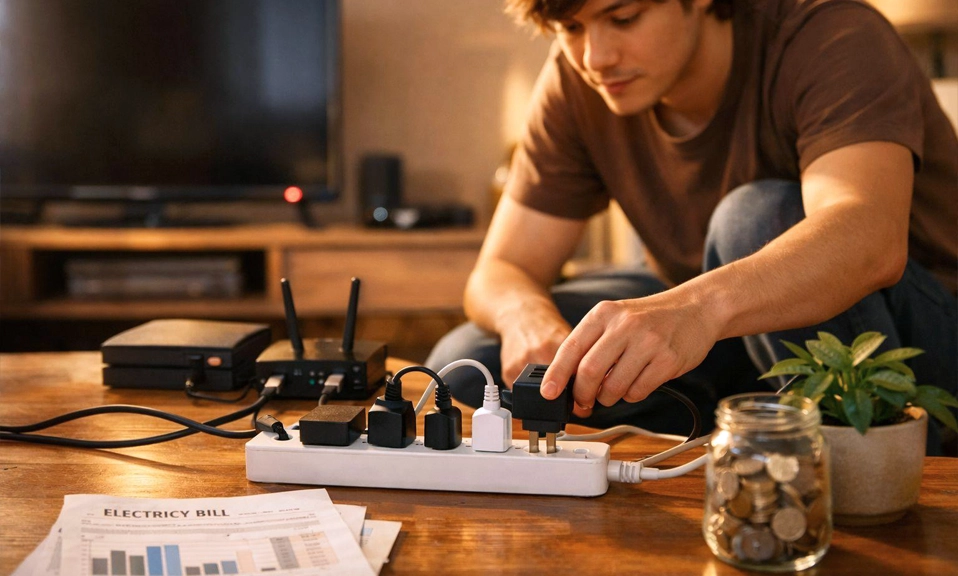
We like to think we’re in control of our finances. We budget, we save, and we avoid buying things we don’t need.
But personal finance isn’t just about the massive, obvious purchases. Often, the biggest threats to our bank accounts are the tiny, invisible leaks. They are the habits so deeply ingrained in our daily routines that we don’t even register them as spending.
Financial experts call this “death by a thousand cuts.” Individually, these habits cost you $5 or $10. Collectively, they can drain thousands of dollars from your wallet every single year.
Ready to plug the leaks? Here are 10 everyday habits that secretly waste your money, and exactly how to stop them.
1. Paying the “Convenience Tax” on Food Delivery 📱
The Habit: You’re tired after work, so you open a delivery app. The food costs $15, but by the time you add the service fee, delivery fee, small order fee, and tip, the total is $28. The Secret Cost: You aren’t just paying for the food; you’re paying a 50% to 100% markup for the privilege of not leaving your couch. Doing this just twice a week can cost you over $1,500 a year. How to Stop It: Implement a “24-Hour Rule” for delivery apps. Delete the apps from your phone’s home screen to add friction. If you still want it the next day, order pickup instead. You get the same food, support the local restaurant more directly, and save $10+ instantly.
2. Subscription Creep 📺
The Habit: You signed up for a streaming service to watch one show, a fitness app for a New Year’s resolution, and a cloud storage upgrade “just in case.” You forgot to cancel them when you stopped using them. The Secret Cost: $15 here and $10 there doesn’t feel like much, but five forgotten subscriptions easily bleed $50 to $100 a month ($600–$1,200 a year) for services you don’t even use. How to Stop It: Do a “Subscription Audit.” Scroll through your last three months of bank and credit card statements. Cancel anything you haven’t used in the last 30 days. For the future, set a calendar reminder to cancel a free trial the day before it renews.
3. The “Discount Trap” Illusion 🏷️
The Habit: You see a jacket that is normally $100, but it’s marked down to $60. You think, “I’m saving $40!” so you buy it. The Secret Cost: You didn’t save $40. You spent $60 on a jacket you wouldn’t have bought at full price. Retailers use artificial urgency and “sales” to trigger a dopamine hit, making you spend money on things you don’t actually need. How to Stop It: Ask yourself one question before buying anything on sale: “Would I buy this at full price if I needed it?” If the answer is no, you’re not saving money; you’re just spending it.
4. The Bulk-Buy Blunder (The “Rotting Spinach” Tax) 🛒
The Habit: You go to a warehouse store and buy a massive bag of salad, a 48-pack of yogurt, or a giant jar of spices because the “unit price” is so much better. The Secret Cost: If you throw away half of it because it expires before you can eat it, the “savings” are an illusion. You are literally throwing your money in the trash. Food waste costs the average household hundreds of dollars annually. How to Stop It: Only buy in bulk for non-perishable items you know you will use (toilet paper, pet food, canned goods). For perishables, buy smaller quantities more frequently, even if the per-unit cost is slightly higher. The true cost is what you actually consume, not what you bring home.
5. Brand Loyalty Blindness 🧠
The Habit: You’ve bought the same brand of laundry detergent, cereal, and paper towels for five years because it’s what your parents bought, or it’s what you’ve always grabbed. The Secret Cost: Brands know that habit is the strongest form of marketing. They quietly raise prices on loyal customers, knowing you won’t notice or switch. You are often paying a 20% to 30% “brand premium” for a product that is chemically identical to the store brand. How to Stop It: Play the “Store Brand Challenge.” For one month, intentionally buy the generic or store-brand version of your top 5 recurring purchases. You will likely find the quality is indistinguishable, saving you 20% on your grocery bill instantly.
6. Paying the “Lazy Tax” on Bills 📞
The Habit: Your internet, phone, and car insurance bills auto-pay every month. You haven’t looked at the itemized charges or shopped around for a better rate in three years. The Secret Cost: Companies rely on customer inertia. They offer the best promotional rates to new customers, while slowly raising the rates of loyal, auto-paying customers. How to Stop It: Once a year, call your internet and insurance providers. Simply say: “I’ve been a loyal customer, but I see a competitor offering a lower rate. Can you match it or apply any current promotions to my account?” You’d be shocked at how often they will instantly lower your bill to keep you.
7. Ignoring Preventive Maintenance 🔧
The Habit: You skip the $50 oil change, ignore that weird noise your car is making, or put off going to the dentist for a routine cleaning because you’re “too busy.” The Secret Cost: This is the ultimate false economy. A $50 oil change prevents a $5,000 engine replacement. A $150 dental cleaning prevents a $2,000 root canal. Procrastination is incredibly expensive. How to Stop It: Treat preventive maintenance like a non-negotiable bill. Schedule your car service, dental cleanings, and HVAC check-ups in advance, and put the money in a dedicated “Maintenance” sinking fund.
8. Micro-Transaction Death by a Thousand Cuts 💳
The Habit: A $3 coffee from the drive-thru, a $2 in-app game purchase, a $5 vending machine snack, a $4 fee to use an out-of-network ATM. The Secret Cost: These purchases are designed to be “frictionless.” Because they are under $5, your brain doesn’t register them as “real” spending. But five dollars a day is $1,825 a year. How to Stop It: Track your “micro-spending” for just one week. Write down every single purchase under $10. The visual shock of seeing them add up is usually enough to break the habit. Switch to a fee-free bank to eliminate ATM charges entirely.
9. The “Checkout Line” Impulse 🛍️
The Habit: You’re waiting in line at the grocery store, pharmacy, or big-box retailer, and you grab a magazine, a candy bar, or a cute pair of socks on display. The Secret Cost: Retailers spend millions of dollars on “point-of-purchase” psychology. Those items are placed there specifically to exploit your decision fatigue. You’ve already made all your hard financial decisions in the aisles; by the checkout, your willpower is depleted. How to Stop It: Keep your hands full (hold your basket, hold your phone, hold your keys). If your hands are occupied, you physically can’t grab the impulse item. Better yet, use self-checkout or scan-and-go apps to bypass the physical displays entirely.
10. Rushed Shipping and Last-Minute Purchases 📦
The Habit: You wait until the day before a birthday or a trip to buy a gift or toiletries, forcing you to pay $15 for overnight shipping or buy an overpriced item at the airport pharmacy. The Secret Cost: Urgency is the enemy of frugality. When you are in a rush, you lose all price sensitivity and bargaining power. How to Stop It: Keep a “Gift Closet” with a few generic, high-quality items (nice candles, gift cards, a good bottle of wine) ready to go. For travel, create a permanent, pre-packed toiletry bag that never gets fully unpacked, so you’re never caught buying a $12 travel-size toothpaste at 6 AM.
Intentionality Over Deprivation
Plugging these financial leaks isn’t about living a life of austerity. You can still enjoy a delivered meal, a good brand, or a spontaneous treat.
The goal is intentionality.
When you shift from mindless spending to mindful spending, you take back control. You stop funding corporate convenience and start funding your own goals—whether that’s a vacation, an emergency fund, or just the peace of mind that comes with a healthy bank account.
Pick one habit from this list to tackle this week. Your future self (and your wallet) will thank you.
Which of these “secret” money wasters are you guilty of? Have you found a clever hack to stop subscription creep or avoid the convenience tax? 💰🛑📉