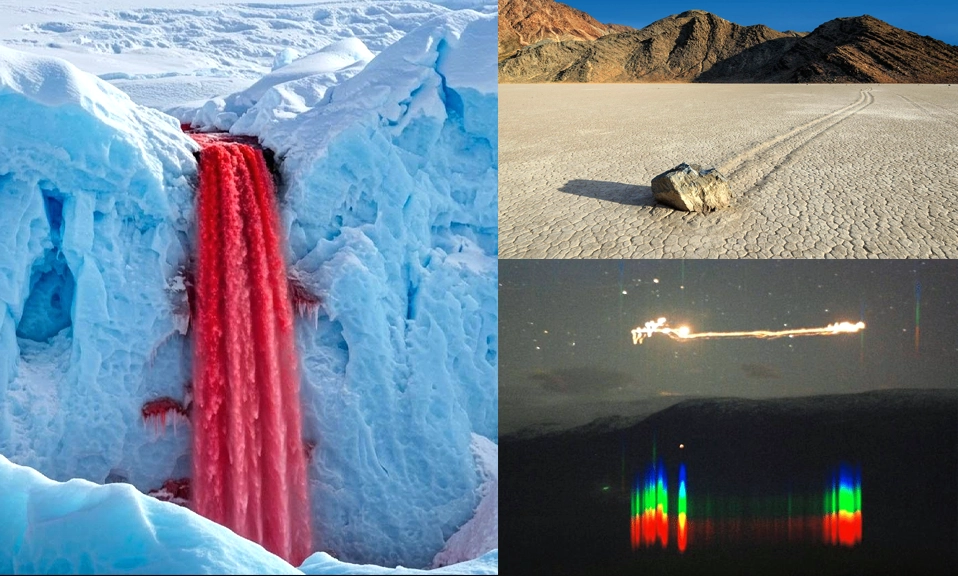
The age of satellite mapping and deep-sea exploration has made the world feel smaller, but it hasn’t made it any less strange. For every mystery that has been solved—the sailing stones of Death Valley, the disappearing water of Devil’s Kettle—there are a dozen more that stubbornly resist explanation. These are places where the rocks don’t behave, the ecosystems shouldn’t exist, and the legends have outlasted every attempt to debunk them.
Here are 10 places on Earth that scientists still cannot fully explain.
1. Movile Cave: The Ecosystem That Shouldn’t Exist
In 1986, workers drilling near the Black Sea in Romania broke into a cave that had been sealed off from the surface for 5.5 million years. What they found inside was a world that should not have been able to support life. The air contains only 7 to 10 percent oxygen—half of what humans breathe—and is laced with hydrogen sulfide, methane, and ammonia. There is no light. No photosynthesis. And yet, Movile Cave is teeming with life.
Researchers have identified nearly 50 species of invertebrates, including worms, pseudo-scorpions, spiders, leeches, and centipedes. More than 30 of them are endemic, found nowhere else on Earth. The food web is not powered by sunlight but by chemosynthetic bacteria that oxidise methane and sulfur from the thermal waters. It is one of the few known ecosystems on the planet that operates entirely independently of the sun, and it offers a tantalising glimpse of how life might survive in the subsurface oceans of other worlds. What scientists still cannot explain is precisely how this community assembled, how long it took to evolve in isolation, and whether there are other Movile Caves waiting to be found.
2. The Richat Structure: The Eye of the Sahara
From space, the Richat Structure in Mauritania looks like a giant, unblinking eye staring up from the desert. The 40-kilometre-wide formation of concentric rings was first thought to be an impact crater, but the lack of shock minerals and the presence of igneous rock at its centre ruled that out. The leading explanation is that it is a deeply eroded geological dome, formed by the uplift of rock above an underground intrusion of magma, with different layers eroding at different rates to create the rings.
That explanation accounts for the shape, but not for the scale and symmetry. The structure has been linked—by fringe theorists, not geologists—to the lost city of Atlantis, and its origin remains “enigmatic and debated” in the scientific literature. The question is not whether the Richat Structure is natural, but why this particular sequence of geological events produced something so improbably circular.
3. The Zone of Silence: Mexico’s Radio Dead Zone
Deep in the Chihuahuan Desert, near the town of Ceballos, lies a patch of land where, according to local legend, radio signals cannot be received and strange lights appear in the sky. The Mapimí Zone of Silence earned its name in the 1970s after a US Air Force rocket test went wrong and crashed in the area. Rumours quickly spread that magnetic anomalies had caused the failure, and that the same anomalies were disrupting communications.
The truth, as is often the case, is more mundane: locals invented the legend to attract tourism, and researchers at the Mapimí Biosphere Reserve say they have never had any issues with radio communication. And yet, the Zone of Silence has never entirely lost its mystique. The story of the rocket crash is real, the biodiversity of the reserve is genuinely extraordinary, and the human tendency to look for meaning in a strange landscape remains as strong as ever.
4. The Deep Earth Blobs: Continent-Sized Mysteries Beneath Our Feet
The strangest places on Earth are not always on the surface. 2,900 kilometres below our feet, at the boundary between the mantle and the outer core, seismologists have found two continent-sized structures that defy easy explanation. Known as Large Low Shear Velocity Provinces (LLSVPs), one lies beneath Africa and the other beneath the Pacific. They are thousands of kilometres across and up to 1,000 kilometres thick, and they slow seismic waves in ways that suggest they are made of something chemically distinct from the surrounding mantle.
Are they super-hot regions? Piles of ancient oceanic crust? Remnants of a primordial magma ocean? Or, as one recent hypothesis suggests, fragments of Theia, the protoplanet that collided with Earth to form the Moon? No one knows. The LLSVPs play a major role in mantle convection—the churning that drives plate tectonics and volcanism—yet their composition and origin remain one of the deepest unsolved problems in geophysics.
5. El Ojo: The Floating Island That Shouldn’t Be a Perfect Circle
In the Paraná Delta of Argentina, there is a near-perfect circular island floating in an equally circular lake. Named El Ojo (“The Eye”), the island is about 120 metres across and is made of decomposing plant matter. Nature generally does not produce perfect circles in organic landscapes, and El Ojo’s symmetry has fuelled years of conspiracy theories about UFO activity and hidden civilisations.
Scientists believe the circle is the result of rotational shear—the same forces that create spinning ice disks in rivers, where eddies in the water cause a circular mass to rotate slowly and maintain its shape. But the explanation is not fully satisfying. The island has persisted for decades, and the precise mechanism that keeps it so perfectly round—and so stubbornly afloat—is still being studied. It is a reminder that even in a world mapped to the metre, nature can still produce shapes that look designed.
6. The Bermuda Triangle: The Mystery That Refuses to Die
The Bermuda Triangle is the ultimate example of a place that science has largely explained but the public has refused to let go. The region between Florida, Puerto Rico, and Bermuda has been the subject of countless disappearances, from ships to planes, and the explanations range from the plausible (rogue waves, human error, methane hydrates) to the absurd (aliens, Atlantis, a third dimension).
The U.S. Navy and Coast Guard maintain that there are no supernatural explanations for disasters at sea, and statistical analyses have found that disappearances do not occur with any greater frequency in the Triangle than in any other well-travelled area of the ocean. And yet, the legend persists. Recent research has suggested that rogue waves up to 30 metres high could explain some of the lost ships, while other studies have pointed to methane eruptions from the seafloor reducing water density and causing vessels to sink. The mystery is less about the place itself and more about why we need it to remain mysterious.
7. The Nazca Lines: Messages to the Gods, or Something Else?
The Nazca Lines in southern Peru are among the world’s most enduring archaeological enigmas. More than 1,000 enormous figures—animals, humans, and geometric shapes—were etched into the desert floor over 400 square miles by the Nazca people, who flourished between roughly 100 BC and 800 AD. The lines are so large that they can only be fully appreciated from the air, which has led to speculation about their purpose for nearly a century.
Were they astronomical markers? Ceremonial pathways? Messages to the gods? A 1968 study found that some lines point to solstice positions of the sun and moon, but later computer analysis by astronomer Gerald Hawkins found no correlation between the lines and the stars. The modern consensus is that the lines were not made at one time or for one purpose, but were added to over centuries, with many superimposed on older ones. The mystery is not how they were made—the Nazca removed dark surface stones to reveal lighter sand beneath—but why. And that question may never be fully answered.
8. Stonehenge: The Monument That Refuses to Be Pinned Down
Stonehenge has been studied for centuries, and it remains one of the most mysterious places on Earth. The 5,000-year-old monument in Wiltshire, England, consists of massive bluestones that were transported nearly 300 kilometres from Wales—a feat that still puzzles archaeologists. The purpose of the site has been debated for just as long: was it a temple, a cemetery, a healing centre, an astronomical observatory, or all of the above?
The astronomical alignments are real—the monument is oriented toward the sunrise on the summer solstice and the sunset on the winter solstice—but the idea that it was a “Neolithic computer” has been overstated. Recent discoveries, including a dismantled stone circle near the Welsh source of the bluestones, have raised the possibility that an ancient legend about Stonehenge’s origin, written down 900 years ago, might contain a grain of truth. The question is no longer whether Stonehenge was significant—it clearly was—but what, exactly, it was for.
9. Lake Baikal’s Magnetic Anomaly: Compasses That Point the Wrong Way
Lake Baikal in Siberia is the deepest and oldest freshwater lake on Earth, and it is home to a magnetic anomaly that has baffled scientists for years. On the northern part of Olkhon Island, compasses deviate from true north, and the cause has been linked to an ancient iron-production site—possibly smelting furnaces with remnants of ore and slag buried underground.
But the anomaly is only one of Baikal’s mysteries. The lake is fed by more than 300 rivers, yet it does not silt up, because it sits on a rift valley that is pulling apart and siphoning sediment into the Earth. Local legends speak of UFOs and disappearing people, and some researchers have suggested that gas hydrates in the lake can reduce water density and cause objects to sink. Baikal is a place where geology, magnetism, and folklore collide, and science has yet to fully disentangle them.
10. Devil’s Kettle Falls: The Waterfall That Swallows Everything
At Devil’s Kettle Falls in Minnesota’s Judge C.R. Magney State Park, the Brule River splits in two above a thick knuckle of rhyolite rock. One side plunges 15 metres into a pool as a normal waterfall. The other side vanishes into a massive hole in the rock and disappears.
For decades, people threw things into the hole—logs, ping pong balls, GPS trackers, even coloured dye—and none of it was ever seen again. The mystery spawned theories about portals to hell and underground passages to Lake Superior. Then, in 2016, hydrologists from the Minnesota Department of Natural Resources measured the volume of water above and below the falls and found that it was almost identical: 123 cubic feet per second before the falls and 121 cubic feet per second after. The water was not disappearing. It was flowing through the hole and re-emerging downstream, hidden from view.
So why is Devil’s Kettle still on this list? Because the mystery was never fully solved. The water returns to the river, but how it moves through the hole—the precise path it takes through the volcanic rock—remains unknown. The strong currents create vortices that can hold, crush, or carry objects deep underground before releasing the water back into the river. It is a place where the explanation is almost as strange as the legend.
A World That Refuses to Be Fully Known
These 10 places share a common thread: they are all reminders that the Earth is not a puzzle that can be solved once and for all. Some, like the Bermuda Triangle, are mysteries more of culture than of science. Others, like the deep Earth blobs and Movile Cave, are genuine scientific frontiers where the answers are still being written. And a few, like Devil’s Kettle and the Richat Structure, are places where the explanation is known but the wonder refuses to fade.
The age of exploration is not over. It has simply moved underground, underwater, and into the spaces between what we know and what we can prove. These places will continue to fascinate us not because they are unsolved, but because they remind us that the world is still larger than our understanding of it.