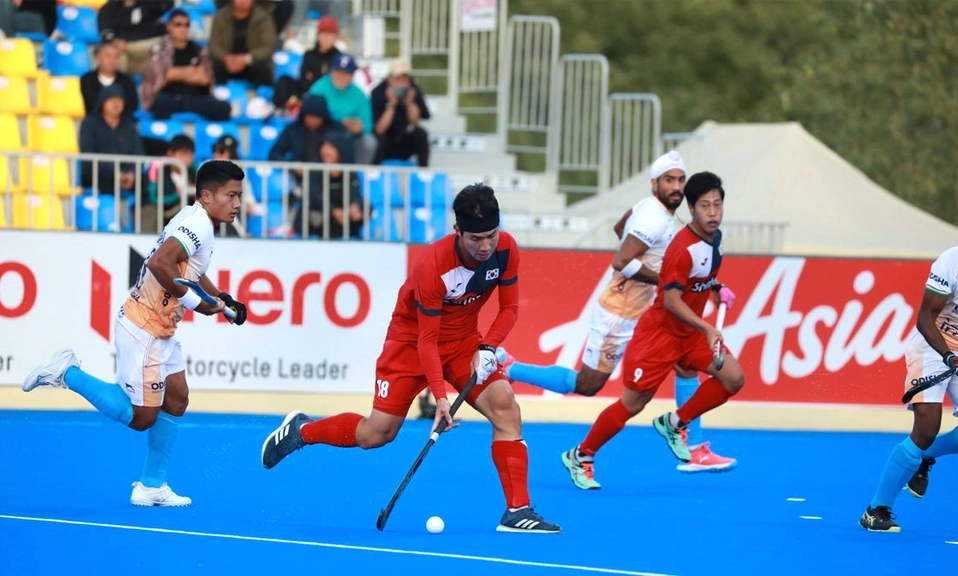
A ruthless, relentless, and utterly dominant India booked their place in the Asian Champions Trophy final with an 8-1 demolition of South Korea on Wednesday. It was a performance that blended clinical finishing with breathtaking speed, and it sent a clear message to the rest of Asia: this Indian side is not just defending a title—it is redefining the standard.
The scoreline tells its own story. Eight goals, seven different scorers, and a second-half onslaught that turned a competitive semi-final into a procession. South Korea, a traditionally stubborn and well-organised opponent, had no answer to India’s pressing, their penalty-corner efficiency, or their ruthless conversion rate in the circle. By the time the final whistle blew, the result felt less like a victory and more like a statement of intent.
The Match: A Slow Burn That Became an Avalanche
For the first fifteen minutes, it looked like the contest might be tighter than the final score suggests. South Korea defended deep, absorbed pressure, and tried to frustrate India’s rhythm. But the dam broke in the second quarter, and once it did, there was no stopping the flood.
Harmanpreet Singh opened the scoring from a penalty corner, firing low and hard past the Korean goalkeeper. The captain’s drag-flick has been a weapon all tournament, and this was another example of its lethal consistency. Within minutes, Jugraj Singh doubled the lead with a crisp finish from open play, and the floodgates opened.
By half-time, India led 3-0. The game was effectively over as a contest. But India didn’t ease off. They came out for the third quarter with the same intensity, adding two more goals in a blistering five-minute spell that included a stunning solo effort from Sukhjeet Singh, who dribbled past three defenders before slotting home.
South Korea pulled one back through a rare defensive lapse, but it was a mere consolation. India responded with three more goals in the final quarter, including a brace from young forward Araijeet Singh Hundal, who continues to underline his reputation as one of the most exciting talents in world hockey.
The Key Performers: A Team Effort, Not a One-Man Show
What made this performance so impressive was its collective nature. Seven different players found the net—Harmanpreet, Jugraj, Sukhjeet, Hundal (2), Abhishek, Manpreet Singh, and Vivek Sagar Prasad. The spread of goals reflects a team that is not reliant on a single superstar but is capable of hurting opponents from every angle.
Harmanpreet Singh was imperious at the back, marshalling the defence and converting his penalty corner with trademark calm. Manpreet Singh, the veteran midfielder, controlled the tempo and provided the platform for India’s attacking waves. And Araijeet Singh Hundal, at just 21, showed why he is considered the future of Indian hockey with two composed finishes.
The goalkeeping rotation also deserves mention. PR Sreejesh, playing in his final major tournament, was barely tested but commanded his circle with authority. His presence alone seems to give the defence an extra layer of confidence.
The Context: A Tournament of Dominance
India arrived at the Asian Champions Trophy as defending champions and the highest-ranked side in the competition. They have lived up to that billing. This semi-final victory follows a group stage in which they remained unbeaten, scoring freely and conceding sparingly. The 8-1 scoreline is the largest margin of victory in a semi-final in the tournament’s recent history.
For South Korea, it is a painful exit, but one that reflects the growing gap between India and the rest of Asia. The Korean side, traditionally one of the continent’s strongest, simply could not cope with India’s pace, precision, and physicality. Their coach acknowledged as much after the match, admitting that India were “on another level” and that his team had “no answers” to their attacking patterns.
What It Means: A Final, and a Warning
India will face either Pakistan or Malaysia in the final, depending on the result of the second semi-final. Whoever they face, they will start as overwhelming favourites.
But the significance of this performance extends beyond the Asian Champions Trophy. With the 2028 Los Angeles Olympics on the horizon, India are building a squad that is not just competitive in Asia but capable of challenging the world’s best. The blend of experienced leaders like Harmanpreet and Manpreet with explosive young talents like Hundal and Sukhjeet is exactly the kind of balance that successful teams are built on.
The final will be a chance to lift another trophy. But it will also be another opportunity to fine-tune, to test combinations, and to send a message to the hockey world that India are not just back among the elite—they intend to stay there.
India’s 8-1 victory over South Korea
was more than a semi-final win. It was a demonstration of a team at the peak of its powers, playing with confidence, fluency, and a ruthless edge that has been missing from Indian hockey for too long. Seven different scorers, a clean sheet in open play until a late consolation, and a performance that oozed class from the first whistle to the last.
The final awaits. And on this evidence, India will take some stopping.