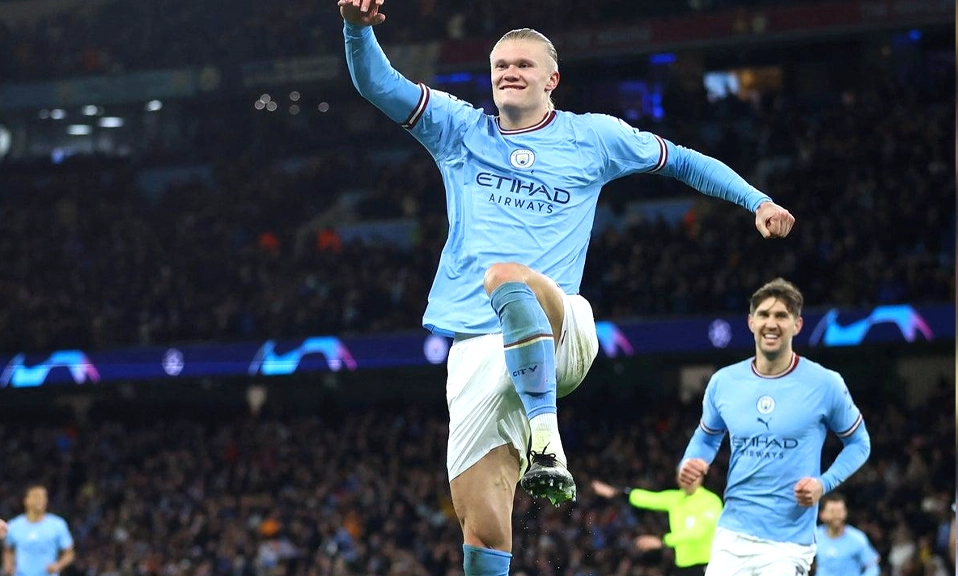
Erling Haaland does not do quiet nights. On a raucous evening in Leipzig, the Norwegian scored twice—including the decisive goal—as Manchester City survived a ferocious RB Leipzig comeback to win 3-2 and maintain their perfect Champions League record. It was a performance that reminded everyone why City are considered favourites for the competition, and why Haaland remains the most feared striker in world football.
The scoreline tells only part of the story. City were dominant for 45 minutes, racing into a two-goal lead through Haaland and Phil Foden. They were cruising. Then Leipzig, driven by a passionate home crowd and a tactical shift from Marco Rose, roared back to level the game. For 15 minutes, City looked rattled. But great teams find a way, and great strikers deliver when it matters. Haaland did both.
The First Half: City’s Clinical Blitz
City started with the kind of intensity that has defined their Champions League campaign. Enzo Maresca made three changes from the weekend win over Aston Villa, bringing in Nathan Aké, Mateo Kovačić, and Savinho, and the fresh legs made an immediate impact.
The opening goal arrived in the 14th minute. Kevin De Bruyne, dictating the tempo from midfield, slipped a perfectly weighted through ball into the path of Haaland. The Norwegian took one touch to steady himself, held off the challenge of Willi Orbán, and smashed a low drive past Péter Gulácsi. It was his 10th goal in his last seven Champions League appearances—a staggering statistic even by his standards.
City doubled their lead ten minutes later. Phil Foden, operating in the pocket between Leipzig’s midfield and defence, exchanged passes with Savinho before curling a delightful left-footed shot into the far corner. It was a goal of precision and poise, and it silenced the Red Bull Arena.
For the remainder of the first half, City were imperious. They controlled possession, restricted Leipzig to speculative long shots, and looked every inch the team that had won three from three in Europe. The only concern was a booking for Rodri, who was walking a disciplinary tightrope after a late challenge on Xavi Simons.
The Leipzig Comeback: A Tactical Masterstroke
Whatever Marco Rose said at half-time, it changed the game. Leipzig emerged with a renewed aggression, pressing higher and forcing City into uncharacteristic errors. The introduction of Benjamin Šeško at the break gave them a focal point up front, and the young Slovenian made an immediate impact.
The comeback began in the 52nd minute. David Raum, who had been Leipzig’s best player all evening, delivered a devilish cross into the box. Loïs Openda got ahead of Aké and glanced a header past Ederson. It was a goal that had been coming, and it lifted the roof off the stadium.
Ten minutes later, the equaliser. Xavi Simons, who had been growing into the game, won the ball in midfield and fed Šeško. The striker held off Rúben Dias, turned sharply, and fired a low shot into the bottom corner. Ederson got a hand to it, but the power was too much. 2-2. City were rattled.
For the next 15 minutes, Leipzig were the better team. They pressed, they probed, and they forced City into a series of hurried clearances. Maresca responded by bringing on Bernardo Silva and Jack Grealish to restore control. It worked—but not before City had survived a scare when Openda headed narrowly wide from another Raum cross.
Haaland’s Moment: The Decisive Blow
With 12 minutes remaining, City found the answer they needed. It came, inevitably, from Haaland.
Bernardo Silva, who had transformed City’s rhythm since his introduction, won the ball on the right and played a quick one-two with Kyle Walker. The Portuguese midfielder then whipped a low cross into the box. Haaland, surrounded by three defenders, somehow found a yard of space, threw himself at the ball, and redirected it past Gulácsi with a finish that was part instinct, part athleticism, and entirely decisive.
It was his second goal of the night, his 11th of the Champions League campaign, and his 40th in all competitions for the season. The celebration was muted—a clenched fist, a shout towards the travelling City fans—but the message was clear. City had survived.
Leipzig pushed for a third equaliser in the dying minutes, but City’s defence, marshalled by the excellent Manuel Akanji, held firm. The final whistle sparked relief rather than celebration. It was not a vintage performance, but it was a winning one.
The Key Performers: Haaland, Foden, and the Bernardo Effect
Erling Haaland was the headline act. Two goals, five shots on target, and a constant menace to Leipzig’s defence. His movement for the winning goal—finding space where none seemed to exist—was a reminder that he is not just a finisher but a genuine predator.
Phil Foden was City’s best player in the first half, linking play, scoring the second goal, and causing constant problems with his movement between the lines. His withdrawal on 70 minutes was a tactical decision, but City missed his creativity in the final stages.
Bernardo Silva changed the game. His introduction on 65 minutes gave City back the control they had lost, and his assist for Haaland’s winner was the kind of moment that defines champions. He may not start every game these days, but he remains City’s most intelligent footballer.
For Leipzig, David Raum was outstanding, Xavi Simons grew into the game, and Benjamin Šeško showed why he is one of Europe’s most coveted young strikers. They will feel they deserved something from the match—and they probably did. But football is decided by moments, and City had the best moment-maker on the pitch.
What It Means for the Group
The win keeps City top of their Champions League group with 12 points from four games, three clear of second-placed Leipzig. A draw or win in their next fixture—at home to Feyenoord—would secure qualification for the knockout stages. The performance, while flawed, demonstrated the resilience that has been the hallmark of City’s European campaigns in recent years.
For Leipzig, the defeat leaves them in a battle for the play-off spots. They have the talent to progress, but they will need to be more clinical in front of goal if they are to challenge the continent’s elite.
Manchester City did not
play well for 90 minutes in Leipzig. They were excellent for 45, vulnerable for 15, and resilient for the rest. But great teams win when they are not at their best, and great strikers deliver when the game is on the line. Haaland did both.
The Norwegian’s two goals were the difference between a comfortable win and a damaging draw. His presence, his movement, and his ruthless finishing turned a nervy night into a valuable three points. City are not yet the finished article—the defensive lapses that allowed Leipzig back into the game will concern Maresca—but they are winning, and they are top of their group.
The Champions League is a marathon, not a sprint. City have the squad, the manager, and the striker to go all the way. On this evidence, they will take some stopping.