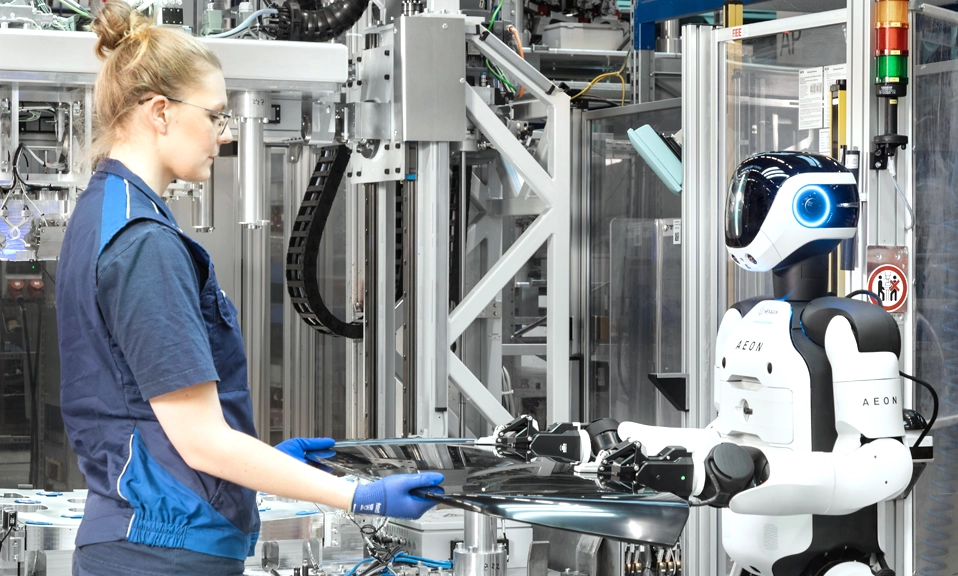
The humanoid robot has been the holy grail of automation for decades—a machine that can walk into any factory, pick up a tool, and do the job a human was doing five minutes earlier. In 2026, that vision is no longer a research project. It is a production line reality. BMW, Mercedes-Benz, Amazon, and a growing list of manufacturers are deploying humanoid robots in real factories, performing real tasks, alongside real workers. The question is no longer whether the technology works. It is whether the workers who once did those jobs will be replaced.
The answer is not a simple yes or no. It is a story of uneven adoption, economic pressure, and a fundamental tension between the efficiency gains that manufacturers desperately need and the human cost of displacement that no one has fully reckoned with.
The State of Play: Who Is Deploying What
The deployment of humanoid robots in factories has accelerated dramatically in 2026, driven by advances in AI, falling hardware costs, and a persistent labour shortage in manufacturing.
BMW has been one of the most aggressive adopters. At its Spartanburg, South Carolina plant, the company has deployed Figure 02 humanoid robots from Figure AI for logistics and assembly support tasks. The robots work five-day, ten-hour shifts and have completed over 90,000 individual parts in live production. BMW has said the robots handle “ergonomically difficult” tasks—the kind of repetitive, physically demanding work that has historically led to injuries and high turnover among human workers.
Mercedes-Benz has partnered with Apptronik to deploy the Apollo humanoid robot at its Berlin-Marienfelde plant. Apollo is designed to handle repetitive tasks like parts handling and quality inspection, with a focus on working safely alongside humans.
Amazon has been testing Agility Robotics’ Digit humanoids at its fulfillment centres since 2024. The robots are designed for tote handling—picking up empty totes from conveyor belts and moving them to where they are needed. Amazon has been careful to frame the deployment as augmentation rather than replacement, but the tasks Digit performs are precisely those that human workers were previously doing.
Tesla has been developing its Optimus humanoid robot with the explicit goal of deploying it in its own factories. Elon Musk has said that Optimus could eventually “eliminate” a significant portion of the company’s assembly line workforce—a statement that has been met with both enthusiasm from investors and alarm from labour advocates.
Chinese manufacturers are moving even faster. UBTech, XPeng, and Xiaomi have all announced plans to deploy humanoid robots in their factories, with some already in limited production. China’s government has identified humanoid robotics as a strategic priority, and the country’s manufacturing sector is seen as the most likely testing ground for large-scale adoption.
The Economics: Why Factories Want Robots
The case for humanoid robots in factories is not just technological. It is economic, and it is driven by three pressures that manufacturers face simultaneously.
Labour shortages. Manufacturing in many developed countries is facing a structural shortage of workers. The global manufacturing industry is short of more than 10 million workers, according to industry estimates. Young people are not entering manufacturing at the same rate as their parents, and the workers who remain are ageing. Robots are a response to a real need, not just a desire for cost-cutting.
Wage inflation. The cost of human labour in manufacturing has risen significantly in the post-pandemic era. Average hourly wages in US manufacturing have grown by over 20% since 2019. Robots, by contrast, have fallen in cost—and humanoid robots, in particular, are designed to be general-purpose tools that can be redeployed across multiple tasks, making their cost-per-task significantly lower than single-purpose automation.
Reshoring. Many companies have been moving production back to their home countries from overseas to reduce supply chain risk. But reshoring only works if there are workers to do the job. Humanoid robots allow manufacturers to bring production home without needing to find workers who do not exist.
The combination of these pressures creates a powerful incentive for manufacturers to adopt humanoid robots. The question is not whether they will, but how fast—and what happens to the workers whose jobs are affected.
The Task Reality: What Robots Can and Cannot Do
The popular image of a humanoid robot is a general-purpose machine that can do anything a human can do. The reality in 2026 is far more limited.
What robots can do well: Repetitive tasks in structured environments. Moving parts from one location to another. Basic assembly with consistent inputs. Quality inspection using computer vision. Tote handling in warehouses. Tasks that require strength and endurance but not complex judgment.
What robots cannot do well: Tasks that require adaptability to unexpected situations. Complex troubleshooting. Fine manipulation with soft or delicate materials. Tasks that require understanding context and intent. Collaboration with humans in unstructured environments. Anything that requires empathy, creativity, or judgment.
The current generation of humanoid robots is best understood as specialised tools with a general-purpose form factor. They are designed to fit into existing factories, use existing tools, and operate in spaces built for humans. But they are not replacing entire jobs. They are performing specific tasks within jobs that still require human oversight, maintenance, and judgment.
BMW’s Figure robots, for example, handle specific logistics tasks. They do not build cars. Amazon’s Digit robots move totes. They do not pick and pack orders. Mercedes’ Apollo robots handle parts. They do not assemble engines. The tasks are real, and they are valuable, but they are not the whole job.
The Displacement Question: Who Is at Risk
The workers most at risk from humanoid robot deployment are not assembly line workers in high-skill roles. They are workers in repetitive, physically demanding, lower-skill roles—the jobs that are easiest to automate and hardest to fill.
Logistics and material handling are the most exposed. Tote handling, parts moving, and warehouse work are the first targets because they are repetitive, structured, and do not require complex judgment. Amazon’s 750,000 mobile robots and its testing of Digit humanoids are a clear signal that the company sees warehouse work as a domain where automation can scale.
Quality inspection is another area of vulnerability. Computer vision can detect defects that human eyes might miss, and it does not get tired or distracted. The workers who currently perform these roles may find their jobs redefined rather than eliminated—but the redefinition will require new skills.
Assembly is more complex. Humanoid robots can perform basic assembly tasks, but the vast majority of assembly work still requires human dexterity, judgment, and problem-solving. The workers most at risk are those performing the most repetitive, lowest-skill assembly tasks—precisely the entry-level roles that have traditionally been the first rung on the manufacturing career ladder.
The long-term risk is that the entry-level manufacturing jobs disappear, and with them the pathway for workers to develop skills and progress into higher-paying roles. If robots take the entry-level jobs, where do the next generation of manufacturing workers start?
The Augmentation Argument
Not everyone sees humanoid robots as a threat. Many in the industry argue that the technology is better understood as augmentation rather than replacement.
The argument is that robots take on the tasks that humans do not want to do—the repetitive, physically punishing, injury-prone work—and free human workers to focus on higher-value tasks that require judgment, problem-solving, and creativity. In this view, robots make factories safer, more productive, and more attractive places to work, which helps address the labour shortage.
There is evidence to support this view. BMW has said that the Figure robots are doing jobs that human workers found ergonomically difficult and that the robots have reduced the risk of injury. Amazon has said that its robots have allowed it to create hundreds of thousands of new jobs while automating some tasks, and that the workers whose tasks were automated have been retrained for higher-skill roles.
But the augmentation argument depends on two conditions: that the workers whose tasks are automated are actually retrained and redeployed, and that the new jobs created by automation are accessible to the workers who lost the old ones. Neither condition is guaranteed. History is full of examples of automation creating new jobs that required skills the displaced workers did not have.
The Policy Response: What Governments Are Doing
The acceleration of humanoid robot deployment has prompted governments to begin thinking about the policy implications.
Reskilling programmes are the most common response. Germany’s dual-training system and Singapore’s SkillsFuture programme are frequently cited as models. But reskilling at scale is expensive, slow, and often mismatched with the pace of technological change.
Social safety nets are being debated in new terms. The idea of a universal basic income (UBI) has moved from the fringe to mainstream policy discussion, though no country has implemented it at scale. More modest proposals—wage insurance, portable benefits, and expanded unemployment protections—are gaining traction.
Regulation is also evolving. The EU’s AI Act and Machinery Regulation impose safety and transparency requirements on robotic systems. In the US, OSHA is updating workplace safety rules to account for human-robot collaboration. The question of liability—who is responsible when a robot causes harm—remains unsettled in many jurisdictions.
But the policy response is still far behind the pace of deployment. The robots are already in the factories. The rules for how they will be integrated are still being written.
Replacement Is Coming, but It Is Not the Whole Story
Could humanoid machines replace human workers? The honest answer is: yes, some of them, in some roles, over time.
The jobs most at risk are the repetitive, physically demanding, lower-skill roles that are easiest to automate and hardest to fill. These are the entry-level positions that have historically been the starting point for manufacturing careers. If they disappear, the impact will be felt most acutely by workers who have the fewest alternatives.
But replacement is not the whole story. Humanoid robots are also creating new jobs—in robot maintenance, programming, supervision, and integration. They are making factories safer and more productive. And they are addressing a labour shortage that threatens to constrain manufacturing growth in many countries.
The outcome is not predetermined. It depends on choices made by companies, governments, and workers themselves. If robots are deployed purely as cost-cutting replacements, the displacement will be severe. If they are deployed as collaborative tools—augmenting human capabilities, taking on dangerous and repetitive tasks, and freeing people for higher-value work—the result can be shared prosperity.
The robots are coming to the factories. The question is not whether they will change the nature of work. It is whether we will manage that change in a way that benefits everyone, not just the owners of the machines.