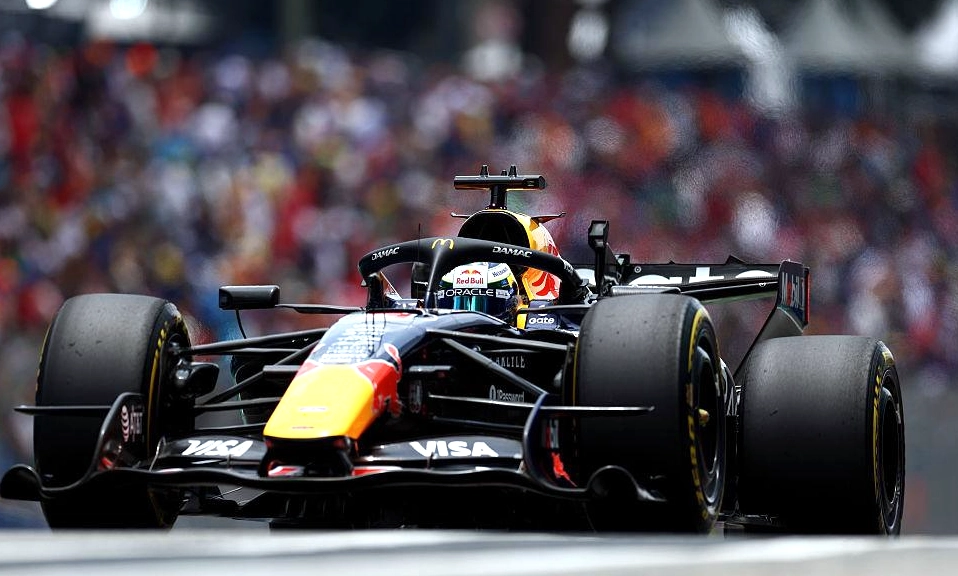
SÃO PAULO — Max Verstappen has built a career on making the extraordinary look routine, but even by his standards, the 2026 São Paulo Grand Prix was something special. Starting from 21st on the grid after a power unit penalty, the Dutchman carved through the field in wet-and-drying conditions to finish second behind Lando Norris—a drive so remarkable that his own team principal admitted it was beyond the reach of their simulation tools.
This was not a lucky recovery aided by a chaotic race. It was a masterclass in opportunistic aggression, precise strategy, and the kind of car control that only a handful of drivers on the grid possess. Here is how Verstappen climbed from the back row to the podium at Interlagos.
The Cause: A Penalty He Could Not Avoid
Verstappen’s journey to 21st on the grid began before the race had even started. Red Bull was forced to change his RB22’s power unit after a small issue on Friday, incurring a grid penalty that sent him to the back of the field. It was the team’s first power unit penalty of the season, a bitter pill in their inaugural campaign with the new Red Bull-Ford powertrain.
The penalty was particularly frustrating because Verstappen’s pace had been strong. “The pace seemed good on Friday and also on Saturday morning,” team principal Laurent Mekies said. “But it’s part of the game”.
The First Stint: 14 Places in Five Laps
The race began on a wet but drying track, with drivers on intermediate tyres. Verstappen’s start was not perfect—he later admitted he held the clutch incorrectly, resulting in a slower reaction time. But what happened next was extraordinary.
By the end of lap one, he had climbed from 21st to 13th, passing eight cars. By the end of lap five, he was already in the top eight, having gained 14 positions in just five laps. The first stint on intermediates was, in Verstappen’s own words, “really, really strong”.
The pace was so ferocious that it defied Red Bull’s own expectations. “No sim in the world will predict that you will go from P21 to P2 or that you get 14 places in five laps,” Mekies said. “There is no sim able to do that. So, he’s beating the sim on a regular basis”.
The Strategy: Precision in Changing Conditions
The key to Verstappen’s recovery was not just raw speed—it was the timing of the pit stops. When the first frontrunners pitted to switch from intermediates to slicks around lap 16, Verstappen was already running fifth. Red Bull’s strategy team, led by Mekies, made the right calls at the right moments, keeping Verstappen on a competitive strategy as the track evolved.
The race was not straightforward. After switching to slick tyres, Verstappen’s car developed a “really weird balance” —an issue he described as “the complete opposite to anything that I’ve felt the whole weekend”. Red Bull acknowledged seeing a loss of rear downforce in the data, and Verstappen later inspected the rear of his car for visible damage.
Despite the handling problems, he managed to move into second place during the middle phase of the race and held the position through the final stint, which was completed on intermediates after rain returned.
The Team Dynamic: Hadjar’s Sacrifice
Verstappen’s podium was also made possible by his teammate, Isack Hadjar. The Frenchman, who started fifth, had climbed to second during the middle part of the race but was instructed to let Verstappen through after running wide and losing time at Turn 1.
Hadjar, who finished third to complete a Red Bull double podium, was gracious about the team order. “I could have avoided a little awkward situation with Max,” he admitted. “I think on that stint I could have kept it a bit more on the track”.
The Context: A Tradition of Comebacks
Verstappen’s drive in Brazil was the latest chapter in a remarkable run of recovery performances at Interlagos. In 2024, he won from 17th on the grid in wet conditions. In 2025, he climbed from the pit lane to third. In 2026, he went from 21st to second—the third consecutive year he has started at the back and finished on the podium in São Paulo.
The result was not enough to challenge Norris for the win—the McLaren driver was 14 seconds up the road at the flag—but it was enough to earn Verstappen the Driver of the Day award and to keep Red Bull’s constructors’ championship hopes alive.
Max Verstappen’s drive
from 21st to second at Interlagos was not a fluke. It was the product of a driver operating at the peak of his powers, a team making the right strategic calls under pressure, and a car that—despite its handling quirks—was fast enough to exploit every opportunity.
The comeback was so impressive that it left Red Bull’s own engineers searching for answers. “He’s beating the sim on a regular basis,” Mekies said. On this evidence, the simulations will need to catch up. Verstappen, as always, is already a step ahead.