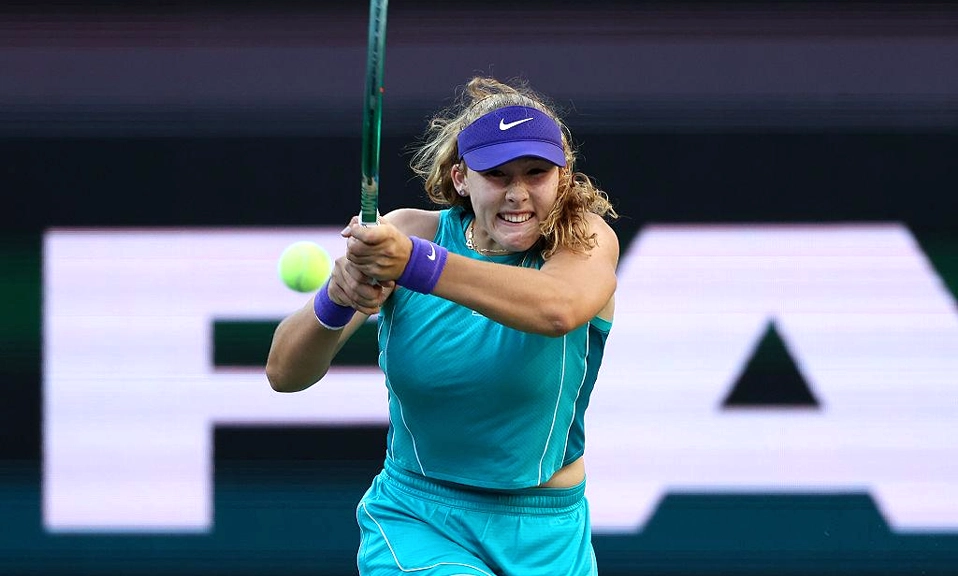
Mirra Andreeva didn’t just beat Aryna Sabalenka on Wednesday night in Indian Wells. She dismantled her. And in doing so, she may have announced the arrival of the WTA’s next genuine superstar.
The scoreline was 6-4, 6-0 in 62 minutes. But the numbers only tell part of the story. Andreeva trailed 1-4 in the opening set. What followed was a 20-of-23 points run that flipped the match entirely, a stretch of tennis so dominant that Sabalenka—the World No. 2, a three-time major champion—had no answer. Andreeva rattled off 11 consecutive games to close out the match and win Group 2 at the WTA Finals.
It was the kind of performance that doesn’t just win a match. It changes a hierarchy.
The Context: Sabalenka’s Vulnerability, Andreeva’s Rise
To understand the significance of Wednesday’s result, you have to understand what both players brought into it.
Sabalenka has been the WTA’s most consistent force for years, but 2026 has been a season of slippage. She lost the No. 1 ranking to Elena Rybakina after 99 consecutive weeks at the top. She arrived at the WTA Finals without a Grand Slam title this season, despite back-to-back WTA 1000 wins at Indian Wells and Miami. And on Wednesday, playing with tape above her right knee, she looked physically compromised and tactically bereft as Andreeva took control.
Andreeva, by contrast, is in the middle of a breakthrough season. The 19-year-old won her maiden Grand Slam title at Roland Garros in June, becoming the youngest French Open champion in 34 years. She entered the WTA Finals at World No. 5, with three titles in 2026 and a 45-15 win-loss record. This is her singles debut at the season-ending championships. She has won her first two round-robin matches by identical 6-4, 6-0 scorelines—first against Elina Svitolina, then against Sabalenka.
And she’s not just winning. She’s winning with a kind of relentless, suffocating authority that is rare in a teenager.
The Head-to-Head: A Reversal, Not a Fluke
Wednesday’s result was not an isolated upset. It was a correction.
Sabalenka had won six of the pair’s seven previous meetings. She was the established force; Andreeva was the challenger. But the trajectory had already begun to shift. Andreeva had beaten Sabalenka in the 2025 Indian Wells final—the same venue where Wednesday’s demolition took place. The hard-court conditions in the California desert suit Andreeva’s flat, penetrating groundstrokes and her ability to take the ball early.
What was different this time was the margin. Sabalenka didn’t lose a tight three-setter. She was bageled in the second set. She won just four games in the entire match after leading 4-1 in the first. That is not a competitive defeat. It is a statement.
The “Diva” Subplot: Andreeva’s Response
Wednesday’s match also carried a quiet subtext. Before the tournament, Jessica Pegula was caught on a hot mic calling Andreeva a “diva” and making other comments for which she later apologized.
Andreeva’s response has been to win eight games lost across two matches. She has not engaged with the controversy publicly. She has simply played. And in a sport where narrative often overwhelms performance, that is its own kind of maturity.
After the match, she was ebullient: “I feel like I could play another two matches. I’m so pumped up and full of energy”. She gave “82% of the credit” to coach Conchita Martinez for a post-warmup pep talk that shifted her mindset. It was a reminder that Andreeva is still a teenager—one who needs reassurance, who responds to belief, who is still learning how to manage the emotional demands of elite competition.
But the tennis itself is not teenage. It is the tennis of a player who has already figured out how to win at the highest level.
Is a New Superstar Emerging?
The question in the headline is not premature. It is the right question.
Andreeva is 19 years old. She is a Grand Slam champion. She is No. 5 in the world, and with Wednesday’s win, she has overtaken Sabalenka in the live rankings, moving into the No. 2 spot behind Rybakina. She is doing this in her first WTA Finals appearance, against the most experienced and accomplished players on tour.
The WTA has been searching for a dominant, marketable superstar since the retirement of Serena Williams. Iga Świątek has been a force, but her dominance has waxed and waned. Sabalenka has been brilliant but volatile. Coco Gauff has shown flashes but not yet sustained Grand Slam consistency. Rybakina is the current No. 1 but has struggled with consistency and injuries.
Andreeva has something different. She has the clarity of a champion—the ability to identify what a match requires and then execute it without hesitation. She has the range to win on clay (her French Open title) and hard courts (Indian Wells, Dubai). She has the temperament to recover from a 1-4 deficit against the No. 2 player in the world and then win 11 straight games. She has the coaching—Conchita Martinez, a Wimbledon champion, is in her corner.
And she has time. She is 19. Her best years are not behind her. They are not even fully ahead of her yet.
Andreeva will face the winner
of the other semifinal. Sabalenka, despite the defeat, can still advance if she beats Svitolina in her final round-robin match on Friday. The WTA Finals are not over. But the balance of power has shifted.
The tennis world has spent years asking who will fill the void left by Serena. The answer might have been hiding in plain sight—a Russian teenager with a flat backhand, a fierce competitive streak, and a French Open trophy in her cabinet. On Wednesday, she didn’t just beat Aryna Sabalenka. She served notice.
Mirra Andreeva is not the future of women’s tennis. She is the present. And she is just getting started.