LeBron James has spent so long rewriting the NBA record book that another milestone can feel almost routine. It is not routine.
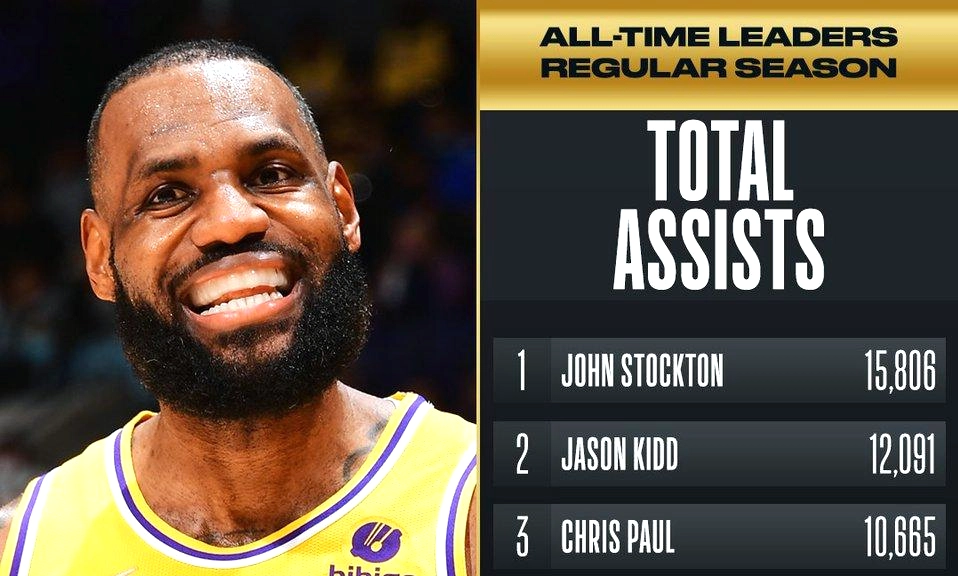
At 41, in his 24th NBA season, James recently passed Jason Kidd for third place on the league’s all-time assist list. Kidd finished with 12,091 assists; James moved to 12,092 and continued adding to a statistical profile that already includes the NBA’s career scoring record.
That milestone came shortly after another first. On November 4, James became the first player in NBA history to make 16,000 career field goals. He reached the mark against Detroit while contributing 13 points, 10 rebounds and eight assists for Philadelphia.
The question is no longer whether LeBron’s records are impressive. The more interesting question is whether the modern NBA will ever produce a player capable of matching them.
The short answer is yes for some individual marks. The longer answer is that matching the entire collection may be nearly impossible.
The latest record is about more than passing
Passing Kidd for third on the assists list is another reminder that James’s greatness cannot be reduced to scoring.
The NBA’s all-time scoring leader has also been an elite playmaker throughout his career. He won the assist title in 2019–20, when he helped lead the Los Angeles Lakers to a championship, and he has averaged at least six assists in every season after his rookie year.
That combination is rare. Many high-volume scorers are asked to finish possessions. James has often been asked to organize them as well. He can initiate a pick-and-roll, attack the rim, draw help and find a shooter in the same possession.
His career total reflects both skill and responsibility. Passing Kidd also places James closer to John Stockton, the all-time assist leader. Stockton’s 15,806 assists remain a significant distance away, but James is still climbing the list while producing at an age when most players have already retired.
The assist milestone is therefore a longevity record and a role record at the same time. James did not reach the top by spending his career as a traditional point guard. He reached it while carrying a scorer’s workload and moving between forward and ball-handler responsibilities.
The 16,000-field-goal milestone may be even harder to match
Made field goals measure every successful two-point and three-point shot from the field. They do not include free throws.
Reaching 16,000 made field goals requires more than a high scoring average. It requires a huge number of games, consistent availability, a long-term role with heavy offensive responsibility and enough efficiency to remain on the floor for many seasons.
James’s field-goal record is especially difficult because it combines volume with versatility. He has scored in transition, at the rim, from the post, in isolation and from three-point range. His offensive role has changed repeatedly, but the production has continued.
Kareem Abdul-Jabbar previously held the mark with 15,837 made field goals. James moved beyond it and became the first player to reach 16,000.
A young scorer could eventually challenge the total, but the path is demanding. A player would need to average roughly 800 made field goals over 20 seasons, or maintain a similar workload for a longer career. That is a simplified illustration rather than a prediction, but it shows why the record is tied so closely to durability.
The record that will attract the most attention: career points
James finished a recent NBA Sunday with 43,606 regular-season points, according to the league. No other player had reached 40,000, and Abdul-Jabbar’s previous record of 38,387 points now sits more than 5,000 points behind James.
The gap is enormous, but the record is not mathematically untouchable. Modern players benefit from improved sports medicine, spacing, three-point volume and offensive systems that can produce more efficient scoring opportunities.
The difficulty is maintaining elite production for two decades. To approach 43,000 points, a player needs a combination of high scoring, exceptional health and a career that survives multiple changes in role. A player who averages 27 points for 20 seasons still needs to play about 79 games every season to reach 43,000 regular-season points. That does not account for missed games, rookie adjustment, injuries or late-career decline.
Luka Dončić is often mentioned as a possible challenger because he became an elite scorer and playmaker early. His case will depend on health, team success, playoff opportunities and whether he maintains a high scoring average deep into his career. Being on pace at 27 is not the same as finishing the journey at 40.
The scoring record is breakable in theory. In practice, it may require another player with James’s production and his extraordinary availability.
Playoff records add a second level of difficulty
Regular-season longevity is difficult. Playoff longevity is even more difficult because a player cannot accumulate postseason statistics without repeatedly helping a team qualify and advance.
James holds the NBA’s playoff records for points, wins and series victories. The Philadelphia 76ers described his totals as 8,521 playoff points, 188 playoff wins and 42 series victories.
These records are connected. A player who loses early cannot accumulate the same number of postseason games as a player who reaches the Finals repeatedly. James has combined individual production with team success across multiple eras and franchises.
A future player would need to be both an all-time regular-season star and the central figure on teams that make deep playoff runs. Even then, the record would require many playoff appearances. One injury or one disappointing roster cycle could end the chase.
This is why playoff records are often more resistant than regular-season records. The player controls only part of the equation. Teammates, front-office decisions, coaching, injuries and conference competition all matter.
Games, minutes and seasons: the hidden foundation
Many of James’s biggest records are built on a less glamorous achievement: he keeps playing.
The NBA identifies James as the all-time leader in games played, minutes played and seasons played. Those categories help explain why his scoring, assists and field goals have reached such extraordinary levels.
Minutes are especially revealing. A player can score at a spectacular rate, but the total career value of that scoring depends on how often the player is available. James has remained a major contributor from his teenage years into his forties, adapting his role instead of disappearing when his athletic profile changed.
A younger player may eventually break the games-played record if the NBA continues to improve recovery and injury prevention. But a long career is not only a medical achievement. It requires maintaining enough performance to justify playing time, accepting role changes and staying valuable to teams with championship ambitions.
The most difficult part of James’s longevity is not that he played 23 seasons. It is that he remained a star through them.
His assist record is different from his scoring record
James is not yet the all-time assist leader. Stockton’s 15,806 assists remain first, while Kidd’s former total of 12,091 placed him second until James passed him.
That makes James’s assist climb particularly impressive. He is not simply accumulating passing statistics in a low-scoring role. He has produced elite assist numbers while also becoming the NBA’s most prolific scorer.
Could someone break James’s eventual total? Yes. The current generation includes large lead ball-handlers who control the ball on nearly every possession. Players such as Dončić, Nikola Jokić and other oversized playmakers have the passing responsibility and offensive usage needed to build huge totals.
But the same trade-off remains. High usage creates assists, yet it also creates fatigue and injury risk. A player who is the team’s primary scorer and primary creator for 20-plus seasons is extremely unusual.
James’s assist total may be more vulnerable than his points record if the league continues moving toward positionless playmaking. It is still difficult because the player must remain both a high-minute creator and an elite decision-maker for a very long time.
What about three-pointers and steals?
James is also near the top of several other statistical categories. The NBA lists him as second in free throws made and attempted, sixth in three-pointers made and sixth in steals.
These records show how his game has expanded. He entered the league as a powerful downhill attacker, but later became a much more willing and effective three-point shooter. His size and anticipation also allowed him to generate steals without being a small guard who spends every possession pressuring the ball.
Three-point records may be the most vulnerable of these categories because the modern game rewards volume. Players now take more threes than James did early in his career, and future stars may attempt them at an even higher rate.
Free throws and steals are harder to forecast. Free throws depend on driving style, officiating and shooting volume. Steals depend on defensive role, playing time and risk tolerance. A player can lead one category without accumulating enough overall career value to challenge James elsewhere.
The awards records may be the hardest to reproduce
James’s statistical totals receive the most attention, but his recognition records may be just as difficult to match.
His official NBA profile lists 22 All-Star selections, 21 All-NBA selections, four Most Valuable Player awards, four championships and four Finals MVP awards.
All-Star selections require long-term popularity and production. All-NBA selections require sustained performance against the entire league. A player can be healthy for 20 seasons and still miss one of those lists because another generation of stars is having an exceptional year.
The 21 All-NBA selections may be especially difficult to break. The award recognizes a player’s level, not simply his availability. James was good enough to remain among the league’s best while the league moved from the Kobe Bryant era to the Curry era and into the current generation.
A future player could surpass 22 All-Star selections if the schedule, voting system and career length remain favorable. But matching 21 All-NBA teams requires a level of sustained excellence that few players have approached.
Why today’s players may have a better chance
The modern NBA could make some longevity records more reachable.
Players benefit from improved training, sports science, nutrition, recovery methods and load management. Offensive spacing also creates more efficient scoring environments. A young star who enters the league ready to shoot, pass and handle the ball can build statistics immediately instead of spending several seasons learning a limited role.
The schedule is still demanding, and injuries remain a major obstacle. But players now have more resources to extend their careers and preserve their bodies.
The counterargument is that modern teams may manage stars more carefully. Rest days can protect a player’s health, but fewer games also reduce the chance to accumulate totals. A player might perform at a higher level per minute while ending with fewer minutes than James.
That tension means future record chasers will need both efficiency and volume. One cannot fully replace the other.
Can anyone break LeBron’s records?
Some of James’s records will eventually fall. Basketball is always changing, and every generation produces players who benefit from a larger talent pool and improved preparation.
The most reachable targets may be individual categories such as three-pointers, assists or particular scoring milestones. A dominant young player with a long career could also challenge the regular-season points record.
The hardest records are the combined achievements: 43,606-plus points, more than 8,500 playoff points, the games and minutes records, 16,000 made field goals, 21 All-NBA selections and 22 All-Star appearances. These marks require talent, health, team success, role flexibility and an unusually long career at the top.
That is why James’s record book feels different. He does not own only one extraordinary number. He owns a connected set of records produced by scoring, passing, availability and winning for more than two decades.
LeBron James’s latest
milestones are not isolated celebrations. Passing Jason Kidd for third in assists and becoming the first player to make 16,000 field goals reveal the same underlying qualities that produced his scoring record: responsibility, adaptability and extraordinary longevity.
A future superstar may score more efficiently, shoot more threes or pass at a higher rate. Another player may eventually pass James in one category. But breaking the full collection will be much harder because the records reinforce one another.
To catch his points, a player needs longevity. To catch his playoff numbers, that longevity must include team success. To catch his assists and field goals, the player must remain heavily involved on both sides of the offense. To match his awards, the player must remain elite while several generations of competition arrive.
So can anyone break LeBron James’s records? Eventually, probably—but not all of them, and probably not soon. The most realistic expectation is that future stars will claim individual marks while James’s complete statistical legacy remains one of the NBA’s most difficult mountains to climb.