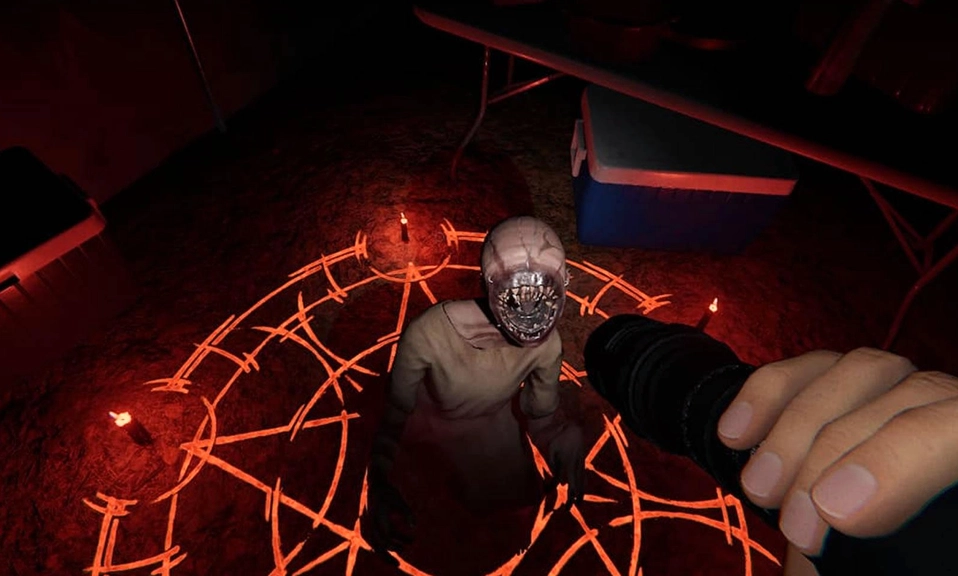
You’re crouched inside a locker in a pitch-black, abandoned high school hallway. Your flashlight is off because the light attracts it. Your character’s breathing is ragged. Through your headset, you hear your friend whisper, “I think it’s in the room with us.”
Then, you hear it. The slow, wet drag of footsteps on the linoleum. It stops right outside your locker.
Your heart rate spikes to 140 BPM. Your palms are sweating. You know it’s just code on a screen, but your primal brain is screaming at you to run.
Welcome to the modern golden age of co-op horror. Games like Phasmophobia, Lethal Company, and Demonologist have completely redefined what scares us. They’ve moved past the cheap, predictable jump scares of the 2010s and tapped into something much deeper, much more psychological, and infinitely more terrifying.
But why do these games get under our skin so effectively? And more importantly, why do we keep coming back for more?
Here is the anatomy of modern horror, and why games like Phasmophobia have mastered the art of digital dread.
👻 1. The Terror of the Invisible Threat
In older horror games, the monster was usually a physical entity you could see, shoot, or run from. Phasmophobia flips this on its head. For 80% of the game, the ghost is completely invisible.
This triggers a psychological phenomenon called fear of the unknown. When you can’t see the threat, your brain goes into overdrive, filling in the blanks with your own personal nightmares. Every creaking floorboard, every shadow, and every flickering light becomes a potential death sentence. The game doesn’t need to show you a gruesome monster; the anticipation of the monster is far more paralyzing than the monster itself.
🎙️ 2. Proximity Chat: The Ultimate Weapon
If Phasmophobia has a “killer feature,” it’s its spatial, proximity-based voice chat.
In most multiplayer games, voice chat is a tool for coordination. In Phasmophobia, it is an instrument of psychological torture. Because the audio is spatial, you can hear exactly where your friends are. But more importantly, you can hear them die.
There is a uniquely horrifying experience in hearing your bravest friend confidently walking down a dark basement corridor, suddenly let out a blood-curdling scream, and then be met with dead silence. The game isolates you. When the ghost hunts, the lights go out, and you are left entirely alone in the dark, listening to the muffled sounds of your team being picked off one by one. It makes the horror deeply, uncomfortably personal.
🧠 3. The “Objective Paradox” (You Want to Stay)
In a game like Outlast or Resident Evil, your primary goal is to survive and escape the terrifying environment. Your brain’s survival instinct aligns perfectly with the game’s objective: Run away.
Phasmophobia creates brilliant cognitive dissonance. You are a ghost hunter. Your actual objective is to find the ghost, get close to it, and provoke it to gather evidence.
This pits your logical brain against your primal brain. Your primal brain is screaming, “There is a demon in this house, get out!” but your logical brain is saying, “I need to get within three feet of it to use the Ouija board.” This internal conflict creates a level of tension that traditional horror games simply cannot match. You are voluntarily walking into the jaws of the beast.
🎧 4. Masterclass in Audio Design
Horror is 20% visual and 80% audio. The developers of these modern horror hits know that sound is the shortest path to the nervous system.
- Binaural Audio: You can hear the ghost’s breathing directly behind your left ear. You can hear the faint, high-pitched whisper of a spirit box through a closed door.
- The Sanity Meter: As your sanity drops, the game plays auditory hallucinations. You hear footsteps that aren’t there. You hear your friends calling your name when they are actually dead. You can no longer trust your own ears.
- The Silence: The most terrifying sound in these games isn’t a roar; it’s the sudden, absolute silence when the ambient crickets stop chirping. It’s the audio cue that the hunt has begun.
🤖 5. AI That Learns and Adapts
Older horror games relied on scripted events. You knew that if you walked down this specific hallway, a monster would jump out of that specific locker. Once you learned the pattern, the fear vanished.
Modern horror games use dynamic AI. In Phasmophobia, the ghost’s behavior changes based on how you interact with it. If you keep throwing objects at it, it gets angry and starts hunting. If you leave the lights on, it loses sanity faster. If you stand in its favorite room, it becomes agitated.
Because the ghost is reacting to your specific mistakes in real-time, no two rounds are ever the same. You can never truly learn the pattern, which keeps your adrenaline spiking every single time you load in.
🩸 The Psychology: Why Do We Pay to Be Terrified?
If these games are so stressful, why are they massively popular? Why do millions of us willingly subject ourselves to this digital trauma?
Psychologists call it the “Excitation Transfer Theory.” When you experience fear in a controlled, safe environment (like your living room), your brain releases a massive cocktail of adrenaline, endorphins, and dopamine. When the “threat” passes (you survive the hunt, or you laugh with your friends after a close call), that physiological arousal transfers into intense euphoria and relief.
Furthermore, these games are incredibly social. Surviving a harrowing ghost hunt with your friends creates a shared trauma bond. The post-game lobby, where everyone is laughing, screaming, and replaying the moments they almost died, is just as important as the gameplay itself. It’s a modern, digital campfire where we tell ghost stories together.
The New Gold Standard of Fear
Horror games like Phasmophobia haven’t just scared us; they’ve evolved the genre. They’ve proven that you don’t need a massive budget, photorealistic graphics, or a gory storyline to terrify a player.
All you need is darkness, a flickering flashlight, the sound of footsteps approaching in the dark, and the knowledge that your friends can hear you scream.
So, the next time you boot up a ghost hunt, turn off the lights in your real-life room, put your headphones on, and turn the volume all the way up. Just don’t be surprised when you find yourself checking the corners of your bedroom before you go to sleep.