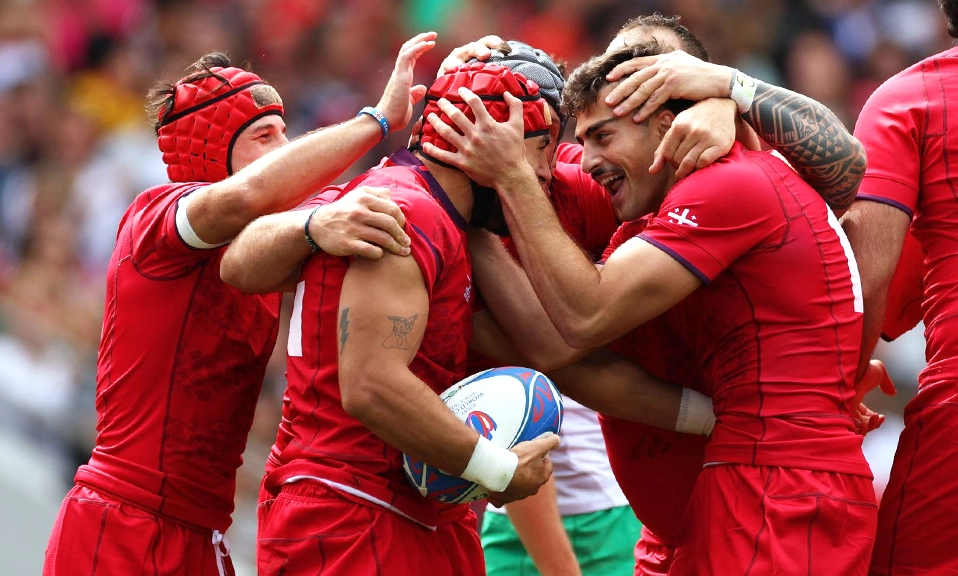
For decades, Georgia has been the undisputed king of European rugby’s second tier—a nation that wins the Rugby Europe Championship almost every year, yet remains locked out of the sport’s top table. But 2026 has been the year the Lelos stopped being a tier-two curiosity and became a genuine force. From an unbeaten World Rugby Nations Cup triumph to a sixth consecutive World Cup qualification, Georgia is no longer asking for respect. It is demanding it.
The Nations Cup: A Perfect Campaign
The inaugural World Rugby Nations Cup was designed to give tier-two nations more meaningful competition. Georgia treated it as a statement of intent. The Lelos won all six of their matches, finishing top of the European-African pool and the overall standings. The campaign included a 38-10 bonus-point victory over the USA in the final round, a match that pitted the two pool champions against each other with both sides boasting 100 per cent records.
Georgia’s path to the title was built on attacking rugby. They beat Samoa 33-12, Chile 49-22, and Canada 59-14, before a 55-31 win over Tonga in Tbilisi marked the 300th international match in the country’s history. In the final against the USA, flanker Luka Ivanishvili and centre Giorgi Shvelidze laid the platform with first-half tries, before Akaki Tabutsadze’s brace took his international tally to 58 tries in 55 tests. Captain Davit Niniashvili was blunt in his assessment: “I’m very happy to beat the USA and now we can see who is the best team in this championship”.
The victory was particularly sweet after a disappointing Rugby Europe Championship campaign earlier in the year, where Georgia’s eight-year grip on the title was ended by a 19-17 defeat to Portugal in the final. The Nations Cup was a brutal but well-deserved response.
World Cup Qualification: The Streak Continues
Georgia’s place at the 2027 Rugby World Cup in Australia was secured in February 2026, when they reached the semifinals of the Rugby Europe Championship with a 40-7 win over the Netherlands in Tbilisi—a result that maintained an almost eight-year unbeaten run in the competition. The highlight of that match was a weaving run from fullback Davit Niniashvili, whose outrageous over-the-shoulder pass set up a try for Vasil Lobzhanidze.
The Lelos have now qualified for every World Cup since their debut in 2003, a remarkable record of consistency for a nation that has long been denied regular access to tier-one opposition. They will face South Africa, Italy, and Romania in Pool B in Australia. It is a tough draw, but Georgia are no longer a team that simply hopes to compete. They have beaten three tier-one sides in the last four years, and they travel to the World Cup with genuine ambitions of reaching the knockout stages for the first time.
The Stars: A Squad Built in the Top 14
The driving force behind Georgia’s rise is a generation of players who have earned their stripes in Europe’s most competitive leagues. Davit Niniashvili, the 24-year-old fullback and captain, is the standout. Described as “arguably the most-talented player to have ever pulled on the Georgian jersey,” Niniashvili plies his trade for La Rochelle in the Top 14 and is the creative heartbeat of the backline.
He is far from alone. Luka Ivanishvili, a flanker for Bristol Bears, has emerged as a dynamic ball-carrier and a two-try hero of the Nations Cup final. Bachuki Tchumbadze, a prop for Exeter Chiefs, anchors the scrum, while Vasil Lobzhanidze, the veteran scrum-half at Oyonnax, brings 102 test caps of experience and a record for being one of the youngest players ever to reach 50 caps for his country. The squad is further bolstered by players from Clermont, La Rochelle, and Montpellier, a testament to the depth of Georgian talent now operating at the highest level of club rugby.
The Coaching Transition: A New Era Under Broncan
Georgia’s rise has not been without turbulence. In December 2025, head coach Richard Cockerill resigned after a 52-0 defeat to Connacht, a result that laid bare the gap between Georgia’s domestic club side, Black Lion, and the top tier of European competition. The Georgian Rugby Union moved quickly, appointing Frenchman Pierre-Henry Broncan on a two-year contract to lead the Lelos through to the 2027 World Cup.
Broncan, a former fly-half who coached at Castres and Brive, took over in June 2026, with former Italy captain Marco Bortolami serving as interim head coach before transitioning to forwards coach. The transition has been seamless. Georgia won every match under Broncan’s new regime at the Nations Cup, and the squad has spoken positively about the fresh tactical ideas he has brought.
The Tier-One Question: knocking on a Closed Door
For all their success, Georgia remain in a frustrating limbo. They are too good for the Rugby Europe Championship—as their eight consecutive titles before 2026 demonstrated—but they are not yet part of the Six Nations or the United Rugby Championship, the competitions that would expose them to regular tier-one opposition.
Bortolami has been outspoken about the need for Georgia to play better teams more regularly. “To improve and to grow… you need to play against the best teams on a regular basis,” he said, criticising a new calendar that will see Georgia play only tier-two teams until the World Cup. The Georgian club side Black Lion has already played in three editions of the Challenge Cup and has fulfilled every requirement to join the URC, but the decision remains with the competition’s organisers.
The Six Nations remains a closed shop, but the URC may offer a pathway. With Welsh rugby in turmoil and the WRU planning to cut its URC teams from four to three, there may soon be an opening. “Everything is manageable,” Bortolami said of the logistical challenges. “The South African teams joined the URC a few years ago”.
A Force That Can No Longer Be Ignored
Georgia’s 2026 has been a season of vindication. The Nations Cup triumph proved they can dominate a global competition. The World Cup qualification extended a streak of consistency that few tier-two nations can match. And the emergence of Niniashvili, Ivanishvili, and a cohort of Top 14 regulars has given the Lelos a squad capable of troubling the sport’s elite.
The question is no longer whether Georgia deserves a seat at rugby’s top table. It is whether the sport’s power brokers will finally give them one. The Lelos have done everything asked of them on the pitch. They have won the tournaments available to them, qualified for every World Cup for two decades, and produced players who compete at the highest level of club rugby. The only thing left is an opportunity—a regular fixture list against tier-one nations, a place in the URC, or, eventually, a route into the Six Nations.
Until then, Georgia will keep winning the competitions they are allowed to enter, and keep knocking on a door that remains stubbornly closed. The rugby world is beginning to listen. The only question is how long it will take to answer.