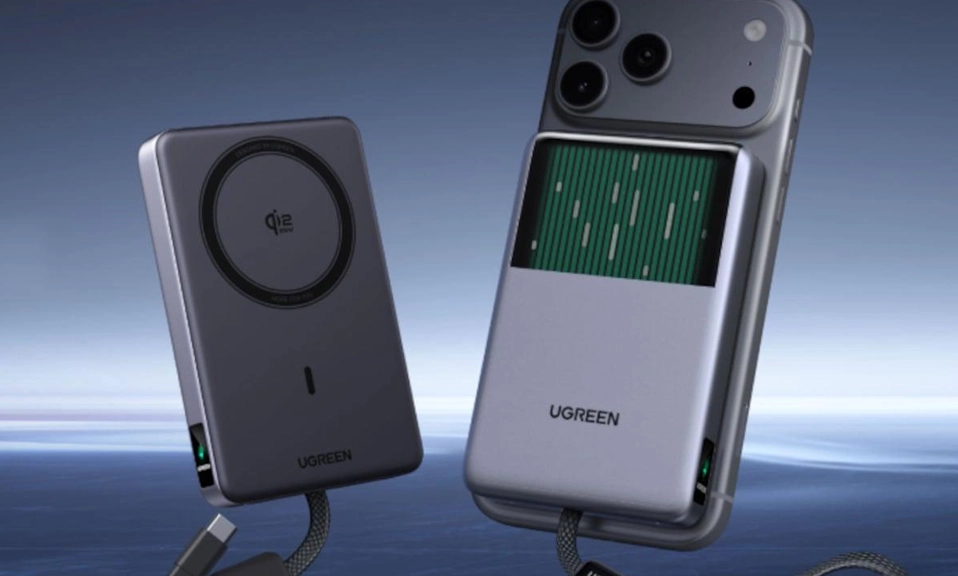
Power banks have always been a compromise. They charge your phone, but they do so slowly, they get uncomfortably hot in your hand, and the heat slowly degrades both the battery inside the bank and the battery inside your phone. The industry’s answer has been bigger cells, faster protocols, and more efficient chips. UGREEN’s answer, launched at IFA 2026, is stranger and more literal: run liquid through it.
The UGREEN MagFlow Pro is the world’s first liquid-cooled Qi2 magnetic power bank. It is a 10,000mAh battery with a micro-pump, a visible coolant window, and a smart display, priced at $149.99. It is either a genuinely clever piece of thermal engineering or an elaborate solution in search of a problem. The truth, according to the first wave of hands-on reviews, is somewhere in between—and the answer depends entirely on what you value in a power bank.
How It Works: A Micro-Pump, Copper Foil, and a Window
The MagFlow Pro’s cooling system is called CryoPulse. Inside the power bank is a micro-pump that circulates coolant through a multi-layer chamber, drawing heat away from the components that generate it most—including the Qi2.2-compatible wireless charging coil. The coolant sits between a copper heat-spreading foil and the aluminium heatsink shell, and it is visible through a small window on the front of the device. When the power bank is active, you can watch the liquid move.
UGREEN claims the system keeps peak temperatures up to 18°F (10°C) below the industry benchmark. The micro-pump consumes just 0.02W and is inaudible in normal use, according to reviewers who tried to hear it and could not.
The rest of the spec sheet is solid. The MagFlow Pro delivers 25W wireless charging and up to 45W wired through a built-in USB-C cable lanyard and a second USB-C port. It can charge an iPhone 17 Pro Max to 50% in about 40 minutes wirelessly. There is a tiny but sharp smart display showing charging power, battery level, cycle count, and cooling status. The battery uses high-density ATL cells and is rated for at least 800 charge/discharge cycles.
Does the Cooling Actually Work?
This is the question every reviewer has tried to answer, and the results are more nuanced than UGREEN’s marketing suggests.
ZDNET monitored the MagFlow Pro with a thermal camera with the pump running and with it off. The finding: with the pump running, the liquid-cooler side was slightly cooler and the charging pad slightly warmer. That is exactly what you would expect if the device is genuinely shifting heat away from the coil and spreading it across a larger surface area. The reviewer also noted that the power bank “never gets what I call ‘worryingly hot'” in use, and that it does a good job of eliminating hotspots—the localized patches of heat that are most uncomfortable when a power bank is pressed against your hand or leg.
A separate review on a Pixel 11 Pro found that both the power bank and the phone stayed relatively cool, with temperature readings between 91.94°F and 96.8°F—impressive compared to a conventional Xiaomi power bank tested in the same conditions. Irish Tech News reported that the cooling allows the MagFlow Pro to sustain its 25W wireless output for longer while keeping the phone noticeably cooler.
So the cooling does something. It reduces hotspots, it keeps the surface temperature more comfortable, and it may help the power bank maintain its charging rate for longer before throttling. But ZDNET’s reviewer raised the critical point: “Every joule of heat the power bank generates still has to exit through the case.” Liquid cooling does not reduce the total amount of heat produced. It moves it around more efficiently. And there are plenty of power banks that already move heat around with passive methods like heat spreaders and vapour chambers—no moving parts required.
The Gimmick Question: A Moving Part in a Device You Throw in a Bag
The most legitimate criticism of the MagFlow Pro is not about whether the cooling works. It is about whether adding a micro-pump—a moving part—to a power bank is a good idea. Power banks are abused. They are dropped, shoved into bags, left in hot cars, and charged overnight. A pump introduces a failure point that a passive heat spreader does not have.
ZDNET’s reviewer explicitly flagged this concern: “I resisted taking the unit apart because I want to keep using it to see whether the micro-pump is a failure point, or whether it’ll outlast the rest of the unit”. That is the unresolved question. UGREEN has not published a lifespan rating for the pump, and the long-term reliability of a liquid cooling system in a $150 accessory is unknown.
There is also the price. At $149.99**, the MagFlow Pro is **considerably more expensive than other 10,000mAh power banks**. A comparable premium power bank like the Anker MagGo 2 Pro costs less, and it does not have a pump that could fail. ZDNET’s verdict was blunt: **”At $150, this would be a tough sell, but for $100, it’s in the same ballpark as other premium-grade 10,000mAh power banks”**. The MagFlow Pro has frequently been discounted to around **$95–$119, and at that price, the calculus changes.
A Conversation Piece With a Real Benefit—If the Price Is Right
The UGREEN MagFlow Pro is not a gimmick in the sense that its cooling system does nothing. It demonstrably reduces hotspots, keeps surface temperatures more comfortable, and may help sustain charging speeds for longer. The visible coolant window is a genuinely delightful piece of design, the display is useful, and the built-in cable lanyard is a practical touch.
But it is also not a revolution. The heat still has to go somewhere, passive cooling is already good enough for most people, and the micro-pump is an added complexity with an unknown long-term reliability record. At its full $149.99 price, it is a hard recommendation for anyone who is not specifically bothered by hot power banks or enchanted by the idea of watching coolant flow through their charger.
At a discounted price closer to $100, the MagFlow Pro becomes a much more interesting proposition. It is a premium power bank with a unique feature, solid performance, and a design that will start conversations. It is not the future of phone charging—the future is likely more efficient chips and better passive thermal design, not micro-pumps in accessories. But it is a genuinely novel gadget that solves a real, if minor, problem in a visually spectacular way. And sometimes, that is enough.