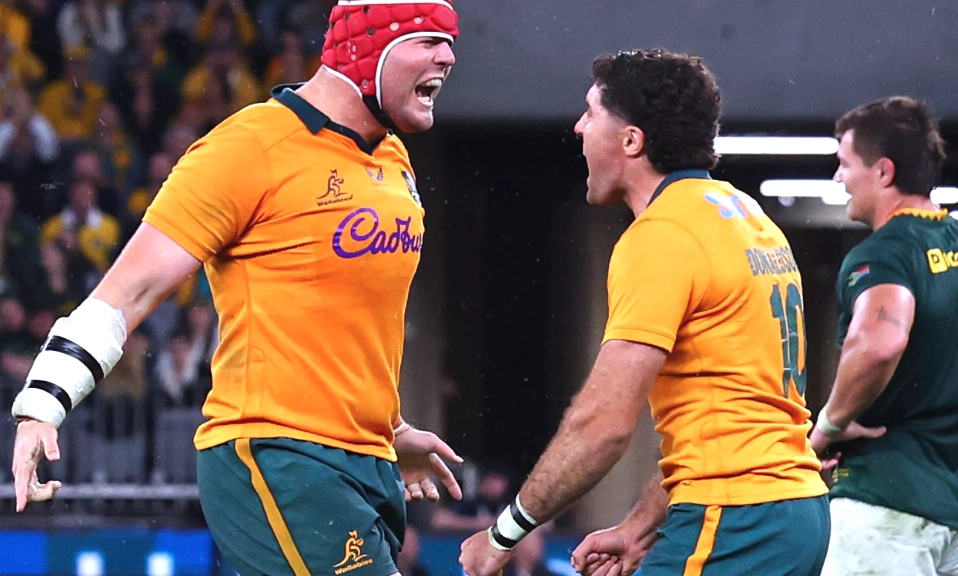
The Wallabies were down to 11 men, defending their own line, with the full Springbok bench coming at them. And they held on. This was the greatest Wallaby win in 11 years, and nobody saw it coming.
Perth. Optus Stadium. 50,000 people. Six minutes left.
Harry Wilson is in the sin bin. Ryan Lonergan is in the sin bin. Joseph-Aukuso Sua’ali’i is in the sin bin. Hunter Paisami has just joined them. The stadium scoreboard is showing the wrong score. The TMO’s phone line has gone down for the second time in fifteen minutes. And 11 Wallabies are standing on their own line, facing the full Springbok bomb squad — the men who’ve closed out two World Cup finals — coming at them off a scrum that’s just split their replacement loosehead like a cheap deckchair.
This is not a drill. This is Test rugby at its most chaotic, its most brutal, and its most beautiful.
Australia beat South Africa 42-38 on Sunday, September 27, 2026, in a match that defied belief, logic, and every pre-match prediction. It was the Wallabies’ first win over the world champions on home soil since 2022. It was their first half-time lead over the Springboks since that same year. And it was their first time scoring 42 points against them since a 49-0 demolition in Brisbane 20 years ago.
But the scoreline? It doesn’t even begin to tell the story.
The First 70 Minutes: A Wallaby Masterclass
For an hour, this was a procession.
The Springboks struck first through a Handre Pollard penalty in the second minute after Paul de Villiers won a turnover at the breakdown. Ryan Lonergan levelled three minutes later. Then Johan Grobbelaar crashed over from a powerful maul to give South Africa a 10-3 lead.
That was as good as it got for the visitors.
Australia responded with a wave of pressure, and centre Len Ikitau drove over from a metre out. Four minutes later, Ikitau struck again, gathering a high ball and finishing superbly to put the hosts 17-10 ahead.
South Africa hit back through Edwill van der Merwe, who finished a sweeping move sparked by a brilliant Canan Moodie break. But Australia had the final say before the break. After 14 patient phases, Ben Donaldson crossed out wide on the stroke of half-time. Lonergan’s conversion made it 24-17 at the interval.
Half-time: Australia 24, South Africa 17. The Wallabies were in control.
The Try That Broke the Game Open
Rassie Erasmus made all eight changes early in the second half, with his side down by 10 points. It didn’t help.
Captain Harry Wilson was denied a try as his foot was in touch, but just seconds later he burrowed over the line close to the posts. Then came the moment of the match.
Wing Max Jorgensen sprinted the length of the pitch to score a stunning solo try after South Africa fumbled the ball. It was electric. It was the kind of score that wins matches. It made it 42-17 with 16 minutes left.
The game, as a contest, was over.
What happened next was something else entirely.
The Collapse: Four Yellow Cards in Nine Minutes
What followed was one of the most extraordinary spells of chaos in modern Test rugby.
Harry Wilson was sin-binned. Then Ryan Lonergan. Then Joseph-Aukuso Sua’ali’i. Then Hunter Paisami. Four yellow cards in nine minutes. Australia were down to 13, then 12, then 11 men.
South Africa finally got their first score of the second half with a penalty try, with Lonergan yellow carded as well. A crossfield kick found Van der Merwe in the corner, but the wing dropped the ball before he could ground it. Replacement scrum-half Morne van den Berg scrambled in to cut the lead to 11 points.
Then, remarkably, Australia appeared to have scored again. Tom Wright intercepted a pass and ran in — only for the try to be ruled out and Paisami shown a fourth yellow card for a dangerous tackle in the build-up.
The Springboks had so much space. Ox Nche scored from a tap with the clock dead. The conversion went over. 42-38. And there was still a restart to survive.
Eleven men in gold defending a line. The full Springbok bench coming at them. The greatest Wallaby win in 11 years hanging by a thread.
They held.
“I’m So Proud of the Group”
Wallabies skipper Harry Wilson was candid after the final whistle.
“I’m so proud of the group,” he said. “We versed the world champions in our own backyard here. Jeez, that was a crazy last 10 minutes, but that first 70 minutes, the way we played, we implemented our game plan in exactly the way we wanted”.
He added: “We knew as a forward pack, we had to step up, we had to back ourselves, we have some special players, and in space, they can do special things”.
Springboks boss Rassie Erasmus was blunt in his assessment.
“For us, we lost in a Springbok jersey against Australia, and with all the disruptions, we have nobody else to blame but ourselves for the result,” he said. “I know the technology failed a bit; the clock kept running and didn’t stop at times, for example, but that didn’t influence how we played. We controlled that. We didn’t play well enough tonight to beat a stronger team”.
He added: “When you’re 25 points behind, there’s nobody else to blame but yourself. We rolled the dice a bit, and some guys haven’t played a lot together in a long time, but it’s not an excuse. We picked the team, and we had a game plan, and I thought we had a chance at the end, but the better team won on the night”.
Why This Win Matters
This wasn’t just an upset. It was a statement.
Australia were without several key players. South Africa made 13 changes from the side that beat New Zealand in Baltimore two weeks earlier, but still fielded a starting XV with 240 caps in the second row alone. The Springboks are the back-to-back World Cup champions. They are the benchmark. And they were beaten by a Wallabies side that played with more confidence, more enterprise, and more belief than they have shown in years.
For Les Kiss, the Wallabies head coach, this was a signature win. He remains unbeaten since taking the reins — five Tests, five wins. And with the World Cup opening at Optus Stadium in a year and four days, this was a warning shot to the rest of the rugby world.
The Wallabies didn’t just beat South Africa. They reclaimed the Mandela Challenge Plate for the first time since 2022. They scored 42 points against the best defensive team in the world. And they did it with 11 men on the field.
This was the kind
of match that reminds you why you watch sport.
It was chaotic. It was controversial. The technology failed, the scoreboard malfunctioned, and the TMO’s phone line cut out twice in the final 15 minutes. There were four yellow cards in nine minutes, a disallowed try, and a comeback that came agonisingly close to completing one of the great escapes in rugby history.
But when the final whistle blew, the scoreboard read 42-38. Australia had won.
“I’m so proud of the group,” Wilson said. He should be. They all should be.
The Wallabies are back. And the rugby world just took notice.