In the history of commercial aviation, there is one date that stands as a somber milestone.
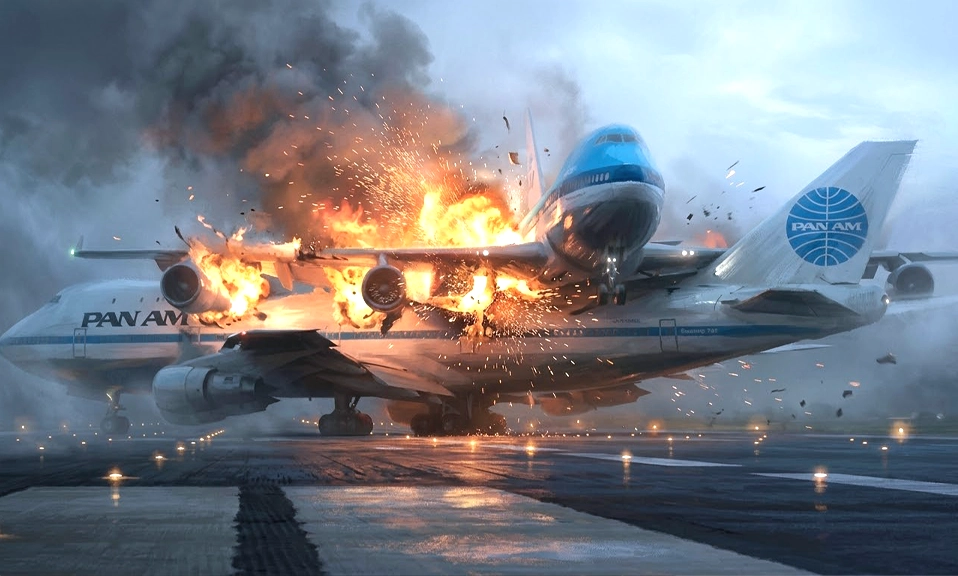
On March 27, 1977, on a fog-shrouded runway in the Canary Islands, two Boeing 747 jumbo jets collided. The resulting explosion and fire claimed 583 lives.
To this day, the Tenerife airport disaster remains the deadliest accident in aviation history.
But the story of Tenerife is not just a tale of tragedy. It is a profound case study in human psychology, communication breakdown, and systemic failure. Most importantly, it is the story of how the aviation industry looked into the abyss of its own worst nightmare and fundamentally rewrote the rules of flight safety, making modern air travel the safest mode of transportation in the world.
Here is the gripping, heartbreaking, and ultimately transformative story of the Tenerife disaster.
🌫️ The Setup: A Perfect Storm of Circumstances
The disaster did not happen in a vacuum. It was the result of a cascading series of unlikely events, often referred to by safety experts as the “Swiss Cheese Model” of accident causation.
- The Diversion: Earlier that day, a terrorist bomb exploded at Gran Canaria Airport, the primary destination for both flights. Authorities closed the airport and diverted all incoming traffic, including KLM Flight 4805 and Pan Am Flight 1736, to the much smaller Los Rodeos Airport (now Tenerife North Airport) on the island of Tenerife.
- The Congestion: Los Rodeos was a regional airport not equipped to handle multiple jumbo jets. The tarmac quickly became so congested with diverted aircraft that planes had to be parked on the main taxiway, forcing departing aircraft to taxi down the active runway to get into position for takeoff.
- The Fog: As the afternoon wore on, a thick, rolling fog descended on the airport. Visibility dropped to as low as 300 meters (about 1,000 feet). Crucially, Los Rodeos did not have ground radar, meaning air traffic controllers were completely blind to the positions of the planes on the tarmac.
📻 The Fatal Miscommunication
At the center of the tragedy were two highly experienced crews and a critical breakdown in radio communication.
The Pan Am 747 (Flight 1736) was instructed to taxi down the runway and exit at the third left turn. However, in the dense fog, the Pan Am crew missed the third exit and continued toward the fourth.
Meanwhile, the KLM 747 (Flight 4805), captained by Jacob Veldhuyzen van Zanten (KLM’s chief flight instructor and a highly revered figure in the company), was at the end of the runway, ready for takeoff. Van Zanten was eager to depart before his crew exceeded their legal duty hours and before the fog worsened.
What happened next is one of the most studied radio exchanges in aviation history:
- KLM Co-pilot: “We are now at takeoff.” (Meaning: We are in position and ready to go).
- Tenerife ATC: “OK, stand by for takeoff, I will call you.”
- Pan Am Co-pilot (transmitting at the exact same time): “We’re still taxiing down the runway, the Clipper 1736!”
Because both the Pan Am crew and the ATC transmitted simultaneously, a loud, three-second heterodyne (a squealing static sound) echoed in the KLM cockpit. The KLM crew heard the ATC say “OK,” but the crucial warning from the Pan Am crew and the ATC’s “stand by” instruction were completely blocked by the static.
Believing they had clearance, Captain van Zanten advanced the throttles. The massive KLM 747 began its takeoff roll.
💥 The Collision
As the KLM jet accelerated down the foggy runway, the Pan Am crew saw the blinding landing lights of the oncoming aircraft emerging from the mist.
Pan Am Captain Victor Grubbs slammed the throttles forward and yanked the yoke, desperately trying to get the heavy jet off the ground and out of the way. The KLM crew, realizing a plane was on the runway, pulled back on the yoke to lift off early.
It was not enough.
The KLM 747, traveling at over 150 mph, struck the upper fuselage of the Pan Am 747. The KLM aircraft became briefly airborne before stalling, crashing back onto the runway, and sliding down the tarmac in a massive fireball. The Pan Am aircraft was torn apart but remained largely intact on the grass beside the runway.
🕊️ The Aftermath: 583 Lives Lost
The human toll was staggering.
All 248 passengers and crew aboard the KLM flight perished instantly. Miraculously, 61 people survived the Pan Am flight, mostly those seated in the forward section of the aircraft who were able to escape through holes in the fuselage before the fire engulfed the plane. However, 335 people on the Pan Am flight lost their lives.
The investigation that followed was exhaustive. It revealed that the disaster was not caused by a single villain or a simple mechanical failure. It was a complex web of factors:
- The Authority Gradient: Captain van Zanten was a legendary figure at KLM. The investigation noted that his junior co-pilot and flight engineer likely harbored doubts about taking off without explicit clearance but were too intimidated by his rank and reputation to forcefully challenge him. ”
- Ambiguous Phraseology: The phrase “at takeoff” was not standard aviation terminology and was misinterpreted by the KLM crew as “taking off,” and by ATC as “in position.”
- Environmental Pressure: The pressure to depart before crew duty limits expired or the weather closed in completely clouded judgment.
🛡️ The Silver Lining: How Tenerife Changed Aviation Forever
The true legacy of the Tenerife disaster is not the tragedy itself, but the monumental safety revolution it triggered. The aviation industry realized that relying on the infallibility of a single “hero” captain was a fatal flaw.
As a direct result of Tenerife, several groundbreaking changes were implemented globally:
- Crew Resource Management (CRM): This was the most significant paradigm shift in aviation history. CRM trains crews to communicate openly, flattening the “authority gradient.” Today, junior co-pilots and flight engineers are explicitly trained and empowered to challenge the captain’s decisions if they believe a safety breach is occurring.
- Standardized Radio Phraseology: The word “takeoff” was banned from all ATC communications unless an actual takeoff clearance is being issued. Pilots now use the phrase “ready for departure” or “in position” to avoid any ambiguity.
- Improved Ground Radar: Airports worldwide were rapidly equipped with Airport Surface Detection Equipment (ASDE), allowing controllers to “see” aircraft on the ground in low visibility.
- Sterile Cockpit Rule: Strict enforcement of rules prohibiting non-essential conversation in the cockpit during critical phases of flight (taxi, takeoff, and landing) to ensure maximum focus.
The Bottom Line: A Legacy of Safety
The Tenerife airport disaster is a haunting reminder of how quickly a routine day can turn catastrophic when communication fails and systemic safeguards are stretched to their limits.
But it is also a testament to the aviation industry’s capacity for brutal honesty and continuous improvement. Unlike other industries that might try to hide their failures, aviation investigates them with relentless transparency, ensuring that every tragedy yields lessons that protect future generations.
Because of the 583 souls lost on that foggy runway in 1977, the protocols that govern every commercial flight today are infinitely safer. Their legacy is the reason that, despite the thousands of flights taking to the skies every single day, an accident of that magnitude has never been repeated.
The story of Tenerife is a heavy but vital one. Did you know about the cascading factors that led to this disaster? How do you feel about the evolution of Crew Resource Management in high-stakes professions? . ✈️🌫️🕊️