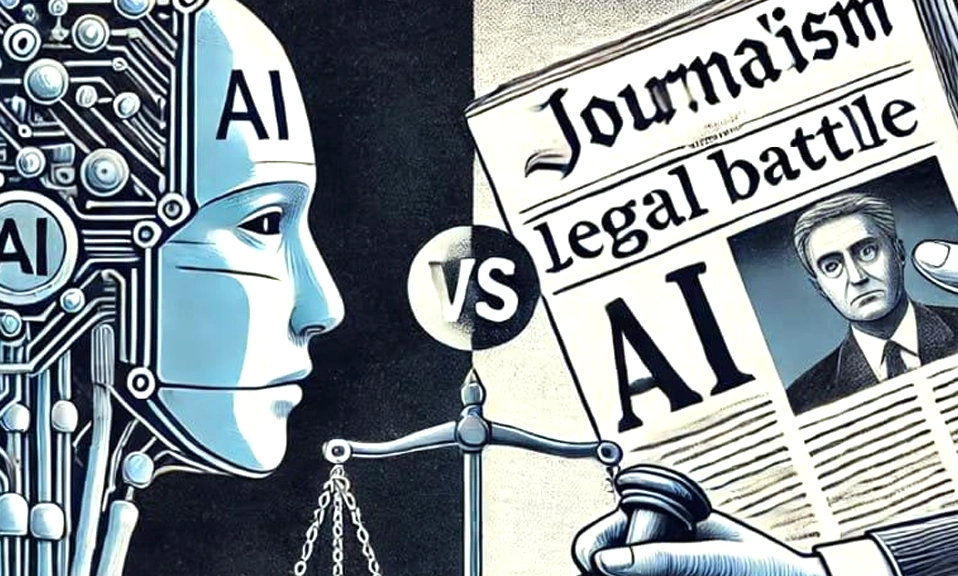
Who Owns the Content Used to Train AI?
The New York Times, The Economist, Agence France-Presse, the BBC, The Guardian, and more than 80 other news organizations have joined forces in what may be the most significant challenge to AI companies since the technology exploded into public consciousness. The question at the heart of it: when an AI model is trained on millions of articles, whose content is it—and who should pay for it?
On October 12, 2026, the Standards for Publisher Usage Rights (SPUR) coalition announced that its membership had grown to more than 80 publishers across over 20 countries . The coalition, launched in February 2026, is co-founded by British institutions including the BBC, Sky News, and The Guardian . Its mission is to create a “fair market” for the use of content by AI systems .
But SPUR is only one front in a much larger battle. Across courtrooms in New York, London, and Brussels, news publishers are fighting on multiple fronts: lawsuits seeking billions in damages, licensing negotiations worth hundreds of millions, and regulatory pushes to force AI companies to disclose what they’ve taken and pay for it.
The Coalition: A United Front
SPUR’s expansion is a direct response to growing frustration among news organizations over the unauthorized use of their content by AI companies . The coalition is developing industry-wide standards and technical systems to help publishers track and control how AI companies use their content, and to facilitate licensing agreements . In September 2026, SPUR introduced its Content Telemetry Standard, designed to standardize how AI agents record and report their use of media content .
“The value of this original work must be recognized, its source indicated, and payment made for it,” said AFP Board Chairman Fabrice Fries .
Rebecca Grossman-Cohen, The New York Times’ head of strategic partnerships, put it more directly: “Intellectual property protection and technological advancement can and must co-exist” .
The coalition’s membership now includes The Atlantic, The Observer, and publisher associations from Brazil, Japan, Argentina, and Colombia, alongside founding members like the Financial Times, BBC, and Associated Press .
The Lawsuits: “The Largest Theft of Labor in Human History”
The legal battles are where the stakes are highest—and where the most damning evidence has emerged.
NYT v. Microsoft and OpenAI
The New York Times sued OpenAI and Microsoft in late 2023, accusing them of copyright infringement by using millions of articles to train AI models . The case is now at the summary judgment stage, and newly unsealed documents have revealed internal concerns that are proving devastating for the defense.
In a January 2023 memo, Brent Hecht, Microsoft’s Director of Applied Science, described large-scale copying of online content for AI training as an “astonishing theft of unprecedented proportions” and perhaps the “largest theft of labor in human history” .
A subsequent Microsoft memo raised a similar concern, saying the company’s AI content strategy had “started a ‘doom loop'” that relied on materials available on the internet, but could simultaneously undermine the economic incentives to produce such materials .
Microsoft has dismissed Hecht’s comments as “one employee’s individual perspective” that “do not represent the company’s views” . But for the publishers, the admission is a smoking gun—evidence that Microsoft and OpenAI knew what they were doing .
OpenAI and Microsoft argue their use of news content is transformative and falls under “fair use” laws . The US Department of Justice filed a brief in September supporting OpenAI and Microsoft, invoking “scientific progress,” economic growth, and “national security” .
A ruling is not expected until 2027 .
USA Today Sues OpenAI for $250 Million
Earlier this month, USA Today and several newspapers it owns filed a separate lawsuit against OpenAI in Manhattan federal court, seeking more than $250 million in damages . The complaint alleges that OpenAI used hundreds of thousands of copyrighted articles without permission to train its AI models . The publishers are also seeking a court order to prevent OpenAI from continuing the alleged infringement .
News Corp Countersues Brave
News Corp, the parent company of The Wall Street Journal and the New York Post, filed a countersuit against search engine Brave Software in July 2026, accusing it of “flagrant theft” —illegally scraping, copying, summarizing, and monetizing content from its publications . News Corp is seeking damages of up to $150,000 per infringement .
The Licensing Deals: A Growing Revenue Stream
Not every publisher is fighting in court. Many have chosen to negotiate—and the deals are getting lucrative.
OpenAI has signed content licensing agreements with News Corp, Axel Springer, Le Monde, Prisa Media, the Financial Times, The Atlantic, Vox Media, Time, and the Associated Press, among others .
News Corp’s agreement with OpenAI could be worth as much as $250 million over five years** . Meta’s deal with News Corp is valued at **”up to $50 million per year for at least three years” . Apple is negotiating multi-year deals with publishers for its Siri AI, with a budget potentially in the nine figures—and a novel payment structure that would compensate publishers each time Siri uses their content, rather than paying for broad access to archives .
OpenAI’s first deals in India—with Bennett, Coleman and Co (Times of India) and the Indian Express Group—are reportedly worth about $5 million and $3 million per year, respectively .
The shift is significant. As one analysis put it: “Every AI answer engine runs on publisher content. Some publishers sue, some sign, and some do both” .
The Regulatory Battlefield: EU Considers Copyright Reform
While US courts grapple with fair use, the European Commission has opened a consultation on copyright reform for generative AI . The consultation, which runs until November 3, 2026, invites content creators, AI developers, and other stakeholders to propose steps to address the challenges . Options under consideration include new binding measures under EU copyright law, enhanced voluntary cooperation via “soft law instruments,” and non-legislative measures to support access to copyrighted content .
The EU’s move comes as a US appeals court rejected ‘fair use’ arguments in a dispute between Thomson Reuters and Ross Intelligence, finding that the use of Westlaw headnotes to train a competing AI legal research product was not covered by fair use . The case is significant because it focused on market substitution—whether the AI product competed directly with the copyrighted work .
The Declining Referral Traffic Problem
Behind all the legal and regulatory battles is a stark economic reality: AI-generated search answers are starving publishers of traffic.
Google organic-search referrals to more than 2,500 websites fell 33% globally between November 2024 and November 2025, according to a Reuters Institute report citing Chartbeat data .
AI assistants answer questions from millions of people every day using information that was “often first gathered and verified by news agency journalists,” as Fries noted . But those journalists aren’t being paid. And the websites that published their work aren’t getting the clicks.
What Comes Next
The battle over AI training data is entering a decisive phase. Three outcomes are possible:
The courts could rule decisively. If the NYT’s summary judgment motion succeeds, it could set a precedent that forces AI companies to license content retroactively—and pay for what they’ve already taken. If OpenAI and Microsoft win, fair use becomes a broad shield for AI training.
Licensing could become the norm. The growing list of deals—and the increasingly generous terms—suggests that AI companies are willing to pay. The question is whether the payments are enough to sustain journalism, or just enough to quiet the loudest voices.
Regulation could force the issue. The EU’s consultation could lead to binding rules requiring disclosure of training data and compensation for rights holders. If Europe acts, AI companies may have to change their practices globally.
For now, the publishers are united, the lawsuits are advancing, and the money is starting to flow. But the fundamental question remains unanswered: who owns the content that trained the AI models reshaping the world?
The answer, it seems, will be decided in courtrooms—and the outcome will shape the future of both journalism and artificial intelligence.