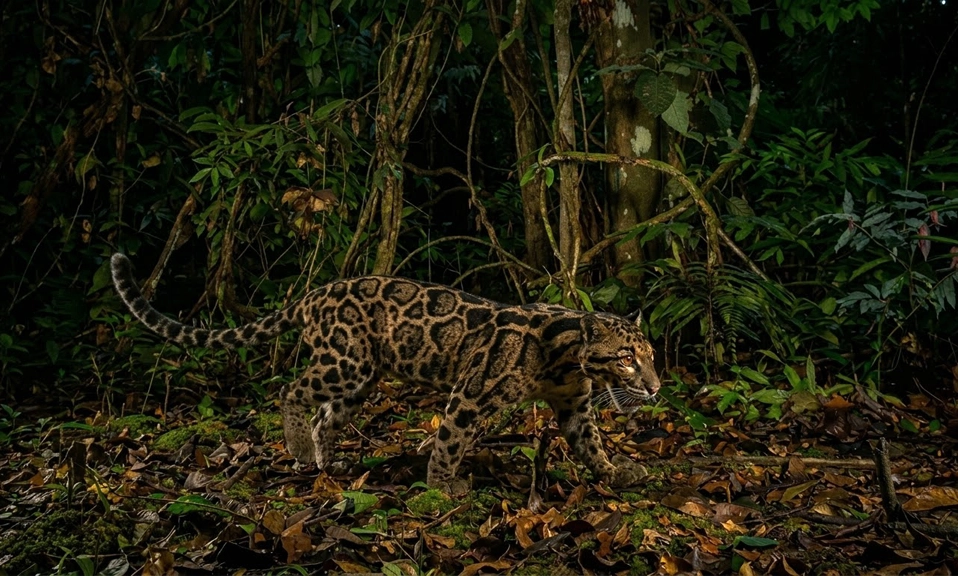
She was first photographed in July 2009, an adult female moving through the rainforest of Sabah, Malaysian Borneo. Over the next six and a half years, she appeared on camera traps again and again — a ghost made briefly visible. When researchers finally pieced together her story, they realised she was the oldest wild Sunda clouded leopard ever recorded, and her persistence had rewritten what science knew about her species.
The study, published in the journal Biotropica, tracked a single female Sunda clouded leopard for a record-breaking 6.51 years — the longest period any individual animal has been followed in a wildlife camera-trap study. It was part of a wider 15-year research effort, running from 2007 to 2023, that deployed 13 camera traps across three forest reserves in Sabah.
The findings are reshaping our understanding of one of the planet’s most elusive wild cats — and raising urgent questions about whether the forests she navigated will survive long enough to protect the next generation.
The Ghost of the Forest
The Sunda clouded leopard (Neofelis diardi) is not a leopard in the traditional sense. It is a distinct species, found only on the islands of Borneo and Sumatra, and it occupies a unique place in the feline family tree — a “special link between big cats and smaller wild cats”.
Its most striking feature is its dentition. Relative to its modest body size, the Sunda clouded leopard has the largest canine teeth of any wild cat, a trait that draws inevitable comparisons to the extinct saber-toothed cats. It is a predator built for precision, hunting at night through the rainforest canopy for primates, birds, and small mammals.
But what makes the species truly remarkable is how rarely it is seen. Its coat — marked with large, cloud-like blotches — blends almost perfectly into the dappled light of the forest understory. It moves silently, hunts in darkness, and spends much of its life in the trees. Scientists call it “the ghost of the forest,” and the nickname is earned: despite decades of camera-trap surveys, it remains one of the least understood big cats on Earth.
Today, fewer than 10,000 mature Sunda clouded leopards are estimated to remain across Sumatra and Borneo. The species is classified as Vulnerable on the IUCN Red List, threatened by deforestation, habitat fragmentation, and the illegal wildlife trade.
The Study: 15 Years, 13 Cameras, One Remarkable Cat
The research was a collaboration between the Leibniz Institute for Zoo and Wildlife Research in Germany, the Sabah Forestry Department, the Sabah Wildlife Department, and Panthera, the global wild cat conservation organisation, with the participation of Indigenous wildlife rangers from Sabah.
Over nearly 16 years, the team deployed 13 camera traps across three forest reserves in Sabah. They identified 52 individual adult Sunda clouded leopards — 30 males and 22 females — and recorded 437 total detections. The dataset ranks among the largest ever collected for the species.
But one individual stood out.
A female first photographed in July 2009 was recorded repeatedly over the following years. By the time she was last photographed in October 2015, the researchers estimated she was at least 8.51 years old — the oldest wild Sunda clouded leopard ever documented. Her minimum residency time in the study area was 6.51 years, shattering the previous record of 5.92 years held by a male.
“She spent years navigating a landscape shaped by logging and human activity,” Panthera wrote in a blog post, “and outlasted every wild clouded leopard on record”.
The Discoveries That Changed the Picture
Females Are Far Harder to Find Than Males
One of the study’s most significant contributions is a quantitative explanation for a long-standing mystery: why female Sunda clouded leopards are so rarely detected.
Females were detected 68.05% less often than males, resulting in a male-dominated adult sex ratio of 30:22. The reason, the researchers believe, is behavioural and anatomical. Females spend far more time in the forest canopy, and their slender bodies and fluffier tails help them balance in the trees. Males, by contrast, spend much of their time on the ground, patrolling and re-marking territory — behaviour that brings them into the path of camera traps far more frequently.
This matters enormously for conservation. If future surveys continue to under-detect females, researchers may mistakenly conclude that populations are healthier than they are, or that breeding is not occurring when it is. “The under-detection of females could prevent us from accurately tracking the population’s breeding success,” explained Thye Lim Tee, Project Coordinator at Panthera Malaysia. “To better protect the Sunda clouded leopard, our future assessments should view the lack of female detections as a sign to explore the forest interior more thoroughly, rather than assuming they simply aren’t present”.
These Cats Move Farther Than Anyone Realised
The study also confirmed that Sunda clouded leopards are far more mobile than previously assumed. Some individuals were recorded travelling up to 36 kilometres (22 miles) between forest reserves. In a landscape increasingly fragmented by logging, plantations, and roads, that kind of movement requires connected habitat — and it makes the protection of forest corridors an urgent conservation priority.
Lifespan Estimates Are Finally Within Reach
Before this study, lifespan estimates for wild Sunda clouded leopards were limited to males. The 6.51-year residency record for a female — and her estimated age of at least 8.5 years — provides the first meaningful data point for female longevity in the wild.
For context, a close relative, the mainland clouded leopard, has lived to 20 years of age in captivity — reinforcing the general pattern that captive cats live roughly twice as long as wild ones. The wild lifespan of the Sunda clouded leopard is almost certainly longer than 8.5 years, but the study establishes a minimum benchmark that conservationists can use to model population health and identify declines.
Why This Matters: Conservation in a Fragmented Landscape
The Sunda clouded leopard’s story is inseparable from the story of Borneo’s forests.
The species has become increasingly rare due to the conversion of its forest habitat into palm oil plantations and urban development, as well as the illegal wildlife trade. Sabah, where the study took place, has lost significant forest cover to logging and agricultural expansion over the past half-century. The female at the heart of this study navigated a landscape shaped by those pressures — and survived.
But her persistence is not a guarantee for the species. A 2026 study using GPS telemetry reaffirmed calls for the protection and restoration of forest corridors within agricultural landscapes, noting that the survival of the Sunda clouded leopard in Sabah “depends fundamentally on intact and connected forest networks”. Another simulation study concluded that habitat area is the dominant driver of population size and genetic diversity, and that current population sizes in Sabah could decline by approximately 26% even without additional development, likely due to time-lag effects.
In other words: the forests are already too fragmented, and the consequences are still unfolding.
For 6.5 years, a single female
Sunda clouded leopard moved through the forests of Sabah, appearing and disappearing on camera traps, living a life that few humans have ever witnessed. She was old — older than any wild member of her species ever recorded. She was female — a demographic that science has consistently failed to see. And she was mobile — travelling distances that reveal just how much space these cats need to survive.
Her story is a scientific breakthrough: the first long-term lifespan data for a female Sunda clouded leopard, a quantitative explanation for why females vanish from surveys, and proof that these cats roam farther than anyone knew.
But it is also a warning. The forests she navigated are shrinking. The corridors she used are under threat. The next female to set a longevity record may not have a forest to do it in.
“Long-term, large-scale monitoring allows us to move beyond snapshots and truly understand how wild cat populations persist over time,” said Wai-Ming Wong, Director of Small Cat Conservation Science at Panthera. “Without it, we risk missing the very dynamics that determine their survival”.
The ghost of the forest is still out there. But for how much longer depends on what we do with what she taught us.