The productivity software industry has spent two decades building increasingly elaborate containers for human work. Project boards, task lists, calendars, documents, wikis—every app is a place where you put information and then act on it yourself. The AI agent promises something fundamentally different: software that does not wait for you to act. It plans, decides, and executes on your behalf. The question is not whether this is a real shift. It is whether it is a shift that will actually work—and what it means for the tools that have organized our working lives for a generation.
The hype is deafening. In 2026, Notion shipped agents that can run autonomously for up to 24 hours on a single task. ClickUp launched Brain2, an AI coworker that generates finished slide decks and dashboards from a single prompt. Meta built an internal messaging board where employees’ personal agents interact with each other independently. Lindy, Zapier, and LangGraph are all racing to build the infrastructure for a world where agents, not humans, are the primary actors in a workflow.
But the reality is more complicated than the marketing suggests. The traditional productivity app is not dying. It is being redefined—and the outcome depends on whether you believe the future of work is about doing tasks faster, or about deciding which tasks matter at all.
What Traditional Productivity Apps Actually Do Well
To understand the shift, you have to understand what the incumbent tools get right. Traditional productivity software is built on a simple contract: deterministic, predictable, auditable.
A task list does exactly what it is told. You add a task, set a due date, assign it to someone. The software does not decide to reschedule it, reinterpret it, or complete it on your behalf. This predictability is not a limitation—it is the foundation of trust. When a project manager opens Asana, they know exactly what they will see. When a finance team uses a spreadsheet, they know the formula will calculate the same result every time.
Traditional apps are also auditable. Every action is logged. Every change is traceable. If a task was moved, you can see who moved it and when. If a deadline slipped, you can reconstruct the sequence of events. This transparency is essential for compliance, for debugging, and for accountability.
And they scale efficiently at what they are designed for. A database can store millions of records. A calendar can hold thousands of events. A project board can track hundreds of tasks. The software does not get tired, does not get distracted, and does not make judgment calls that need to be second-guessed.
The limitation is not in what these tools do. It is in what they do not do. They do not handle ambiguity. They do not decide what to work on next. They do not read an email, extract an action item, and add it to the right project without human intervention. They are containers, not collaborators. The human is the integrator—the one who moves information between apps, decides which tool to use, and translates a goal into a sequence of clicks.
What AI Agents Bring to the Table
AI agents invert the contract. Instead of giving the software a command, you give it a goal. Instead of navigating menus, you describe what you want. Instead of the software waiting for your next instruction, it plans, acts, and adapts on its own.
From commands to goals. A traditional app requires you to know what you want to do and how to do it. An agent requires only the first part. You tell it to “review the pipeline and flag deals that have stalled for more than two weeks,” and it reads the data, identifies the deals, and produces the report. You tell it to “summarize the customer complaints from last month and flag the ones that need immediate attention,” and it reads the emails, categorizes them, and surfaces the urgent ones.
From apps to agents. In the traditional model, each application is a silo. Your calendar does not know about your email. Your spreadsheet does not know about your CRM. An agent can operate across all of them, because it is not bound by the boundaries of a single application. It can read an email, check a calendar, update a spreadsheet, and send a message—all as part of a single task. Notion’s agents can connect outward to more than 150 tools via MCP. ClickUp’s Brain2 pulls from every task, doc, and conversation in the workspace. Zapier’s Agents connect to 9,000+ apps.
From deterministic to probabilistic. This is the critical difference, and the source of both the agent’s power and its risk. An agent does not follow a fixed set of rules. It uses a large language model to reason about the task, generate a plan, and decide what to do next. That means it can handle ambiguity, adapt to unexpected situations, and solve problems that were never explicitly programmed. But it also means it can make mistakes, hallucinate facts, or take actions that were not intended.
The most ambitious agents in 2026 are designed not just to assist, but to act autonomously over extended periods. Notion’s Custom Agents can run for up to 24 hours. Meta’s internal agents can talk to each other without human involvement. These are not features. They are a redefinition of what productivity software is for.
Where Agents Genuinely Win
The case for agents is not theoretical. In specific, well-defined domains, they deliver measurable gains that traditional tools cannot match.
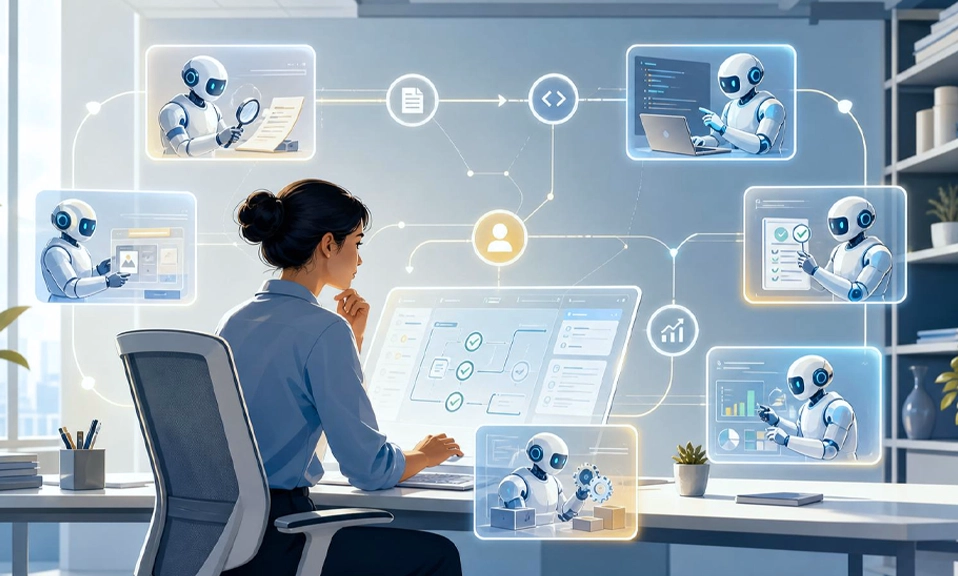
Workflow orchestration. The most valuable work in most organizations is not any single task—it is the coordination between tasks. Moving data between applications, triggering actions based on conditions, and coordinating multi-step processes. Agents can handle this natively. A traditional app can tell you a task is overdue. An agent can check the task, email the assignee, reschedule the deadline, and notify the client—all without you opening a single app.
Research and synthesis. Finding information across multiple sources, summarizing it, and producing a report is a task that agents do exceptionally well. Perplexity’s Teammates can take ownership of ongoing research, plan tasks, and coordinate with other agents. ChatGPT’s Deep Research can generate a fully cited report in 5 to 30 minutes. These are tasks that would take a human hours, and the agent does them with a level of consistency that humans struggle to maintain.
High-volume, low-judgment tasks. Customer service triage, invoice processing, data entry, and email sorting are all tasks where agents excel. The cost per task is lower, the error rate is consistent, and the agent does not get bored. For organizations handling thousands of these tasks per day, the economics are compelling.
Where Traditional Apps Still Win
The hype around agents obscures a simple truth: most work still requires a human in the loop, and most productivity software is designed for that reality.
High-stakes, deterministic operations. Financial transactions, medical device control, aviation systems—anything where a single error could be catastrophic—require the predictability and auditability of traditional software. An agent that hallucinates a decimal point in a financial report is not a productivity tool. It is a liability. These workflows need the determinism that traditional apps provide.
Regulated and auditable workflows. Compliance, legal processes, and financial reporting require explicit rules and traceable decision paths. An agent can assist, but the final decision must be auditable and defensible. The same features that make agents flexible make them difficult to audit. When a regulator asks “why was this decision made?” the answer “the model reasoned that it was the right choice” is not acceptable.
The learning curve is real. Agents are not self-explanatory. The same tools that promise to automate work require significant investment to configure, prompt, and maintain. Notion’s AI is an add-on at $20 per member per month**. ClickUp’s Brain AI adds **$9 per user per month on top of a paid plan. Motion starts at $19 per seat per month and has no free tier. The cost of entry is higher than most traditional apps, and the time to value is longer. A task list works in five minutes. An agent might take weeks to configure properly.
The accountability gap. When an agent makes a mistake—books the wrong flight, sends an email to the wrong person, deletes a file—who is responsible? The developer who trained the model? The company that deployed it? The user who gave the instruction? The agent itself cannot be held accountable. The legal and ethical frameworks for agentic computing are still being written, and the gaps are significant. Traditional apps have clear ownership: the person who clicked the button is responsible for the outcome. Agents blur that line.
The Hybrid Reality: What the Future Actually Looks Like
The most likely outcome is not a binary choice between agents and traditional apps. It is a hybrid model where the two coexist, each doing what it does best.
The core systems that run the world will remain deterministic and traditional. Databases, operating systems, payment networks, industrial controls—these will not be replaced by agents. They will continue to be governed by explicit rules, audited for compliance, and managed by humans who understand the systems.
The layer above them will be increasingly mediated by agents. The interface between humans and information—the place where we decide what to do and how to do it—will be transformed by agents that can understand context, anticipate needs, and take action. You will not replace your bank’s core ledger with an agent. But you might use an agent to interact with your bank, to dispute a charge, or to plan a budget.
The productivity tools themselves are adapting. Notion is not being replaced by agents; it is integrating them. ClickUp is not being replaced by Brain2; it is rebuilding its platform around it. Asana is not being replaced by AI Teammates; it is embedding them in its project management workflows. The traditional app is becoming the substrate on which agents operate—the place where data lives and where the output of agentic work is stored, reviewed, and acted upon.
This is the critical insight. The future of work is not about choosing between agents and apps. It is about designing systems where agents handle the coordination and the repetitive work, while humans handle the judgment and the accountability. The app becomes the record of what happened. The agent becomes the active participant that makes it happen.
A Paradigm Shift, With Caveats
Is the future of work changing forever? Yes—but not in the way the hype suggests.
AI agents are not going to replace traditional productivity apps wholesale. They are going to redefine what those apps are for. The app becomes the system of record. The agent becomes the system of action. The human remains the system of judgment.
This shift is real and irreversible. The tools are too powerful, the productivity gains too significant, and the investment too large for the industry to retreat. But the shift is also slower, more uneven, and more fraught than the marketing suggests. The accountability gap, the reliability problems, the cost of entry, and the learning curve are all real barriers that will not be solved overnight.
The organizations that succeed in this new era will be the ones that understand the difference between work that can be automated and work that must be owned. They will use agents to handle the coordination overhead, the research, and the repetitive tasks that consume human time without requiring human judgment. They will use traditional apps to store the output, audit the decisions, and maintain the accountability that every organization needs.
The future of work is not human versus machine. It is human and machine, with the human holding the reins. The tools are changing. The question is whether we are ready to change with them.