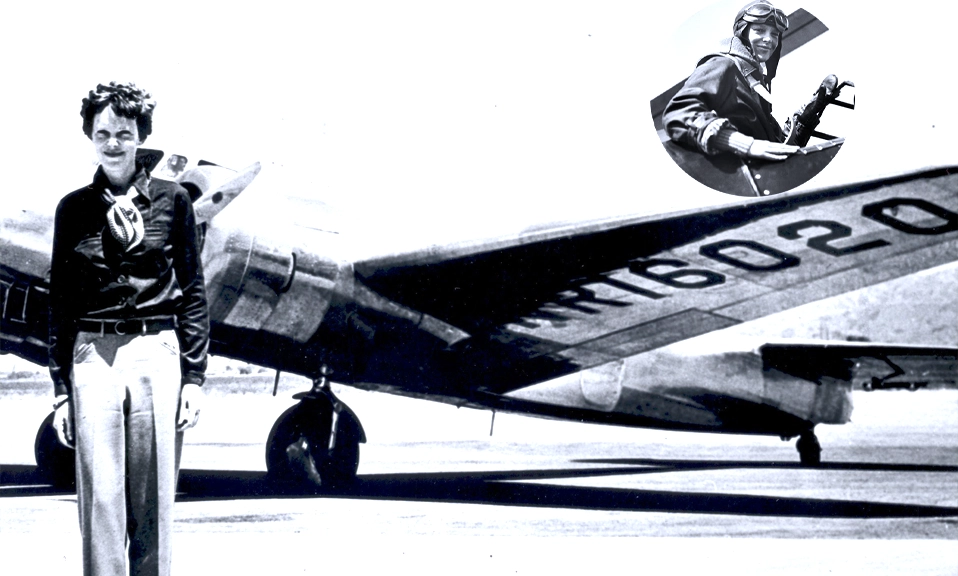
On July 2, 1937, Amelia Earhart and her navigator Fred Noonan vanished over the Pacific Ocean while attempting to become the first woman to fly around the world. No trace of them or their Lockheed Electra 10-E was ever found. Now, nearly 90 years later, a team of researchers is sailing toward a remote Pacific atoll to investigate what they believe could finally be the wreckage of her plane.
The Taraia Object: A Mystery Hidden in Satellite Imagery
The expedition centers on what researchers call the Taraia Object — a multi-branched visual anomaly sitting on the edge of a lagoon off Nikumaroro Island in the Pacific Ocean. It was first spotted in satellite imagery in 2020, and according to Purdue University, the object has since been confirmed to have been visible in aerial photography of the area dating back to 1938 — the year after Earhart disappeared .
The images show what could be the remnants of a small aircraft sitting in shallow waters. The team believes there is “very strong” evidence that the object is Earhart’s lost plane .
The Expedition: 17 People, 830 Miles, Five Days
The mission, originally set for October 2025, was delayed by a year due to weather conditions and the need for permission from Kiribati’s government, which controls Nikumaroro . The 17-person team — a joint effort between Purdue University, the Archaeological Legacy Institute (ALI), and the Purdue Research Foundation — departed Los Angeles earlier this month aboard the Marin Mainiku, a Kiribati National Shipping Line vessel .
The $900,000 Purdue mission is expected to arrive at Nikumaroro on Tuesday, October 13, local time, following an 830-mile journey from the Kiribati capital . They plan to remain on the island for five days before making the six-day return trip .
When they arrive, they will navigate through a narrow gap in the atoll’s reef created by the British in 1963 — the last time the island was inhabited .
What They’ll Do
Once on site, the team will take photos and videos of the lagoon and the Taraia Object. They will then use magnetometers and sonar devices to scan the area before dredging the item from the water so researchers can attempt to identify it . The process will be documented by the Archaeology Channel, with short vlogs on their streaming platform .
“Finding Amelia Earhart’s Electra aircraft would be the discovery of a lifetime,” said Richard Pettigrew, head of the ALI and the expedition lead .
The Castaway Theory
The Taraia Object is at the heart of a long-standing hypothesis: that Earhart and Noonan didn’t crash into the ocean, but instead landed on Nikumaroro and died there as castaways.
Pettigrew believes the pair landed on the island and camped there, surviving for some time. He cites 1930s relics and human skeletal remains found on the island — though the bones were lost over the decades .
The theory is supported by a compelling body of evidence amassed by rival explorer Ric Gillespie, who has led a dozen expeditions to the atoll over three decades. Gillespie’s investigation uncovered:
A 1930s-era glass cosmetic jar for freckle cream and remnants of a jackknife like one Earhart carried
Modern forensic analysis of skeletal remains found on the island in the 1940s
Radio transmission bearings from distress calls picked up by wireless operators in the days after Earhart vanished
A photograph taken months later showing an object that appears to be the Electra’s landing gear
The Purdue team credits Gillespie for laying the foundation of the theory they hope to prove .
The Skeptics: “It Ain’t Gonna Happen”
Not everyone is convinced.
Ric Gillespie himself — the very man whose research underpins the castaway theory — is the expedition’s most prominent skeptic. He believes the plane has since been lost to history, eventually swept by tides off the coral flat where it had landed and carried into the sea to sink and break apart .
“The object looked like a tree that had fallen from the atoll into the nearby water,” Gillespie told Reuters. “I’d love to find that airplane. It ain’t gonna happen” .
He noted that two previous attempts to locate the plane’s wreckage in the surrounding ocean — including a 2019 operation by Robert Ballard, the marine archaeologist famed for discovering the Titanic — proved fruitless. A plane-shaped sonar image from elsewhere on the sea floor turned out to be a pile of rocks .
Gillespie’s skepticism is rooted in a painful irony: he has spent decades arguing the castaway theory, but he doubts the plane itself still exists to be found.
The Wider Context: A Mystery That Refuses to Die
Earhart’s disappearance has spawned countless theories over the decades — from a simple crash due to fuel exhaustion to elaborate claims of capture and interference. The official explanation is that the plane suffered communication problems while Earhart and Noonan struggled to find Howland Island, and that Earhart eventually crashed into the ocean when she ran out of fuel .
The U.S. government conducted what was at the time its largest-ever search for a lost aircraft, but after two weeks, with no trace of Earhart, Noonan, or their plane, the search ended. On January 5, 1939, both were declared legally dead .
The Nikumaroro castaway theory has gained traction in recent years, bolstered by artifacts, forensic analysis, and radio evidence. But no physical proof of the plane has ever been recovered .
What Happens Next
The expedition is expected to reach Nikumaroro on October 13. The team will spend five days investigating the Taraia Object before beginning the long journey home.
“We owe it to Amelia’s legacy at Purdue to follow the evidence,” said Steve Schultz, a senior vice president at Purdue University and a field assistant on the expedition .
Earhart lectured at Purdue before embarking on her final flight, and some of her belongings remain on display in the university’s archives .
Whether the Taraia Object turns out to be a fallen tree, a pile of rocks, or the wreckage of the most famous missing plane in history, the expedition represents something remarkable: the refusal to let one of the 20th century’s greatest mysteries remain unsolved.
Amelia Earhart
disappeared 89 years ago. No trace of her plane has ever been found. And now, a team of researchers is betting that a strange object in a remote Pacific lagoon — visible in photographs since 1938 — is the answer.
The evidence is compelling. The skeptics are loud. And the world is watching.
The expedition arrives on October 13. Whatever they find, it will be a moment that aviation historians have been waiting for since 1937.
The mystery of Amelia Earhart may finally have an answer. Or it may remain as elusive as the aviator herself.