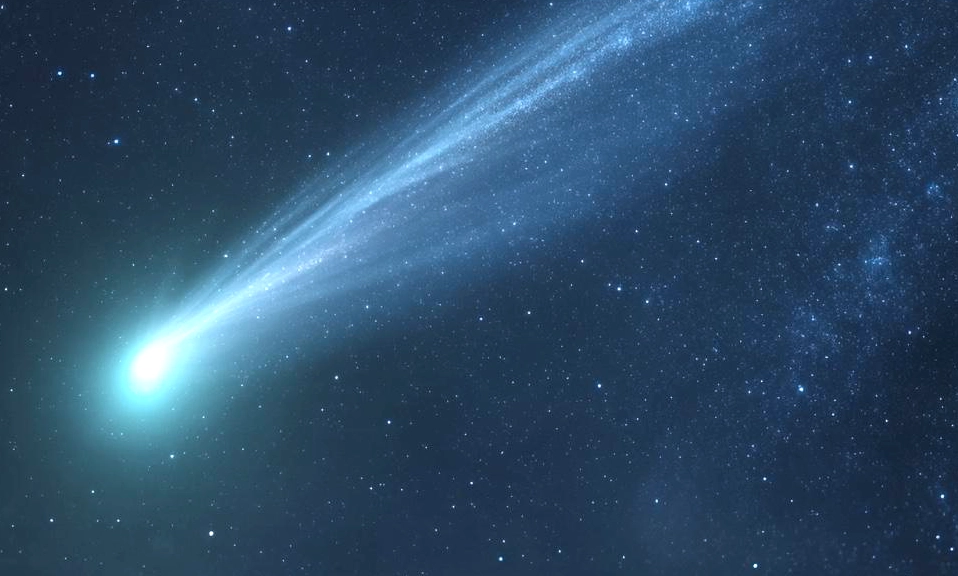
Scientists Found Something Strange About Its Gases
It is only the third interstellar object ever confirmed in our solar system. It formed before the Sun existed. And its chemical signature is so alien that it is forcing astronomers to rethink what “normal” looks like — both out there, and right here at home.
On June 22, 2026, a team of astronomers published a landmark study in the journal Nature detailing the chemical composition of Comet 3I/ATLAS. What they found was not just unusual. It was a fundamental challenge to our understanding of how planetary systems form. The comet, which passed through our solar system and has now begun its journey back into interstellar space, is carrying a chemical fingerprint that bears almost no resemblance to anything that formed around our Sun.
And the strangest part? The gases aren’t the only anomaly. The water isn’t either. It’s the kind of water — and what it says about a freezing, ancient world that existed billions of years before our own.
What Is 3I/ATLAS?
3I/ATLAS is the third confirmed interstellar object ever detected, following 1I/’Oumuamua in 2017 and 2I/Borisov in 2019. It was discovered on July 1, 2025, by the NASA-funded ATLAS (Asteroid Terrestrial-impact Last Alert System) survey telescope, and it made its closest approach to the Sun on October 29, 2025.
Unlike the first two interstellar visitors, 3I/ATLAS was caught early enough — and was active enough — to be studied in extraordinary detail. As it approached the Sun, its ices began to sublimate, releasing gases that formed a bright coma around the nucleus. That glowing cloud of gas became a chemical fingerprint, readable by the most powerful telescopes on and above Earth.
What that fingerprint revealed was unlike anything astronomers had ever seen on a comet.
The Gases That Shouldn’t Be There
The first major surprise came from NASA’s James Webb Space Telescope. Using its Mid-Infrared Instrument (MIRI), Webb made the first-ever direct detection of methane gas on an interstellar object. Methane is highly volatile — it sublimates from solid to gas at relatively low temperatures. Its delayed appearance in 3I/ATLAS suggested it had been buried below the comet’s surface layer, protected from sublimation until heat from the Sun reached deeper into the icy subsurface.
But methane wasn’t the only anomaly. Webb’s observations also confirmed that 3I/ATLAS is unusually rich in carbon dioxide, releasing far more CO₂ relative to water than typical solar system comets. And the amount of methane relative to water was, as NASA put it, “surprisingly high, with few similar analogs in our own solar system”.
The team also noted a significant depletion of atomic sulfur in the comet’s coma, a chemical signature that further distinguishes it from solar system comets. And the comet showed an exceptionally high production rate of nickel and iron, detected as far as 3.88 astronomical units from the Sun — a behavior that is, again, completely unlike typical comets.
The Water That Broke the Thermometer
If the gases were strange, the water was even stranger.
In April 2026, researchers using the Atacama Large Millimeter/submillimeter Array (ALMA) in Chile made the first-ever measurement of deuterated water — also known as semi-heavy water — in an interstellar object. The results, published in Nature Astronomy, were nothing short of astonishing.
In solar system comets, roughly one molecule of semi-heavy water exists for every ten thousand molecules of ordinary water. In 3I/ATLAS, that ratio is at least 30 times higher — and over 40 times the proportion found in Earth’s oceans.
The ALMA observations also revealed something even more unusual: ordinary water (H₂O) itself fell below ALMA’s detection threshold. The team had to infer the water production rate indirectly, through the excitation of methanol lines — a sophisticated modeling approach that highlights just how unusual this comet’s composition is.
“It was really surprising,” said Luis E. Salazar Manzano, a doctoral student at the University of Michigan and lead author of the study. “The water in this comet is very different from the water in our solar system. Our observations show that the conditions that led to the formation of our Solar System are much different from how planetary systems evolved in different parts of our Galaxy”.
The “Thermometer” of a Frozen World
Why does heavy water matter so much? Because the ratio of deuterium to hydrogen in water acts as a thermometer for the environment where that water formed.
“The chemical processes that lead to the enhancement of deuterated water are really sensitive to temperature and usually require environments colder than about 30 Kelvin, or about minus 406 degrees Fahrenheit,” Salazar Manzano explained.
In other words, the extreme heavy-water enrichment in 3I/ATLAS tells us that its home system formed in conditions far colder than anything in our own solar system. The comet’s ancient ices were never warmed enough to reprocess that “heavy water” into the ordinary H₂O we’re familiar with on Earth.
Wherever 3I/ATLAS came from, it was a place of deep, persistent cold — and it has preserved that chemical memory intact across billions of years of interstellar travel.
A Messenger From Before the Sun
The isotopic data doesn’t just tell us where the comet formed. It tells us when.
Webb’s NIRSpec instrument showed only traces of carbon-13 compared to lighter carbon-12. Stellar systems become enriched with carbon-13 over time as generations of stars are born and die. Our solar system, which formed 4.5 billion years ago, has relatively high levels of carbon-13. The low carbon-13 in 3I/ATLAS points to a very old origin — a system that formed when the galaxy was much younger.
Combined with the heavy-water data, the research team estimates that 3I/ATLAS could have formed as long as 10 to 12 billion years ago, during the Universe’s “cosmic noon,” when star formation was at its height. That makes it older than the Sun, older than the Earth, and possibly older than the Milky Way itself was when it began taking its current shape.
“This was a unique opportunity to study an ancient object from the distant Galaxy, probably pre-dating our Sun and Solar System,” said Martin Cordiner of NASA’s Goddard Space Flight Center, lead author of the Nature study. “On the one hand, we get direct insight into that distant time and place, and on the other, we learn something about how unusual our own Solar System may be”.
Why This Matters: The Solar System Is the Oddball
The most profound implication of the 3I/ATLAS findings is not about the comet itself. It’s about us.
For decades, astronomers have assumed that the chemical composition of solar system comets — their water, their carbon dioxide, their methane — represents the “normal” outcome of planetary system formation. The 3I/ATLAS data suggests the opposite: our solar system may be the anomaly.
“Each interstellar comet brings a little bit of its history, its fossils, from elsewhere,” said Teresa Paneque-Carreño, the principal investigator of the ALMA program. “We don’t know exactly where, but with instruments like ALMA we can begin to understand the conditions of that place and compare them to our own”.
The heavy-water enrichment, the unusual CO₂-to-water ratio, the delayed methane release, the sulfur depletion, the nickel-iron abundance — all of it points to a formation environment that was colder, more chemically distinct, and fundamentally different from the nebula that gave birth to our Sun and planets.
And that raises a question that is as much philosophical as it is scientific: if a comet like 3I/ATLAS represents how most planetary systems form, what does that say about the conditions that made Earth — and life — possible?
The Comet That Keeps Surprising
3I/ATLAS has now passed through our solar system and is heading back toward interstellar space, toward the constellation Gemini. But its legacy will endure in the data it left behind — and in the questions it raised.
It was the first interstellar object where astronomers directly detected methane. It was the first where semi-heavy water was measured. It was the first to show such extreme isotopic anomalies that it forced a re-evaluation of what “normal” cometary chemistry looks like.
And it was, perhaps most importantly, a messenger from a time before our Sun existed — a frozen relic of the galaxy’s infancy, carrying within its ices the chemical signature of a world that no longer exists, in a place we will never see.
“This was a unique opportunity,” Cordiner said. “We get direct insight into that distant time and place”.
We may never know exactly where 3I/ATLAS came from. But thanks to the telescopes that watched it pass, we now know something about what it was — and what it tells us about the astonishing diversity of worlds being born across the galaxy.
The comet is gone. The questions remain. And somewhere, billions of years ago, in a cold and distant corner of the universe, a world was born that would one day send a fragment of itself hurtling past our Sun — carrying secrets older than the solar system itself.
The findings were published in Nature on June 22, 2026, and in Nature Astronomy on April 23, 2026.