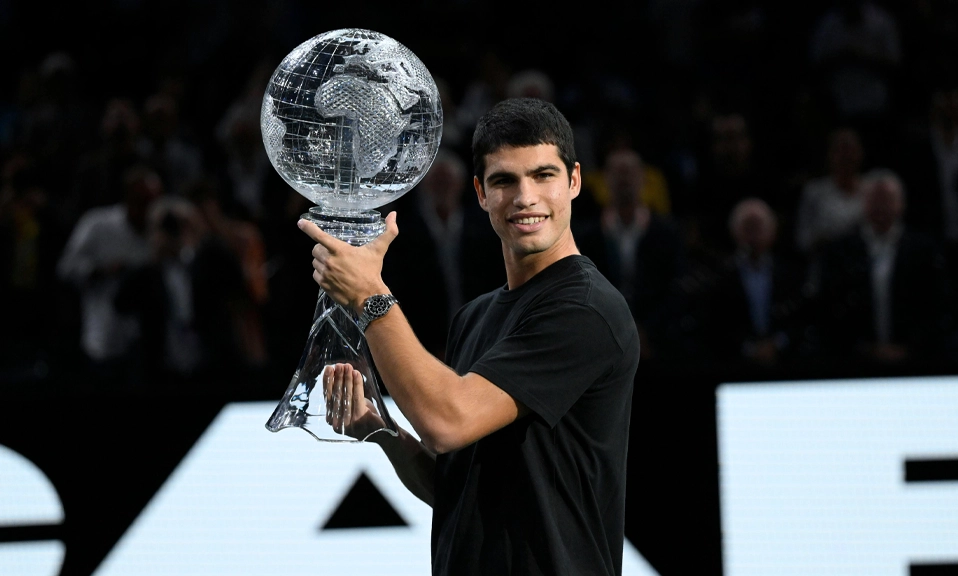
PARIS — The question hung in the air at La Défense Arena long before Carlos Alcaraz struck the final backhand: is the heir to men’s tennis finally ready to reclaim his throne? For 57 minutes, Ben Shelton made it feel unresolved. Then, with a trademark backhand down the line on his second championship point, Alcaraz answered it — 7-6(5), 7-5 — and the tennis world exhaled.
This was not just another Masters 1000 title. It was his ninth, his first in Paris, and the clearest signal yet that the 23-year-old Spaniard has emerged from the most turbulent year of his career as a more complete, more dangerous player than ever before.
The Victory: Revenge, Resilience, and a Record
The narrative of the final was impossible to ignore. Two months earlier, Shelton had ended Alcaraz’s return tournament at the US Open in a five-set quarter-final epic that finished at 3:33 a.m. local time — the latest finish in tournament history. Alcaraz had been fresh off a four-month layoff due to a wrist injury, and the loss raised questions about whether he could recapture the form that made him the youngest man to complete the career Grand Slam earlier in the year.
The final in Paris was the answer. Alcaraz saved all six break points against him in a tense opening set, then recovered from a break down in the second to close out the match in one hour and 57 minutes. The statistics told a story of dominance: he won 37 per cent of points against Shelton’s first serve, a figure that would be respectable against any opponent but is remarkable against one of the biggest servers on tour. He improved his head-to-head record against Shelton to 4-1, and he did it by beating the American at his own game — matching power with power, then adding the variety and finesse that Shelton could not answer.
The significance of the victory extended beyond the scoreline. Alcaraz became only the third player in series history to win Masters 1000 titles in five consecutive years, joining Novak Djokovic and Rafael Nadal. He now has seven of the nine Masters 1000 events on his CV, with only Canada and Shanghai remaining before he completes the set. And at 23 years and 188 days old, he is already breathing down the neck of Manolo Orantes on the list of most decorated Spanish players.
The Comeback: From Injury to Invincibility
To understand why this victory matters, you have to understand the journey. Alcaraz began 2026 by winning the Australian Open, becoming the youngest man in history to complete the career Grand Slam. It was the moment he seemed poised to assert a dominance that had been promised but never fully delivered.
Then came the wrist injury. Four months on the sidelines. The French Open and Wimbledon passed without him. When he returned at the US Open, he reached the quarter-finals — a result that exceeded expectations but ended in the crushing, late-night defeat to Shelton.
What happened next was a statement. In the two months since, Alcaraz has won three titles — Tokyo, Vienna, and now Paris — and lost just once in 17 matches. He has won five titles in 2026, second only to Jannik Sinner’s six. He arrived in Paris on a nine-match winning streak, having saved two match points against Taylor Fritz in the quarter-finals — the fourth time in his career he has won a title after being match points down at a tournament.
Most tellingly, he has transformed his record on indoor hard courts, historically his weakest surface. He began the European indoor swing with a 70 per cent success rate; after Vienna and Paris, that figure has risen to 75 per cent, with a record of 45 wins and 15 losses under a roof. The surface that once exposed his vulnerabilities is becoming another stage for his dominance.
The Sinner Question: The Rivalry That Defines the Era
No discussion of Alcaraz’s dominance is complete without Jannik Sinner. The two have built the most compelling rivalry in men’s tennis, and the 2026 season has been defined by their contrasting trajectories.
Sinner, the world No. 1, has six titles to Alcaraz’s five, and he has held the top ranking for much of the year. At his peak, he led Alcaraz by 2,740 points in the rankings, a gap that reflected a season of relentless consistency. But Sinner has been sidelined with a knee injury since Wimbledon, and his absence has opened the door for Alcaraz to close the gap.
The ranking maths is complicated. Alcaraz is currently No. 3, battling to finish the year as No. 2 and surpass Sinner — but a single loss could see him finish third. Sinner has already secured a second-place finish in the 2026 rankings, and the gap between them remains significant.
Yet the momentum is unmistakably with Alcaraz. He has won seven of the nine Masters 1000 events, a tally that eclipses Sinner’s record at the same age. He has proven he can win on every surface, in every condition, and against every style of opponent. And he has done it while Sinner has been forced to watch from the sidelines.
The question is not whether Alcaraz can dominate. It is whether he can dominate Sinner — and whether the Italian’s return in 2027 will restore the balance of power or confirm a new hierarchy.
The Remaining Tests: What’s Left to Prove
Alcaraz himself is cautious about the “dominance” narrative. After the final, he admitted he does not see himself as the favourite ahead of the ATP Finals in Turin, despite arriving on a nine-match winning streak. “I have taken a step forward,” he said, “but I don’t see myself as a favourite”.
That humility is characteristic, but it also reflects a realistic assessment of what remains. The ATP Finals is the biggest indoor title he has not won — he lost the 2025 final to Sinner. The Davis Cup is the other major team honour missing from his CV. And the Canadian Open and Shanghai Masters are the two Masters 1000 events he has not yet conquered.
There are also questions about his durability. The wrist injury that cost him four months in 2026 was a reminder that his all-action style carries risk. He has managed his schedule carefully since returning, but the demands of a full season — particularly with Sinner back and a new generation of challengers emerging — will test his body in ways that the past two months have not.
Ready to Dominate, But Not Yet Dominant
Is Carlos Alcaraz ready to dominate men’s tennis again? The honest answer is: he is ready. But readiness is not the same as certainty.
The evidence for dominance is compelling. He has won nine Masters 1000 titles at 23, a rate of accumulation that places him in the company of Djokovic and Nadal. He has won three of his last four tournaments and lost once in 17 matches. He has conquered his indoor hard-court demons, saved match points when it mattered, and beaten the opponent who ended his comeback tournament in a final that demanded revenge. He is, by any measure, the most complete player in men’s tennis when he is fit and firing.
But dominance requires more than a hot streak. It requires sustained superiority over a full season, against a fully fit field. Sinner has been the more consistent player in 2026, and his return in 2027 will test whether Alcaraz’s resurgence is a permanent shift or a temporary window. The ATP Finals in Turin will provide an immediate answer — a title Alcaraz has never won, on a surface where he has historically been vulnerable, against a field that will include Sinner if he is fit.
The most likely outcome is not a return to the one-sided dominance of the Big Three era. It is a continuation of the Alcaraz-Sinner rivalry — a duopoly that has defined the sport for the past three years and will continue to define it for the next five. Within that rivalry, Alcaraz is no longer the challenger. He is the player with the momentum, the titles, and the proven ability to win on every stage.
He is ready to dominate. Whether he actually does depends on what happens next — and on whether Sinner, and the rest of the field, can find a way to stop him.