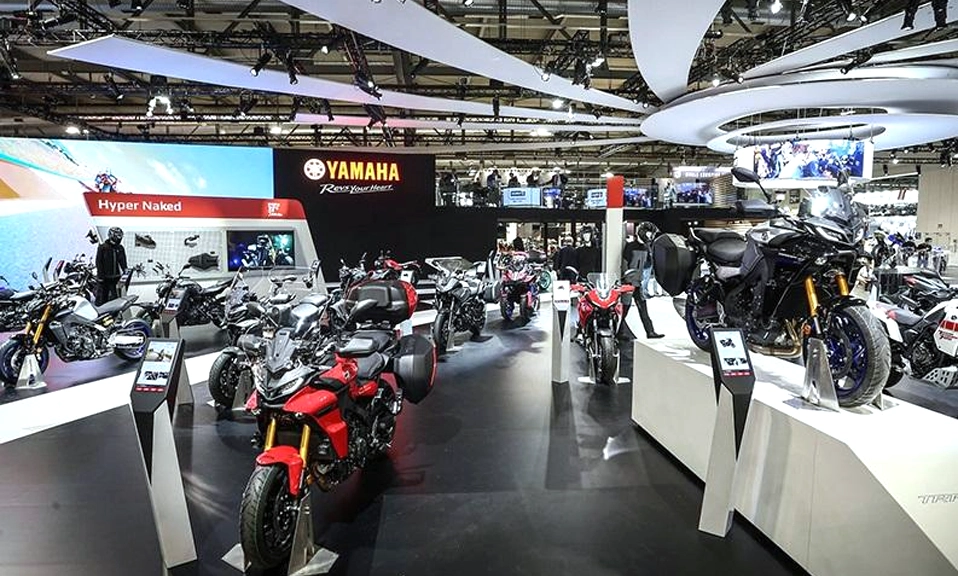
EICMA 2026 is not just a motorcycle show. It is a referendum on what motorcycles are becoming. This year’s edition, running November 3–8 in Milan, is defined by a quiet but profound split: the machines that still burn fuel are getting smarter, safer, and more technologically dense, while the electric motorcycles arriving alongside them are experimenting with the very idea of what a gearbox, a motor, and a riding experience should be. The seven highlights below capture that tension perfectly.
1. E-Motiv’s Seamless Two-Speed Transmission: The Gearbox That Never Stops Pulling
What it is: A British company called E-Motiv Shift Systems is bringing a two-speed seamless powershift transmission for electric motorcycles to EICMA. Unlike conventional gearboxes, which briefly cut power during shifts, E-Motiv’s system maintains torque delivery throughout the change. The technology traces its roots back to the Zeroshift system, which eventually appeared in Aprilia’s MotoGP bikes in 2015.
Why it matters: Most electric motorcycles use single-speed transmissions because electric motors produce strong torque across a wide rev range. But a lower first gear could provide stronger acceleration, while a taller second gear could optimize motor efficiency at higher cruising speeds—potentially improving range and reducing heat. The demonstrator, built with BSA, the University of Bath, and the IAAPS, will begin real-world testing in early 2027. It is a development project, not a production bike, but it signals that electric motorcycles are entering a phase of mechanical experimentation that the internal-combustion world took decades to refine.
2. Royal Enfield Himalayan 750: The Largest Adventure Bike Enfield Has Ever Built
What it is: Royal Enfield’s Himalayan 750 is expected to be one of the busiest stands in Milan. Built around a new 750cc parallel-twin, it becomes the company’s largest adventure bike, a clear step up from the Himalayan 450 with better touring ability and more advanced electronics.
Why it matters: Royal Enfield has spent years building a reputation for accessible, characterful machines. The Himalayan 750 represents something different: a genuine long-distance adventure platform with the power and sophistication to compete beyond the beginner and mid-weight segments. The Continental GT 750, a larger sibling to the GT 650, is expected alongside it, carrying over the cafe-racer styling with a new 750cc twin and a noticeable performance boost. For a brand that built its modern identity on nostalgia, this is a statement of ambition.
3. QJMotor OAO MAX: An Electric Motorcycle with a Manual Four-Speed Gearbox
What it is: QJMotor’s OAO MAX is an electric motorcycle equivalent to a 125cc combustion bike, but it comes with something almost no electric motorcycle offers: a manual four-speed gearbox. It has a clutch lever on the left handlebar, a pedal shifter, and a chain final drive—the layout of a conventional motorcycle, applied to an electric powertrain.
Why it matters: The OAO MAX is not trying to be more efficient than a single-speed EV. It is trying to make an electric motorcycle feel like a motorcycle—with the engagement, the mechanical interaction, and the learning curve that riders who grew up on combustion engines associate with the experience. It is a bet that some riders want the ritual, not just the torque. QJMotor is also showing the SRK 1000 RR, a 163-hp four-cylinder supersport, making it one of the few manufacturers exploring both extremes of the two-wheeled spectrum in the same hall.
4. Kawasaki Versys 900: Radar Safety Comes to the Mid-Size Crossover
What it is: The new Kawasaki Versys 900 brings a 122-hp inline-four engine and, for the first time in this model range, front and rear radar technology as part of Kawasaki’s Advanced Rider Assistance Systems (ARAS). The system enables adaptive cruise control, collision warning, and blind-spot detection.
Why it matters: Radar-based rider assistance has been trickling down from flagship touring bikes to more accessible machines. The Versys 900 is a mid-size crossover—a bike designed for everyday riding, commuting, and weekend touring—and fitting it with front and rear radar makes the safety case for the technology impossible to ignore. Bosch, which supplies radar systems, estimates that such functions could prevent up to one in six motorcycle accidents on German roads. When that technology reaches the middle of the market, it stops being a luxury and starts becoming a baseline expectation.
5. Ducati Multistrada V4 S Grand Tour: Radar Safety as Standard
What it is: Ducati’s Multistrada V4 S Grand Tour comes with a factory-fitted radar suite as standard equipment: Adaptive Cruise Control (ACC), Blind Spot Detection (BSD), and Forward Collision Warning (FCW). It also includes a rear radar system, tire pressure monitoring, auxiliary LED lights, and an automatic lowering device that drops the bike by up to 30mm below 10 km/h to make stopping and low-speed manoeuvres easier.
Why it matters: Ducati is not treating radar as an optional extra on a premium tourer. It is making it standard equipment, the same way ABS and traction control became standard. The Multistrada V4 S Grand Tour is a statement that safety technology is not a feature to be upsold—it is part of what a modern touring motorcycle should be. The 170-hp V4 engine and the factory-fitted luggage and heated grips complete a package that is designed to cover continents without compromising on the technology that keeps the rider aware of everything around them.
6. Astemo’s EERA Electronic Suspension and In-Wheel Motor: The Chassis Becomes Software
What it is: Astemo (formerly Hitachi Astemo) is showing two technologies that point toward the future of motorcycle chassis design. The new EERA electronic suspension can switch spring rates according to riding conditions and rider demands—delivering direct response for sport riding and high stability and comfort for touring. It is, in effect, a suspension system that lets one bike have multiple characters.
Alongside it, Astemo is exhibiting an in-wheel motor for motorcycles, combining proprietary rotary-fin natural air cooling with high-output technology to achieve a compact, lightweight, and powerful package. The in-wheel layout offers high design freedom and a direct-drive riding feel that could broaden the possibilities for next-generation electric motorcycles.
Why it matters: Electronic suspension that changes spring rates is a step beyond adaptive damping—it changes the physical characteristics of the bike, not just the damping curve. And an in-wheel motor for motorcycles, with natural air cooling rather than liquid cooling, could simplify packaging and reduce weight in future electric bikes. Astemo is not building complete motorcycles. It is building the components that will define how the next generation of motorcycles behaves.
7. AUMOVIO’s MK 120 MAB and Radar ARAS: Safety Scales Across the Powersports Spectrum
What it is: AUMOVIO is presenting the MK 120 MAB, a brake system adapted for three-wheeled scooters, side-by-sides (SxS), utility terrain vehicles (UTVs), and ATVs/quads. It incorporates stability functions from both passenger cars and two-wheelers, including active yaw control and front- and rear-wheel lift mitigation. The company is also showing the Motorcycle ABS 2.3 Base (compact, low weight, optional integrated IMU), the MiniMAB EVO for smaller scooters and mopeds, and radar sensors for advanced rider assistance systems on premium two-wheelers, enabling adaptive cruise control, collision warning, blind-spot detection, and lane-change warning.
Why it matters: AUMOVIO is not a household name, but its components are in millions of vehicles. The MK 120 MAB extends proven stability technology from cars and motorcycles into the powersports segment—ATVs, UTVs, three-wheelers—where safety systems have historically lagged behind. The radar ARAS portfolio brings the same safety functions that premium touring bikes are adopting to a broader range of machines. This is the unglamorous, essential work of making the entire ecosystem safer, not just the flagship models.
EICMA 2026 is defined
by a paradox. The combustion motorcycles on display are more technologically advanced than ever—radar safety, electronically variable suspension, and rider-assistance systems that were science fiction a decade ago. And the electric motorcycles are experimenting with the fundamentals of what a motorcycle is: a seamless gearbox that never stops pulling, a manual transmission on an EV, an in-wheel motor with natural cooling, a two-speed that could improve efficiency at cruising speed.
The show is not about one technology winning. It is about a industry refusing to settle for a single answer. The bikes that burn fuel are getting smarter. The bikes that run on electrons are getting more mechanical. And the rider—whatever they choose to ride—is the beneficiary.