Inside the Dangerous Journey to Their New Forest Home
They walked through flames. They survived on scattered trees in oil palm plantations. They were rescued by dart gun, net, and sheer human determination. And on Friday, October 9, 2026, eight critically endangered orangutans began a new chapter in a protected forest — a rare moment of hope in a season of unprecedented destruction.
The Rescue: 46 Orangutans Pulled From the Fire Zone
The wildfires that swept across Borneo this summer were among the worst in Indonesia’s recorded history. Driven by the strongest El Niño on record and fueled by slash-and-burn land-clearing practices, the blazes tore through rainforests that contain more than half of the world’s remaining Bornean orangutan population.
Between August and October 9, Indonesian authorities and the wildlife rehabilitation foundation YIARI rescued 46 orangutans from the fire zone in West Kalimantan. Several remain under intensive medical treatment for burns, malnutrition, and severe anemia.
But on Friday, eight of them were declared healthy enough to go home.
The Eight: Three Mothers, Three Daughters, Two Teenage Males
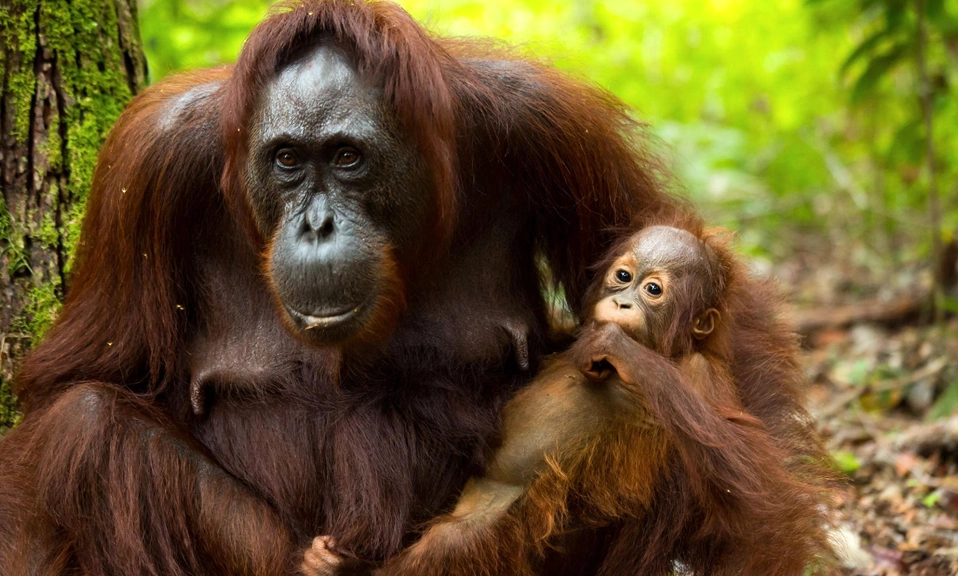
The group of eight consisted of three mother-and-offspring pairs and two adolescent males. Each had a story of survival against impossible odds.
Mama Nopi, Nopi, Naufal, and Nopan
Mama Nopi and her offspring were living in a coconut and rubber plantation when the fires hit. The surrounding forest was incinerated, cutting off their access to food and driving them closer to human settlements. Naufal and Nopan, two juvenile males, were part of the same group. Nopan was found with a body temperature of 40°C before receiving medical treatment and IV fluids.
They were rescued on September 4 from Pemangkat Village in North Kayong Regency.
Mama Lifa and Lifa
Mama Lifa and her baby, Lifa, were found isolated on a patch of acacia trees just 400 square meters in size — completely surrounded by oil palm plantations in Pelang Village, Ketapang District. They had nowhere to go. The forest around them was gone.
They were rescued in mid-September. Dental examinations estimated Mama Lifa’s age at about 15 years.
Mama Man and Man
Mama Man and her baby had been monitored by rescuers since June, when they were found living in a plantation area adjacent to a small patch of forest. Fires that spread near the site restricted their roaming area further, leaving them without a safe route to other forestry.
Mama Man, estimated to be around 20 years old, was sedated with a dart gun. Ten minutes later, she was evacuated to the YIARI rescue centre using a net. They were rescued on September 3.
The Journey: From Rescue Centre to Protected Forest
The eight orangutans were translocated on Friday, October 9, to the Batu Nyambu Protected Forest in Ketapang District, West Kalimantan.
The reserve spans 23,000 hectares and contains both primary and secondary forest cover. It was chosen after careful assessment of food availability, water sources, and ecological suitability. Crucially, it is connected to other forested areas — giving the orangutans room to roam and a chance to integrate into a wider population.
“We want to ensure that rescued orangutans are not simply moved from one place to another, but actually have a chance to survive in their natural habitat,” said Argitoe Ranting, YIARI’s operational director.
The translocation was not a simple release. Each orangutan underwent medical examinations and observation before being declared fit for release. For the mothers and their young, the journey meant sedation, transport, and the disorienting experience of waking up in an unfamiliar forest. For the two adolescent males, it meant leaving behind everything they had known.
But for all eight, it meant a second chance.
The Crisis They Escaped: A “Warning Shot” for the Species
The fires that drove these orangutans from their homes are part of a broader catastrophe.
The International Union for Conservation of Nature (IUCN) warned in September that wildfires were burning in habitats containing 52% of Borneo’s orangutan population. The fires were more intense this year due to El Niño, which has become the strongest on record and is expected to have a knock-on effect on the climate into 2027.
Experts have also pointed to slash-and-burn land-clearing practices as a major factor. Naturally fire-resistant forests have been replaced by less dense, more flammable vegetation, creating landscapes where fires spread faster and burn hotter.
The human cost has been severe: tens of thousands of cases of respiratory illness, and air pollution spikes in Singapore and Malaysia.
And the long-term threat to orangutans is existential. Around 104,000 orangutans remain in Borneo and Sumatra, down from more than 230,000 a century ago. A large portion of their remaining habitat will become inhospitable if climate change continues at its current pace.
“Protection of habitats will always be a top priority to ensure orangutans continue to have safe forests to live in,” said Karmele Llano Sanchez, CEO of YIARI. “But as long as their habitat remains threatened, rescue is one of the best options we can take to help them survive”.
What Comes Next
The eight orangutans are now in their new home. They will be monitored by YIARI and the forestry ministry to ensure they adapt to the reserve. For the mothers and their young, the transition may be relatively smooth — they have each other, and the forest provides the food and shelter they need. For the two adolescent males, the challenges are greater. They must learn to navigate unfamiliar terrain, find food, and avoid conflict with other orangutans.
But they are alive. They are safe. And they are free.
The rescue of these eight is a victory. But it is also a warning. The fires that drove them from their homes are still burning. The forests they left behind are still being cleared. The climate that fueled the blazes is still warming.
For now, the eight are home. For the species, the fight continues.