What’s Behind the EV Divide?
The Atlantic has never looked wider. In Europe, electric vehicles are surging to record market share, with buyers flocking to showrooms and charging networks expanding faster than the cars themselves. In the United States, EV sales have plummeted by nearly a third in a single year. Same technology. Same decade. Radically different outcomes.
The numbers tell a story of two markets moving in opposite directions. In the first nine months of 2026, EVs accounted for 23.2% of the European auto market, up from 17.7% a year earlier. In the United States, EVs made up just 6% of sales, down from 8.5% — a 30.7% year-over-year decline.
This isn’t a story about consumer preferences. It’s a story about policy, prices, and the political choices that shape them.
The Policy Chasm: Subsidies vs. Rollbacks
The single most important factor driving the divide is government policy — and the two regions have taken opposite approaches.
In Europe, governments have doubled down on EV support. Germany offers up to €6,000 in income-based subsidies. France provides up to €5,700. Italy leads with up to €11,000 depending on income and trade-in conditions. Spain offers up to €4,500 for EU-made cars. These aren’t token incentives. They’re substantial sums that bring EV prices within reach for middle-income buyers.
In the United States, the opposite happened. The $7,500 federal tax credit — the single most important financial lever for EV adoption — expired in September 2025. The Trump administration worked with Congress to eliminate support for EVs and watered down fuel-efficiency regulations. The result was immediate and dramatic: EV sales cratered, automakers cancelled models, and buyers turned elsewhere.
“There’s still demand out there [for EVs], but the energy and the masses are definitely running to hybrid technology,” said Thad Szott, a Detroit-area dealer.
The Price Gap: Affordable EVs vs. $50,000 Flagships
Europe’s EV boom isn’t just about subsidies. It’s about product availability.
In the first half of 2026, there were more than 150 EV models on sale in Europe, up from about 100 in 2024. Many are priced below €25,000 (approximately $28,000). Chinese automakers — BYD, MG, and others — have flooded the European market with affordable, well-equipped EVs that compete directly with petrol cars on price.
In the United States, the average new EV costs significantly more. High tariffs and a ban on Chinese-made vehicle software have effectively blocked Chinese car brands from the American market. Without that competitive pressure, American automakers have focused on high-margin trucks and SUVs, leaving the affordable end of the market underserved.
The result: in Europe, an EV is a practical choice for a middle-class family. In America, it’s often a luxury purchase.
The Fuel Price Factor: Pain at the Pump
Europe’s embrace of EVs has been accelerated by something Americans know well: expensive fuel.
The war in Iran sent European petrol prices soaring. By March 2026, the EU average petrol price had risen 12% to €1.84 per litre. Home-charged electric cars now cost 50% less to run than gasoline and diesel cars.
In the United States, gas prices also spiked — but the effect was different. Instead of driving buyers to EVs, it drove them to hybrids. Hybrid sales jumped 23% through the first three quarters of 2026, accounting for 15.6% of total sales. Hybrids are seen as a “safer choice” for consumers worried about range and charging infrastructure.
The Charging Infrastructure: Europe Is Ready, America Is Catching Up
Charging anxiety remains a barrier to EV adoption everywhere. But Europe has moved faster to address it.
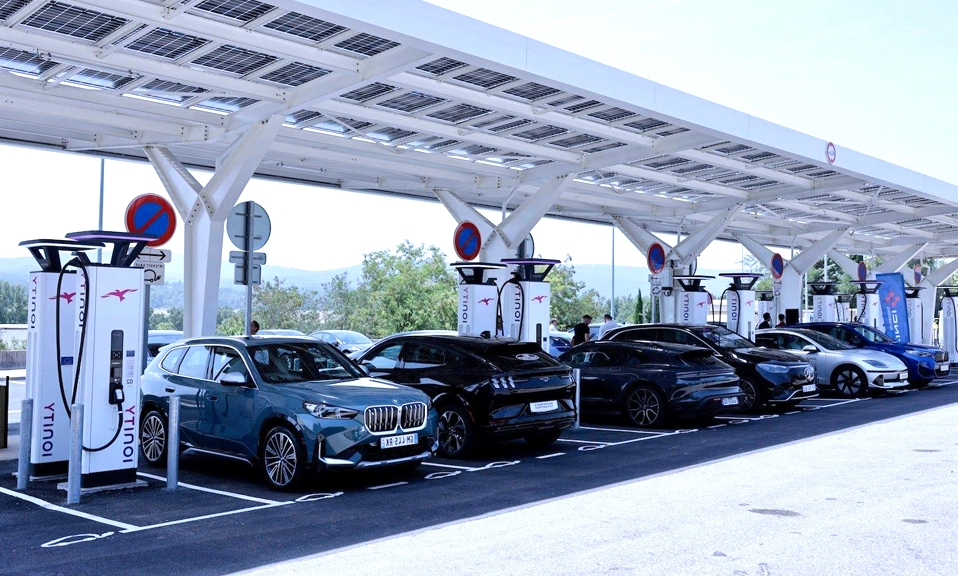
The EU now has approximately 1.16 million public charging points, with infrastructure growing faster than EV sales. By June 2026, 79% of the Core network — mainly motorways — had met the bloc’s ultra-fast charger targets. In Germany, 99% of the core network has achieved the target.
The United States has made progress — surpassing 250,000 charging ports in June 2026 — but the network is less dense and less reliable. For many Americans, especially those in rural areas or apartment buildings without home charging, the infrastructure simply isn’t there yet.
The Chinese Factor: A Flood vs. a Wall
One of the most significant differences between the two markets is the presence of Chinese manufacturers.
In Europe, Chinese EVs accounted for 14.2% of market sales in the first five months of 2026, despite EU tariffs. BYD, MG, and others have opened factories in Hungary, Spain, and Turkey, integrating into the European industrial ecosystem. They’ve brought prices down, forced European brands to compete, and expanded consumer choice.
In the United States, Chinese EVs are effectively banned. High tariffs and software restrictions have blocked them entirely. Without that competition, American consumers pay more and have fewer options. The EV market has become a luxury niche rather than a mass-market transition.
The Automaker Response: Diverging Strategies
The policy divide has reshaped corporate strategy on both sides of the Atlantic.
In Europe, automakers continue to roll out electric models to meet stringent tailpipe-emissions regulations. Stellantis, BMW, and Volkswagen are expanding their EV lineups. The regulatory pressure to electrify is non-negotiable.
In the United States, many automakers have discontinued electric models or scrapped plans for new ones. General Motors has “essentially no new EVs planned” and is shifting back to gas-powered vehicles. Ford’s EV sales dropped 68% through September, while GM’s fell 43%. Honda is ending EV production in the US and expanding hybrids instead.
The message from American automakers is clear: without policy support, EVs don’t make business sense at scale.
What This Means for the Future
The EV divide between Europe and America is not a temporary divergence. It’s a structural gap created by deliberate policy choices.
Europe has chosen to accelerate the transition through subsidies, regulation, and openness to competition. The result is a market where EVs are becoming the default choice — affordable, practical, and supported by infrastructure that’s growing to meet demand.
America has chosen a different path. Without federal support, with Chinese competitors blocked, and with automakers retreating to hybrids and gas-powered vehicles, the EV market has stalled. It’s not that Americans don’t want EVs. It’s that the policy environment has made them expensive, scarce, and risky.
The irony is that both markets face the same climate imperatives and the same technological trajectory. The difference is political will.
Europe is betting that electrification is inevitable. America, for now, is betting that it can slow down.
The road ahead is diverging. And the gap is only getting wider.