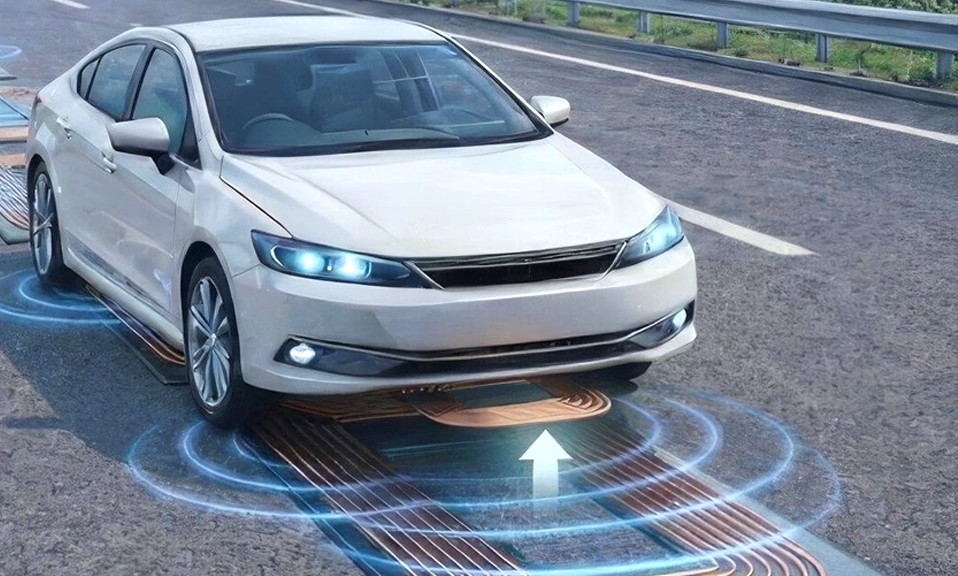
Imagine driving down the highway and watching your EV’s battery percentage climb instead of fall. No plugs, no cables, no stopping. That’s the promise of Honda’s dynamic wireless power transfer (DWPT) technology, and the company just moved it from the lab to the test track. But does it mean the end of the charging station? Not quite — at least not yet.
Honda’s Bold Bet: Charging Roads, Not Just Cars
On October 5, 2026, Honda R&D, in partnership with construction giants Taisei Corporation and Taisei Rotec, announced it had developed the underlying technology for a “magnetic coupling wireless power transfer road system” — essentially, roads that wirelessly charge electric vehicles as they drive over them.
The system is not a vague concept. Honda has been working on DWPT since 2021, and the three companies have been jointly developing the road-integrated version since 2025. Testing is scheduled to move to public roads in Japan from the 2027 fiscal year (starting April 1, 2027) , with a 300-metre trial section on the E14 Tateyama Expressway in Chiba Prefecture.
The first target isn’t passenger cars. It’s logistics and commercial trucks — vehicles that rack up huge mileage and where eliminating charging stops could meaningfully improve fleet efficiency.
How It Actually Works (No Magic, Just Physics)
The technology is an extension of the same principle behind wireless phone charging, scaled up to handle up to 150 kW of instantaneous peak output per ground unit.
Here’s the chain:
Transmitter coils (Ground Assembly, or GA) are embedded in the road surface. A DC power supply feeds them, and a resonant capacitor tunes the coils to a specific frequency.
An alternating current flows through the coils, generating a magnetic field.
A receiver coil (Vehicle Assembly, or VA) mounted on the underside of the car picks up that magnetic field and converts it back into electricity, which charges the battery.
The key is resonance — the same phenomenon that causes one tuning fork to vibrate when another is struck nearby. Because the coils on both sides are tuned to resonate at the same frequency, power can be transferred efficiently even when there’s a gap between the road and the vehicle, and even when the vehicle’s position shifts slightly as it moves.
Crucially, no electricity is “flying” through the air. The energy is transmitted via the magnetic field, not through a conductive arc.
The Testing Gauntlet: Durability, Safety, and Speed
Honda isn’t rushing this to market. Before any public-road demo, the system has to survive brutal testing.
A new test track at Taisei’s T-FIELD/TAMURA site is planned for late 2026. There, real vehicles will put the embedded equipment through 1 million wheel-load cycles at 11,000 pounds per wheel — a simulation of years of heavy-truck punishment compressed into a shorter period.
Engineers will also measure electromagnetic-field leakage at that site. Any road that moves this much power into a vehicle has to pass strict safety checks before it can open to regular traffic.
And there’s the speed question. Later trials will raise power output to 150 kW and test whether the system can keep charging while a vehicle runs at highway speed — because power level and speed together determine whether this works for real-world trucks or only for slow test vehicles.
The Big Question: Do Charging Stations Become Obsolete?
The short answer is no — not in the foreseeable future. But the long answer is more interesting.
Honda itself frames DWPT as a way to reduce the frequency of charging stops, not eliminate them entirely. The company says the technology “could reduce the need for EV drivers to stop at charging stations, while also allowing automakers to use smaller battery packs”.
That last point is crucial. If you can charge while driving, you don’t need a 100 kWh battery to conquer range anxiety. A smaller, lighter, cheaper battery becomes viable — and that could lower the cost of EVs across the board.
But DWPT is not a replacement for home charging or destination charging. You still need to charge when you’re parked. You still need infrastructure for areas not equipped with embedded coils. And you still need a baseline charging network for the vast majority of roads that will never have this technology.
Plug-in chargers are unlikely to disappear if DWPT becomes a reality, but drivers might not need to visit them quite as often.
The Challenges: Cost, Efficiency, and Scale
The technology is real. The road to widespread adoption is steep.
Cost is the elephant in the room. Embedding transmitter coils, DC power systems, and control electronics into road pavement is enormously expensive. Road-installation cost and long-term maintenance “still have to pencil out before anyone talks about wider use”. One analysis of electrified roadway systems identified high capital costs as a major obstacle, alongside urban spatial constraints and grid capacity limitations.
Efficiency trails conductive charging. Wireless power transfer is less efficient than plugging in, particularly over large air gaps and when coils are misaligned. The challenge of “achieving high transfer efficiency during vehicle motion” is explicitly identified in the research literature as a key hurdle.
Standards are missing. There is currently no standardized protocol for dynamic wireless charging, which means interoperability between different vehicle manufacturers and road operators is unresolved.
And it’s not a solo effort. Honda is not alone in this space. Electreon has tested wireless charging on a motorway near Paris with peak power transfer exceeding 300 kW. Detroit has a public wireless charging road. Stellantis has tested inductive charging on a dedicated track in Italy. The UK has explored similar electric highway technology. Honda’s contribution is real, but the race is global.
Honda’s DWPT technology
is not a fantasy. It’s a working system with a clear testing roadmap, a credible industrial partnership, and a defined first market — commercial logistics. The physics is sound, the engineering is impressive, and the potential benefits for fleet operators are significant.
But charging stations are not about to vanish. They will remain the backbone of EV infrastructure for decades, because most roads will never have embedded coils, because cost and efficiency challenges are formidable, and because you still need to charge when you’re not driving.
What DWPT offers is something more subtle: a future where charging is less of a chore and more of a background process. A future where you don’t plan your journey around charging stops, because the road itself is part of the charging network. A future where the battery in your car can be smaller, lighter, and cheaper, because it doesn’t have to carry all the energy you’ll ever need.
Honda’s charging road won’t make charging stations obsolete. But it might make them less central to the EV experience. And that, in itself, is a revolution worth watching.