Forget the Hero You Think You Know
Robin Hood has been portrayed as a charming outlaw, a noble archer, a merry bandit and a romantic folk hero. Hugh Jackman’s new film asks what happens when the legend is stripped of all those comforting descriptions.
The Death of Robin Hood, written and directed by Michael Sarnoski, presents Robin as an aging, wounded man whose life has been defined by crime, murder and violence. After surviving a battle that he expected to be his last, he is taken in by a mysterious woman who offers him a chance at salvation.
The film is not interested in repeating the familiar story of robbing the rich and giving to the poor. It is an R-rated period drama about a violent man confronting the damage he has done and wondering whether redemption is still possible when his legend has become more famous than his humanity.
A24 released the film in theaters on June 19, 2026. It is now listed on HBO Max, where it is presented as a 2026 drama and action film starring Jackman, Jodie Comer, Bill Skarsgård, Murray Bartlett and Noah Jupe.
This Robin Hood is not a hero at the beginning
The central change is moral rather than cosmetic.
In many familiar versions, Robin Hood begins as someone the audience is expected to admire. He may be a rebel against corrupt authority, an expert archer or a charismatic leader of the Merry Men. The story usually gives viewers a reason to cheer before the adventure begins.
Sarnoski’s film starts somewhere much harsher. The director describes Robin as a wanted, aging marauder who has killed in order to survive. The opening takes place in 1247 on the Celtic fringe, where combat is presented not as polished chivalry but as brutal, muddy survival.
That means the movie asks viewers to look at Robin before the myth has softened him. He is not an elegant outlaw moving through a storybook forest. He is a worn-down man shaped by years of violence.
The film’s premise is built around a difficult question: if a person has spent a lifetime causing harm, is a final opportunity for compassion enough to change what that life means?
Michael Sarnoski goes back to the darker source material
Sarnoski’s approach is partly inspired by the 17th-century ballad Robin Hood’s Death, which treats the character’s final days in a more intimate and human way than many modern adaptations.
The director has said that he grew up with the Disney version of Robin Hood and later encountered the darker ballad while dealing with the loss of his father. The contrast between the animated folk hero and the story of a man dying quietly became the starting point for his own interpretation.
That background helps explain why The Death of Robin Hood is not simply a gritty remake of an older movie. Sarnoski is interested in the gap between folklore and mortality.
The legend says Robin Hood is larger than life. The ballad reminds us that the man eventually dies. The film uses that tension to ask what happens when an immortal cultural image is forced to confront an ordinary body, an exhausted mind and an irreversible past.
Jodie Comer is the counterpoint to Jackman’s violence
Jodie Comer plays Sister Brigid, the woman who cares for Robin after he is gravely injured. She is not merely a healer who keeps the hero alive long enough for the plot to continue.
Sister Brigid represents a completely different way of organizing life. Robin has built his world around violence, fear and survival. Brigid has built a community around care, order and human connection.
The film does not treat her as a simplistic saint. Variety reports that Sarnoski wanted to move away from earlier versions of the character as an “evil nun” and instead portray Brigid as compassionate, wise and capable of creating a world based on love.
That gives the relationship its central tension. Brigid is not only nursing Robin’s wounds. She is confronting the worldview that made those wounds—and his violence—seem inevitable.
She also has a personal reason to distrust him. The film reveals that Brigid must contend with Robin’s role in the death of her own family.
Their relationship therefore cannot be reduced to a romance or a simple redemption partnership. She is caring for a man whose life has caused pain to people like her. Any possibility of salvation must pass through that history rather than erase it.
Hugh Jackman disappears into an older Robin Hood
Jackman is best known for combining physical intensity with warmth. That combination made him an enduring Wolverine, but it also creates an unusual tension in this film.
Sarnoski knew Jackman could play the aggressive and violent side of Robin. He also wanted the character’s moments of kindness to feel real. That contrast is central to the movie’s idea of redemption: a brutal man may still contain traces of the person he could have been.
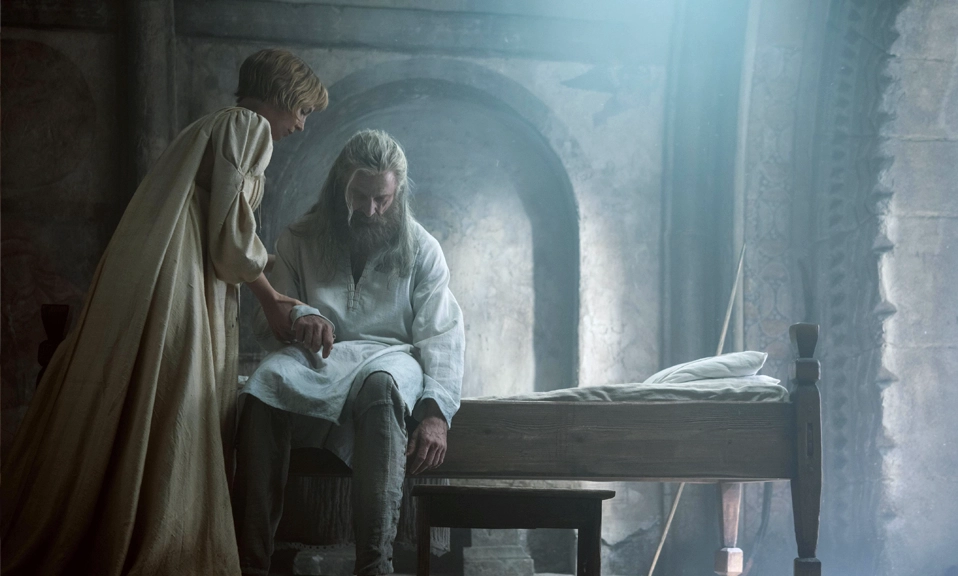
The visual transformation is substantial. Jackman appears with long silver-gray hair, a beard and a face that has been weathered by age and violence. Variety reports that the hair and costume departments deliberately wanted to make him difficult to recognize as the actor audiences normally see.
The costuming follows Robin’s psychological journey. Early in the film, he is described as a hermit emerging from the landscape, wearing layered skins and rough materials that suggest what he could have found, stolen or fashioned in the wilderness. One of his fur coats weighed roughly 200 pounds.
Later, at the priory, his appearance becomes cleaner and less defensive. The clothes are shaped by the community caring for him, and the costume design begins to reflect the possibility that Robin might become part of a world not built around combat.
The physical change is therefore part of the storytelling. Robin does not simply put on a new costume. He moves from being an animal-like survivor to someone being asked to become human again.
The opening deliberately makes Robin Hood difficult to watch
Sarnoski has said that he wanted the first act to disturb the audience. The violence is meant to be unpleasant rather than triumphant.
That is a direct rejection of the swashbuckling tradition. In a conventional adventure, action proves the hero’s skill. In The Death of Robin Hood, action exposes the moral and physical cost of a life spent killing.
The film’s opening battles are set in mud, darkness and exhaustion. There is no clean separation between good fighters and bad fighters. People are simply trying to survive long enough to hurt each other again.
The effect is to remove the protective distance that often surrounds historical adventure stories. Medieval combat is not presented as a colorful pageant of banners and heroic poses. It is presented as bodies colliding in terrible conditions.
The violence also establishes why Robin needs to change. He is not looking for redemption because he has made one mistake. He has reached the end of a system of life that has consumed him.
Little John is not the familiar loyal companion
Bill Skarsgård plays Little John, Robin’s former companion. Their relationship is not presented as the uncomplicated friendship associated with many versions of the legend.
Little John is connected to the encounter that leaves Robin near death, and the film treats their history as part of Robin’s unresolved past. That makes the character less like a cheerful member of the Merry Men and more like someone who knows exactly what Robin has become.
Skarsgård’s casting also reinforces the film’s interest in damaged and physically transformed bodies. The actor has previously made a specialty of disappearing into unsettling roles, and his Little John belongs to a world far removed from the cleanly drawn sidekick of an adventure serial.
Their confrontation is important because Robin’s greatest danger does not come only from strangers. It comes from people who remember the man he was before the legend made him difficult to reach.
The priory changes the movie’s shape
The first part of the film is built around survival and brutality. Once Robin is brought to the priory, the story becomes more meditative.
That shift is not an escape from the violence. It is an examination of what violence has done.
At the priory, Robin has to live among people who do not know him as a heroic outlaw. They see a dangerous, damaged man who needs care. Some may pity him. Others may fear him. Still others may have their own reasons for wanting him to suffer.
The change in setting also changes the film’s visual language. The early landscape is dominated by bleak browns, grays, mud and combat. The priory introduces more natural light and a different visual rhythm, but the story does not become sentimental. Robin’s past follows him into the place that is supposed to heal him.
Sarnoski’s films often focus on solitary figures who have reached an emotional impasse and then encounter a possibility of connection. Pig centered on a withdrawn man whose life begins opening again through human relationships. The Death of Robin Hood follows a similar structure, but places it inside a violent medieval legend.
This is a film about legacy, not just redemption
The word “redemption” can make a story sound simple. A bad person recognizes the error of his ways, performs one noble act and earns forgiveness.
The Death of Robin Hood is more complicated. Robin’s problem is not just that he has done bad things. It is that his entire identity has been built around those things.
He is a legend because he is violent. The stories told about him may leave out the suffering he caused. Even his name has become larger than the people he killed and the communities he damaged.
That is why the film’s concern with legacy matters. Robin is not only asking whether he can live differently. He is confronting what people will remember when he is gone.
Will he be remembered as a hero? A criminal? A survivor? A monster? Or simply a dying man who finally understood what his life had cost?
The title signals that the film is interested in the end of the legend, but the deeper story may be about whether a person can exist beyond the story told about him.
Why the film needed to be an indie production
Sarnoski has emphasized that audiences may expect a large-scale epic because the project involves Robin Hood, medieval battles and Hugh Jackman. But he describes the film as an independently made production with a controlled budget and an intentionally focused scale.
That decision suits the material. A studio epic might have emphasized castles, armies, elaborate action and the familiar iconography of the legend. An independent production can spend more time with the wounded person inside the myth.
The film was shot in Northern Ireland, largely on location, during harsh winter conditions. Production lasted about 30 days, which is a short period for a movie involving battle scenes, mud, fire, stunts and multiple historical settings.
The limitation becomes part of the aesthetic. The landscape feels physical because the actors and crew were working in real weather and real terrain. The movie’s world is not polished into a fantasy kingdom. It is wet, cold, unstable and difficult to control.
Jackman reportedly told Sarnoski that he had not made a film in such a short period since his first independent movie in Australia nearly three decades earlier.
That compressed production schedule also required trust. The cast had to move quickly between action and emotionally intense scenes, sometimes from a battle sequence one day to a quiet dramatic scene the next.
How critics have responded
The critical response has focused on the film’s refusal to make Robin comforting.
Deadline described the opening as a deliberate destruction of the heroic tradition and praised the film for making Jackman’s Robin a “wreck of a human being” before turning toward the possibility of empathy.
Rotten Tomatoes’ published consensus likewise describes the film as a grim, ultraviolent version of the legend that succeeds in exploring the complicated humanity behind a folk hero, even if it could use more levity.
That response suggests the film’s biggest strength and biggest risk are the same thing. Its seriousness gives the story weight, but its brutality and meditative pace may challenge viewers expecting a fast-moving outlaw adventure.
This is not Robin Hood as a comfort watch. It is closer to a character study that uses the legend as a framework for examining violence, guilt and the desire to become someone else before death arrives.
What Hugh Jackman’s film changes about the legend
The traditional Robin Hood is often defined by what he gives: money, justice, hope or resistance to tyranny.
Sarnoski’s Robin is defined first by what he has taken. He has taken lives, trust and perhaps the possibility of a peaceful future. The story begins after the heroic interpretation has failed.
That reversal changes the role of every familiar element. The forest becomes a place of hiding rather than adventure. The bow becomes a weapon rather than a symbol of skill. Little John becomes part of a violent past rather than a source of comic loyalty. The healer becomes a moral challenge rather than a supporting love interest.
Most importantly, Robin’s final act is not about winning. It is about deciding what kind of person he can be when there is no longer time to build a new life from scratch.
Is this the Robin Hood story viewers expect?
No—and that is the point.
The film is not designed to replace the lighter versions. The Disney fox, Errol Flynn’s swashbuckler, Kevin Costner’s action hero and other interpretations will continue to exist. The Death of Robin Hood adds a different chapter to the tradition by asking what the legend looks like after the adventure is over.
Sarnoski’s film is a dark, grounded and sometimes punishing reimagining. It uses the final chapter of Robin Hood’s story to question the idea that a charismatic outlaw is automatically a good man.
Hugh Jackman’s performance anchors that experiment. He brings the physical authority needed to make Robin frightening, but also enough vulnerability to make the possibility of change believable. Jodie Comer gives the film its moral counterweight, offering care without pretending that care can erase the past.
The result is not a celebration of Robin Hood as a hero. It is an examination of why people need heroes—and what happens when the man behind the myth can no longer live up to the story.
Forget the Robin Hood who rides through the forest with a grin and a perfect shot. This version is older, bloodier and far less certain that he deserves to be remembered at all.