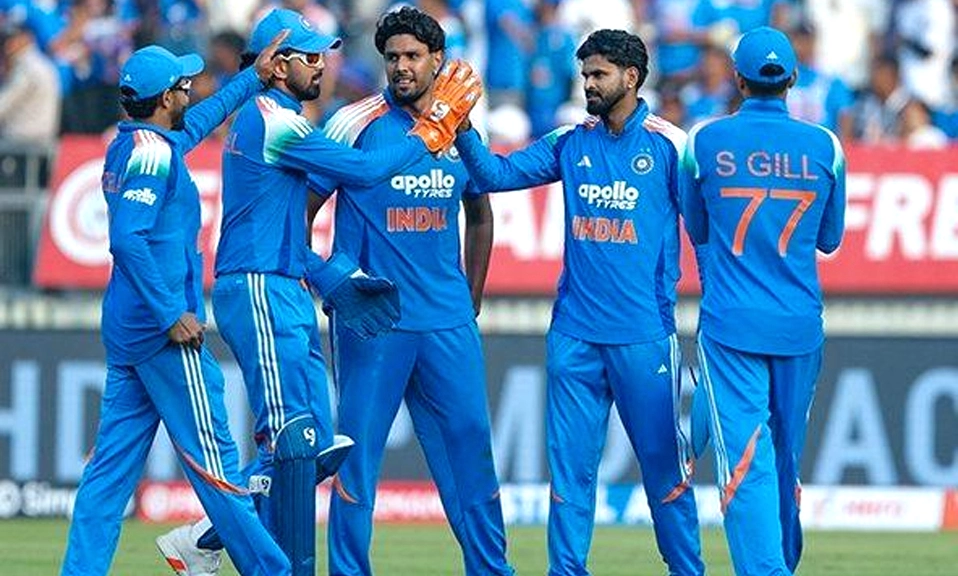
AUCKLAND — The first ODI between India and New Zealand at Eden Park was never going to be a straightforward contest. Rain was forecast, the pitch had pace and bounce, and both sides were using the series as preparation for the 2027 World Cup. What unfolded on Wednesday was a match that was decided not by a single moment of brilliance, but by a combination of relentless seam bowling, a masterful chase from Virat Kohli, and the cold, unforgiving mathematics of the Duckworth-Lewis-Stern method.
India won by five wickets, taking a 1-0 lead in the five-match series. But the scorecard—India 143 for 5 (22.4 overs) beat New Zealand 185 (40.2 overs) by 5 wickets (DLS)—only begins to tell the story.
The Foundation: India’s Seamers Dismantle New Zealand
Shubman Gill won the toss and elected to bowl, a decision that proved inspired. On a surface offering considerable assistance to the seamers, India’s four-pronged pace attack—Arshdeep Singh, Gurnoor Brar, Anshul Kamboj, and the returning Mohammed Siraj—were relentless.
New Zealand never settled. Tim Seifert top-scored with 38, but no other batter passed 30. Daryl Mitchell made 28, Glenn Phillips 30, and the lower order offered little resistance until Blair Tickner produced a late flourish of 34 off 23 balls, including four sixes, to drag the hosts to 185.
Arshdeep Singh was the chief destroyer, claiming 4 for 70 in his 10 overs. He used the short ball to unsettle Will Young and Henry Nicholls, both of whom top-edged attempted pull shots. Gurnoor Brar picked up three wickets, including the crucial scalp of Seifert, while Anshul Kamboj—preferred over the experienced Mohammed Siraj—was arguably the standout, finishing with figures of 2 for 22 in 10 overs, extracting seam movement right until his final spell.
The fielding matched the bowling’s intensity. Rohit Sharma produced a superb diving run-out to dismiss Mitchell, and Kohli, a day short of his 38th birthday, pulled off a stunning one-handed catch at second slip to remove Nathan Smith. New Zealand were bowled out in 40.2 overs, and India’s decision to bowl first had been fully vindicated.
The Rain: DLS Rewrites the Target
India’s chase began badly. Rohit Sharma fell for a duck in the first over, unable to keep an off-drive down. Axar Patel also departed without scoring, and at 64 for 1 after 12 overs, the visitors were rebuilding.
Then the rain came. Twice. The first interruption halted play with India at 64 for 1. When the players returned, the target was revised to 143 in 32 overs under the Duckworth-Lewis-Stern method. A second delay followed, but the revised target remained achievable, and the reduced overs gave India a clear equation: 79 runs needed from 20 overs, with nine wickets in hand.
The Chase: Kohli Makes a Difficult Pitch Look Easy
The conditions that had made batting look like hard work for everyone else seemed to have no effect on Virat Kohli. While Shubman Gill laboured to 37 off 56 balls, Kohli operated on a different plane.
His 74 off 51 balls was an innings of controlled aggression. He took on the short ball with disdain, repeatedly pulling Tickner and the other New Zealand seamers to the boundary. He struck 13 fours and a six, manipulating the field and refusing to let the required rate climb. His partnership with Gill was worth 113 runs, the foundation of the chase, and by the time he fell, India were within touching distance of the revised target.
Naman Dhir struck the winning runs, and India reached 143 for 5 in 22.4 overs, with 56 deliveries to spare. It was a victory built on the bowlers’ discipline in the first innings and sealed by the composure of the former captain in the second.
What It Means for the Series
The win gives India a 1-0 lead in a series that serves as crucial preparation for the 2027 World Cup. The performance of the seamers—particularly Kamboj and Gurnoor Brar—was a reminder of the depth India have built in their pace attack. The decision to leave out Mohammed Siraj, one of the most experienced bowlers in the squad, and still bowl out New Zealand for 185 is a statement of intent.
For New Zealand, the defeat raises familiar questions. Their batters struggled against high-quality seam bowling, and the late collapse—losing their last five wickets for 39 runs—undid the work of the top order. The return of Kane Williamson and the inclusion of Mark Chapman and Rachin Ravindra, both of whom were ruled out of the series through injury, cannot come soon enough.
The second ODI is in Wellington on Saturday, and New Zealand will need a response. India, meanwhile, will travel south with a spring in their step and a blueprint for how to win in these conditions: bowl first, bowl fast, and let Kohli do the rest.