Could They Rewrite the Story of Cosmic Origins?
They are small. They are red. They are everywhere. And they shouldn’t exist.
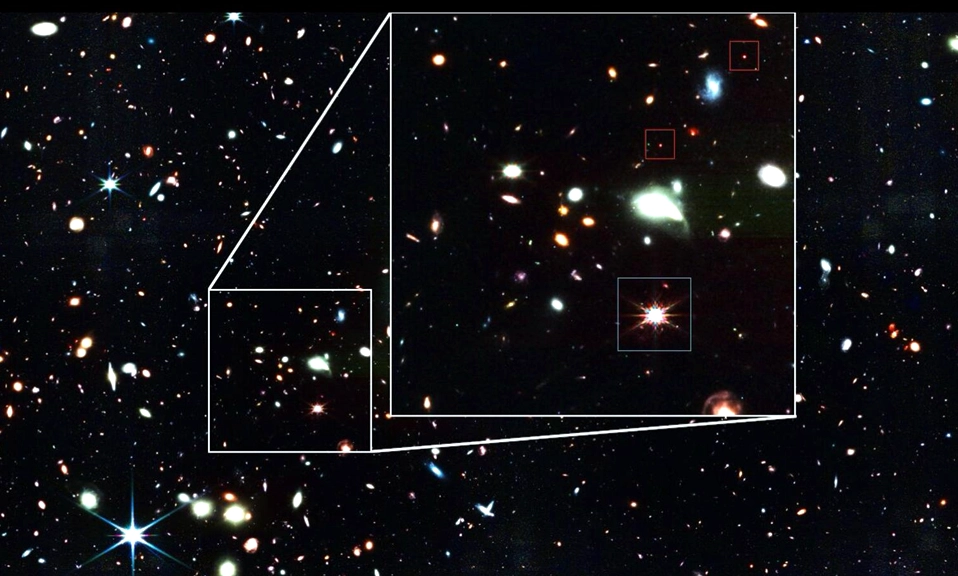
When the James Webb Space Telescope (JWST) began sending back its first images in 2022, astronomers expected to see the familiar architecture of the early universe: young galaxies, primordial stars, the faint glow of a cosmos still forming. What they found instead were hundreds of tiny, crimson pinpricks scattered across the deep field—objects so compact, so bright, and so ancient that they seemed to break the fundamental rules of how galaxies and black holes are supposed to grow.
Astronomers called them “little red dots” (LRDs). And for four years, nobody could agree on what they were.
Now, after a relentless international effort involving the world’s most powerful telescopes, sophisticated supercomputer simulations, and some of the sharpest minds in astrophysics, a consensus is finally emerging. The little red dots aren’t “universe breakers” or exotic new physics. They are the missing link in the story of how supermassive black holes—including the one at the center of our own galaxy—came to be.
The answer is stranger and more elegant than anyone predicted.
The Discovery That Broke the Models
The story begins in February 2023. A team led by Ivo Labbé of Swinburne University of Technology was analyzing some of JWST’s first deep-field data when they spotted something unexpected: 13 bright red blobs of light.
When they used the objects’ brightness to estimate their mass and their color to estimate their distance, the results were baffling. Six of the dots appeared to be nearly as massive as the Milky Way galaxy—yet they existed within the first 600 to 700 million years of the universe.
That was a problem. According to every model of galaxy formation, a galaxy the size of the Milky Way cannot possibly assemble itself that quickly. The universe was simply too young. Too hot. Too chaotic. The team called them “universe breakers”.
“We had a lot of sleepless nights,” Labbé told National Geographic. “The story didn’t add up”.
By 2026, astronomers had catalogued nearly 1,000 little red dots, and theories about their nature had proliferated wildly. Some suggested they were massive galaxies. Others proposed they were dust-shrouded black holes. A few even speculated that they were evidence of new physics—something entirely unknown to science.
None of the explanations quite worked.
The Breakthrough: Black Holes in a Cocoon
The first major breakthrough came in January 2026, when researchers at the University of Copenhagen’s Cosmic Dawn Centre published a study in Nature that appeared on the journal’s front cover.
After two years of continuous analysis, the team concluded that the little red dots were young black holes, a hundred times less massive than previously believed, enshrouded in a dense cocoon of ionized gas—gas they are actively consuming in order to grow.
The process, they explained, generates enormous heat. That heat shines through the gas cocoon, and it is this radiation escaping through the gas that gives the little red dots their distinctive crimson color.
“When gas falls towards a black hole, it spirals down into a kind of disk or funnel towards the surface of the black hole,” said Professor Darach Watson, one of the lead researchers. “It ends up going so fast and is squeezed so densely that it generates temperatures of millions of degrees and lights up brightly. But only a very small amount of the gas is swallowed by the black hole. Most of it is blown back out from the poles as the black hole rotates. That’s why we call black holes ‘messy eaters'”.
The discovery was a revelation. It meant that the little red dots were not anomalies. They were a previously unknown phase in the life cycle of supermassive black holes—a phase that occurred in the early universe when conditions were so dense and so gas-rich that black holes could grow at rates that would be impossible today.
“They are far less massive than people previously believed,” Watson said. “So we do not need to invoke completely new types of events to explain them”.
The Simulations That Confirmed It
The Copenhagen team’s conclusion was compelling. But it needed confirmation. That came in September 2026, when a research team led by Sunmyon Chon at the Max Planck Institute for Astrophysics published the most detailed cosmological simulations to date, using the Japanese supercomputer ATERUI III.
Their simulations started with the conditions surrounding a galaxy in the early universe, then zoomed in to individual gas clouds. What they found was a chain of events that explained everything.
In the early universe, intense far-ultraviolet radiation from nearby galaxies suppressed star formation in gas clouds. Rather than forming many small stars, the gas collapsed into a single, supermassive star, which then collapsed into a black hole seed.
Once formed, these black hole seeds were surrounded by dense gas disks. This environment trapped radiation, enabling the black holes to grow at rates dozens of times faster than would be possible in the modern universe.
The simulated properties of these rapidly growing black holes provided a precise match to the little red dots observed by JWST.
The answer, the researchers noted, was “deceptively simple”—a natural consequence of the conditions in the early universe, requiring no exotic assumptions or chance accidents. This was crucial for explaining why little red dots are so ubiquitous. If they required special circumstances, they would be rare. Instead, they are everywhere—because in the early universe, they were inevitable.
The “Black Hole Star” and the Host Galaxy
While the black hole explanation gained ground, a parallel line of research was uncovering another layer of the puzzle: the host galaxies in which these little red dots reside.
In August 2026, a study published in Nature Astronomy combined JWST images of 217 little red dots to reveal faint optical emission—light extending beyond the central objects that could not be detected in individual images.
Modelling of the data indicated that this emission likely comes from star-forming galaxies, with the little red dots residing at their centers as supermassive black holes. These galaxies had average radii of just 210 parsecs (about 685 light-years)—making them about 2.5 times more compact than other star-forming galaxies of similar mass from the same cosmic era.
The findings suggested that little red dots are not simply single points of light. They exist within compact, dense star-forming galaxies that serve as the nurseries for their black holes.
Meanwhile, in June 2026, a team led by Vasily Kokorev at the University of Texas at Austin identified a particular little red dot—GLIMPSE-17775—whose spectrum provided the strongest evidence yet for the “black hole star” scenario.
The object’s spectrum, captured over 30 hours of JWST time and amplified by gravitational lensing, revealed more than 40 spectral lines—the most detailed LRD spectrum to date. When the team analyzed the data, they found multiple lines of evidence all pointing to the same conclusion: GLIMPSE-17775 is a supermassive black hole enveloped in a dense cocoon of partially ionized gas.
“I think part of the scientific community is converging on a singular picture—that little red dots can be explained by black hole star models,” Kokorev said. “But none of the previous little red dots have all of the pieces of evidence in the same place. With GLIMPSE-17775, we can test these models because of how deep and amazing this source’s spectrum is”.
Why This Matters: Rewriting the Story of Black Hole Growth
The little red dots are more than a curiosity. They are the key to one of the biggest unanswered questions in astrophysics: How did supermassive black holes grow so large so quickly?
At the center of the Milky Way sits a supermassive black hole four million times the mass of the Sun. The same is true of virtually every massive galaxy. But how did these behemoths form? And how did they grow so massive in the first billion years of cosmic history, when the universe was still a fraction of its current age?
The little red dots answer this question. They are the first stages of supermassive black hole growth—a phase when black holes could feed at rates that would be impossible today because the early universe was so much denser and more gas-rich. Once the universe expanded and thinned out, that phase ended. The little red dots disappeared—exactly as observed.
The discovery also has implications for how galaxies and black holes co-evolve. The compact star-forming galaxies that host LRDs suggest that black hole growth and galaxy formation are more intimately linked than previously understood. The black hole isn’t just a passive resident at the galaxy’s center. It’s an active participant in shaping the galaxy’s evolution.
The little red dots are no longer a
mystery. They are a discovery—one of the most significant of JWST’s short but extraordinary career.
But the work is far from over. Astronomers are still studying the full population of nearly 1,000 known LRDs, analyzing their spectra, and refining their models. The next generation of telescopes—including the Nancy Grace Roman Space Telescope and the Extremely Large Telescope—will be able to survey these objects in greater detail, probing deeper into the early universe and revealing the full story of how black holes and galaxies grew together.
What astronomers have learned so far is both humbling and exhilarating. The universe, it turns out, was even stranger and more dynamic in its infancy than anyone imagined. And the little red dots—those tiny, crimson pinpricks scattered across JWST’s deep fields—were the clue that unlocked the mystery.
They weren’t “universe breakers.” They were the universe’s first black holes, growing up.
And in their brief, brilliant existence, they left behind a record of the violent, chaotic, and beautiful processes that shaped everything we see around us today.