Imagine living your entire life without ever touching the ground.
No walking, no running, no standing on solid earth. For the vast majority of their lives, orangutans experience the world exclusively from 100 feet in the air, suspended in the dense, emerald canopy of the Southeast Asian rainforest.
They are the largest habitually arboreal (tree-dwelling) primates on Earth.
But they are not just surviving up there; they are thriving. Through millions of years of evolution, they have become master architects, acrobats, and geniuses of the canopy.
Yet today, this breathtaking treetop existence is under siege. Here is a look at the extraordinary biology of the orangutan, the genius of their canopy culture, and why their world is rapidly disappearing.
🌳 Anatomy of a Canopy Acrobat
To live life without ground, you have to be built for it. The orangutan’s body is a masterpiece of biological engineering, perfectly tailored for a three-dimensional world of swinging branches and fragile foliage.
- The 2-Meter Wingspan: An adult orangutan’s arm span can reach up to 2 meters (over 6.5 feet), which is significantly longer than their standing height. This allows them to bridge gaps between trees with effortless grace.
- Hook-Like Hands and Feet: Their long, curved fingers and toes act like natural grappling hooks. Combined with highly flexible shoulder, wrist, and ankle joints, they can hang by a single arm while reaching for fruit with the other.
- Branch Engineering: Orangutans don’t just climb; they calculate. Research shows they employ unique strategies to test and control the flexibility of branches before committing their massive body weight to them, preventing catastrophic falls.
- Nests in the Sky: Every single night, an orangutan builds a new, comfortable sleeping nest high in the canopy, weaving branches and lining them with soft leaves. They are the only great ape to build a new bed every single night.
🧠 The Genius of the Canopy
For a long time, chimpanzees were considered the undisputed geniuses of the ape world. But modern primatology has revealed that orangutans possess a quiet, profound intelligence that rivals, and in some ways exceeds, their African cousins.
Because they live solitary or semi-solitary lives in the trees, their intelligence manifests differently. It’s not about complex group politics; it’s about individual problem-solving and cultural transmission.
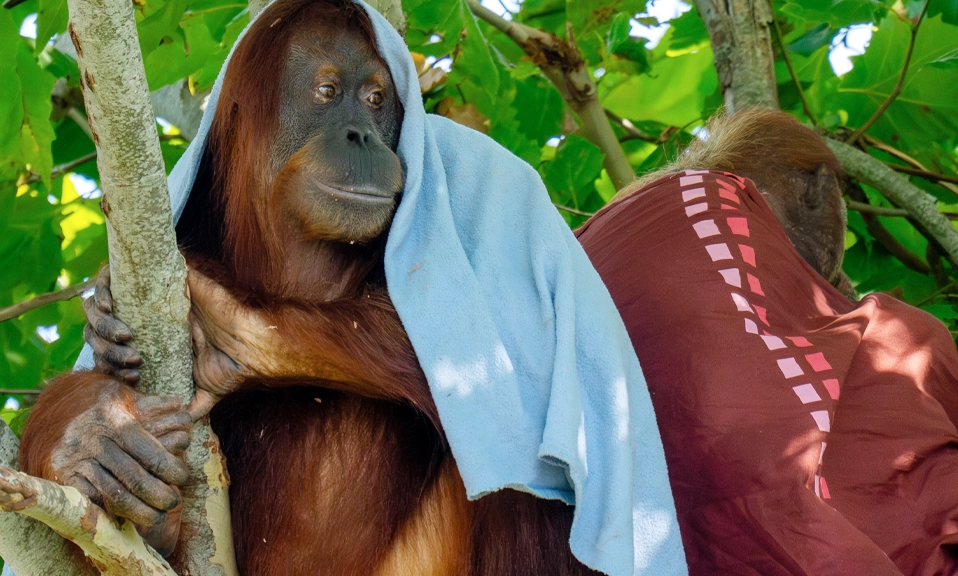
Master Tool Users: Orangutans have been observed using sticks to extract honey from tree hollows, using leaves as “gloves” to handle spiky fruits, and even holding large leaves over their heads as umbrellas during tropical downpours.
The Ultimate Apprenticeship: An orangutan mother will carry her infant everywhere for up to five years, teaching them every survival skill: which plants are medicinal, how to build a sturdy nest, and how to crack open tough nuts. This knowledge is passed down through generations, creating distinct “cultures” of tool use in different forests.
Deception and Empathy: In captivity and the wild, they have demonstrated advanced social intelligence, including the ability to deceive, mediate conflicts, and show clear signs of empathy and intention.
🌿 The Gardeners of the Forest
Orangutans are not just residents of the rainforest; they are its primary engineers.
As frugivores (fruit-eaters), they consume massive amounts of fruit and travel vast distances through the canopy. The seeds they swallow pass through their digestive system and are deposited miles away, fertilized and ready to grow.Without orangutans, the rainforest’s ability to regenerate would collapse. They are quite literally the gardeners of one of the most biodiverse ecosystems on the planet.
⚠️ The Ground is No Longer Safe
For an orangutan, the forest floor is traditionally a place of vulnerability, visited only occasionally by large, dominant “flanged” males traveling between forest patches.
But today, the ground represents an existential threat.
The Bornean and Sumatran orangutans are classified as critically endangered.
The single greatest driver of their decline is the rampant destruction of their habitat for agricultural expansion, most notably palm oil plantations.
Every minute, acres of ancient, carbon-rich rainforest are bulldozed and burned to make way for monoculture crops. When the trees fall, the orangutans have nowhere to go. They are forced to the ground, where they are vulnerable to poaching, human-wildlife conflict, and starvation.
Recent reports continue to expose illegal deforestation in critical orangutan habitats, proving that the emergency is far from over.
🛑 How You Can Help (Yes, Really)
It’s easy to feel helpless when facing global deforestation, but consumer choices have real, measurable power. Here is how you can protect the canopy:
- Demand Sustainable Palm Oil: Palm oil is in nearly 50% of packaged supermarket products (from shampoo to peanut butter). Boycotting it entirely can sometimes shift demand to less efficient crops that require more land. Instead, look for the RSPO (Roundtable on Sustainable Palm Oil) certification label, which ensures the product was sourced without destroying primary forests or harming wildlife.
- Reduce, Reuse, Recycle: The demand for paper, timber, and mineral extraction also drives deforestation. Reducing your consumption of single-use products directly lowers the pressure on tropical forests.
- Support Reputable Conservation Groups: Organizations like the Orangutan Land Trust, Borneo Orangutan Survival Foundation, and the World Wildlife Fund (WWF) are on the ground, rescuing displaced orangutans, restoring degraded peatlands, and fighting for legal protection of remaining forests.
The orangutan’s way of life is a testament to the beauty of evolutionary specialization. They have spent millions of years perfecting the art of living in the sky, becoming the gentle, brilliant guardians of the rainforest.
But their specialized adaptation is now their greatest vulnerability. They cannot adapt to a world of bulldozers and palm oil monocultures.
Saving the orangutan isn’t just about saving a single, magnificent species. It’s about saving the complex, ancient, and irreplaceable canopy that sustains us all.