The race to build self-driving cars has never been a straight line. It has been a series of pivots, retreats, regulatory battles, and technological bets, with two of the world’s most prominent automakers taking radically different paths. By late 2026, those paths have diverged so sharply that asking “who is winning?” requires first asking a more fundamental question: winning at what?
Mercedes-Benz, the century-old German engineer, has just made a stunning admission: its pioneering Level 3 autonomous driving system was “too early,” and it is abandoning the technology to focus on a more capable Level 2 system before leaping directly to Level 4 after 2030 . Tesla, the Silicon Valley disruptor, is doing the opposite. It is doubling down on its consumer FSD software, rolling out version 15 with a claimed 25x improvement in safety-critical interventions, and expanding its driverless Robotaxi service across the United States at breakneck speed .
One company is retreating to consolidate. The other is charging forward, accumulating real-world miles and regulatory approvals, and betting that scale will solve the remaining problems. The scorecard is more complicated than either side would like to admit.
Mercedes-Benz: The Pragmatic Retreat
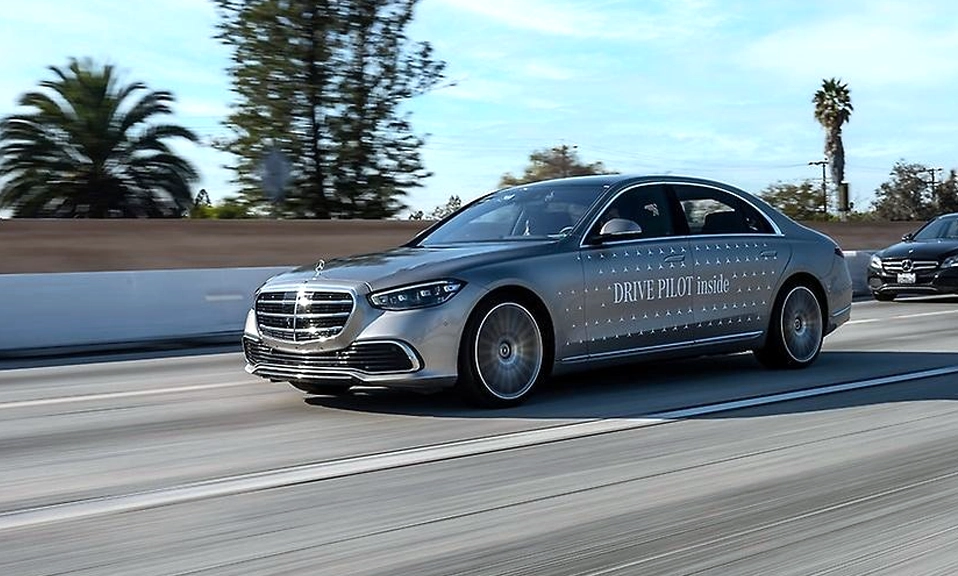
Mercedes-Benz was the first automaker to bring a legally approved Level 3 system to public roads. Its Drive Pilot, certified in Germany in 2021 and approved in Nevada and California in 2023, allowed drivers to take their hands off the wheel and their eyes off the road—but only under extraordinarily specific conditions . The system worked only on congested highway sections, at speeds below 64 km/h (about 40 mph) , in sunny daytime, and with high-precision map coverage . In Germany, where many highways have no speed limit, those conditions rarely align. The optional package cost €5,000 to €9,000 in Germany and was offered as an annual subscription in the US .
The refreshed S-Class launched in 2026 without Drive Pilot at all . CTO Jörg Burzer was blunt: “Launching new technology ahead of the curve does not mean it can meet the actual needs of consumers. Sometimes when a technology is launched too early, you end up realizing you have to re-examine what customers really want” .
The new roadmap is clear. Mercedes is pushing its Level 2++ system—MB.Drive Assist Pro, developed with Nvidia—to its absolute limit, then skipping Level 3 entirely and targeting Level 4 after 2030 . MB.Drive Assist Pro is a “hands-off, eyes-on” system: the driver can remove their hands from the wheel on highways and in cities, but must remain attentive and ready to intervene . It can change lanes, navigate intersections, make turns, and respond to traffic lights, supported by as many as 27 sensors .
The system has just scored a significant regulatory victory. On November 20, 2026, Mercedes received German certification for MB.Drive Assist Pro, becoming the first carmaker to secure approval for an advanced assisted driving system in Germany—a market where Tesla’s system had not yet been approved . The Financial Times described it as a “surprise victory” over Tesla in the race for self-driving credibility in Europe .
But the victory comes with caveats. MB.Drive Assist Pro is still a Level 2 system. The driver remains responsible at all times . The German certification is national, not EU-wide, though it is expected to facilitate deployment across the bloc early next year . And Tesla, despite lacking German approval, already holds authorisations in 12 EU countries and needs 15—covering 65% of the bloc’s population—to secure EU-wide approval through a vote expected in December . The regulatory edge Mercedes has won may prove temporary.
Tesla: The Scale Bet
Tesla’s approach is almost the inverse of Mercedes’. Instead of retreating from autonomy, it is pushing it to consumers at scale while simultaneously building a driverless robotaxi business.
FSD v15, rolled out to the first batch of customers on November 21, 2026, represents Tesla’s most significant architectural overhaul yet. JPMorgan described it as featuring “major revisions to the end-to-end driving architecture,” including an upgraded visual encoder shared across FSD, Robotaxi, and Optimus, generative driving visualization, and fleet-learning navigation capabilities . The safety-critical intervention rate has improved by about 25 times compared to v14, and Tesla claims the system’s safety performance is roughly 9 times better than human driving . The bank maintained a Neutral rating with a $430 price target, noting that the breadth of v15 “once again demonstrates Tesla’s leading edge in consumer-grade autonomous driving and raises the industry’s entry barrier” .
The numbers behind Tesla’s FSD adoption are substantial. In the third quarter of 2026, more than 75% of North American deliveries included paid FSD sign-ups, and active FSD customers exceeded 1.7 million globally, with subscriptions accounting for half . That is a massive, revenue-generating fleet collecting real-world driving data every day—a data advantage that no competitor can easily replicate.
The Robotaxi business is where Tesla’s autonomy ambitions become most concrete. As of November 2026, Tesla operates unsupervised Robotaxi services in eight U.S. cities: Austin, Dallas, Houston, Fort Worth, Miami, Orlando, Tampa, and San Antonio . Jacksonville, Las Vegas, and Phoenix are listed as “coming soon” . The Cybercab, Tesla’s purpose-built robotaxi, began passenger service in Austin in September and expanded to Dallas on November 19 . Cumulative unsupervised miles increased eightfold sequentially, approaching 2 million by the end of Q3 . Elon Musk has said Robotaxi operations could become “financially noticeable” in the second quarter of 2027 .
The weaknesses are equally clear. Tesla’s FSD is still a supervised system in consumer vehicles—the name “Full Self-Driving” has been criticised as misleading, and European regulators required it to be renamed “Tesla Assisted Driving” . The Robotaxi service, while expanding, remains geofenced to specific cities, and Tesla has not yet demonstrated the kind of fully driverless, anywhere-operation that Waymo has achieved in its most mature markets. CFO Vaibhav Taneja acknowledged that Robotaxi operating costs remain above Tesla’s targeted 30 cents per mile . And Musk’s repeated promises of imminent full autonomy have yet to be matched by regulatory clearance for truly hands-off, eyes-off driving in any country .
The Head-to-Head
On technology, Tesla has the more ambitious and more general system. FSD is designed to work anywhere, on any road, with no geofencing and no high-definition maps. It is a software-first, vision-only approach that improves through fleet learning at scale. Mercedes’ approach is more conservative: sensor-rich, geofenced where necessary, and deliberately limited to what regulators will approve. Tesla’s system is more capable in theory; Mercedes’ is more predictable in practice.
On deployment, Tesla is far ahead in consumer vehicles. More than 1.7 million active FSD customers and 75% attachment rates on new deliveries represent a scale of real-world deployment that Mercedes cannot match. Mercedes’ MB.Drive Assist Pro is only now launching in Germany, with EU-wide expansion expected next year . In robotaxis, Tesla is building a fleet; Mercedes has no comparable robotaxi service.
On regulation, Mercedes has just won a meaningful victory in Germany, beating Tesla to certification in Europe’s largest car market . But Tesla’s country-by-country strategy has already secured approvals in 12 EU states, and its December vote could deliver EU-wide approval that would render Mercedes’ national edge moot . In the US, Tesla operates unsupervised robotaxis in eight cities; Mercedes has no equivalent commercial driverless service. The regulatory scorecard is mixed, and the December EU vote will be pivotal.
On business model, Tesla is pursuing a two-pronged strategy: sell FSD to consumers and operate its own robotaxi fleet. Mercedes is pursuing a premium, subscription-based approach to assisted driving, with Level 4 autonomy planned for after 2030 but no robotaxi ambitions announced. Tesla is building a transportation network; Mercedes is selling a feature.
Different Races, Different Leaders
So who is winning? The honest answer is that Mercedes and Tesla are running different races.
If “winning” means having the most advanced, most widely deployed consumer autonomy system, Tesla is ahead. FSD v15 is a genuine technological achievement, the scale of its deployment is unmatched, and the Robotaxi expansion demonstrates that Tesla can translate software into a commercial service. The company has built a data engine that compounds its advantage with every mile driven.
If “winning” means regulatory credibility and a cautious, safety-first path to higher autonomy, Mercedes has just scored an important victory. It was the first to certify Level 3, it is the first to certify an advanced assisted driving system in Germany, and its decision to skip Level 3 in favour of a more capable Level 2 and a later Level 4 reflects a pragmatism that Tesla’s more aggressive approach lacks.
But the deeper truth is that neither company has yet delivered the fully autonomous, anywhere, anytime driving that the entire race is supposedly about. Tesla’s consumer FSD still requires supervision. Mercedes’ MB.Drive Assist Pro still requires hands-on attention in cities. Level 4 production cars are, by Mercedes’ own estimate, after 2030 . Waymo, the actual leader in driverless ride-hailing, operates in a handful of cities and is not an automaker in the traditional sense.
The race to build self-driving cars is not a sprint, and it is not a single contest. It is a series of overlapping bets on technology, regulation, and consumer trust. Tesla is betting that scale and data will get it to full autonomy first. Mercedes is betting that cautious, certified progress will win the trust of regulators and premium buyers. Both bets are rational. Neither has yet paid off in full.
For now, Tesla is the more advanced and more ambitious player. Mercedes is the more disciplined and more certified one. The next twelve months—FSD v15’s wider rollout, the December EU vote, the expansion of Robotaxi to new cities, and Mercedes’ EU-wide deployment of MB.Drive Assist Pro—will determine which bet starts to look prescient. The race is far from over. It is only becoming more interesting.