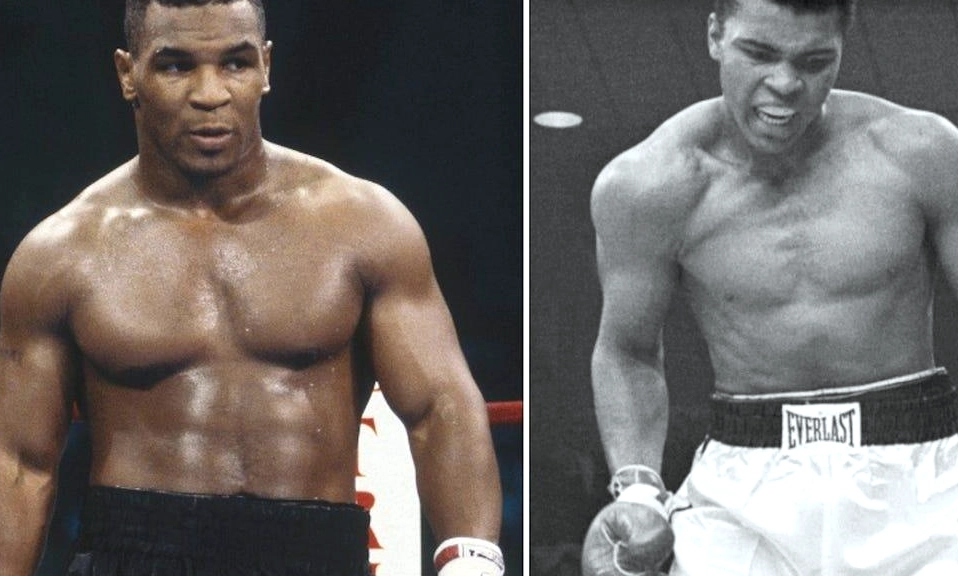
Mike Tyson and Muhammad Ali represent two of the most powerful ideas in heavyweight boxing.
Tyson was fear compressed into three-minute rounds. He entered the ring with explosive speed, a compact defensive style and combinations that could end a fight before an opponent had time to adjust.
Ali was movement, intelligence and defiance. He could win from distance, fight through adversity, change tactics in the middle of a bout and remain dangerous long after the plan had broken down.
Both men became world heavyweight champions. Both defeated elite opponents. Both created images that still define boxing. But they were great in different ways.
If the question is who had the more frightening peak, Tyson has a powerful case. If the question is who was the greater heavyweight overall, the answer is Muhammad Ali.
The records tell only the beginning
Ali finished his professional career with a 56–5 record and 37 knockouts. He became the first boxer to win the world heavyweight championship three times and successfully defended the title 19 times.
Tyson retired with a 50–6 record, two no-contests and 44 knockouts. He became the youngest heavyweight champion in boxing history at age 20, unified the WBC, WBA and IBF titles, and became universally recognized as champion after defeating Michael Spinks in 1988.
At first glance, Tyson’s knockout percentage looks more intimidating. He won 44 of his 50 victories by knockout, while Ali stopped 37 of his 56 opponents.
But knockout totals do not measure the quality of opposition, the length of a career or the different ways a fighter can control a match. Ali fought 61 professional bouts across more than two decades. Tyson’s championship peak was shorter, and his career became less consistent after his loss to Buster Douglas in 1990.
The records establish the debate. They do not settle it.
Ali’s case: the deepest résumé in heavyweight history
Ali’s greatest argument is the quality and variety of his opponents.
He defeated Sonny Liston, Joe Frazier, George Foreman, Ken Norton, Floyd Patterson, Ernie Terrell and Leon Spinks. Those victories came in different circumstances and required different solutions.
Against Liston, Ali entered as a significant underdog and forced the champion to retire after six rounds in 1964. In the rematch, he stopped Liston in the first round. Against Foreman, who had destroyed Joe Frazier and was considered nearly invincible, Ali used the rope-a-dope strategy before stopping him in the eighth round in the 1974 “Rumble in the Jungle.”
Against Frazier, Ali experienced one of the defining rivalries in boxing. He lost the first fight, won the second and prevailed in the third when Frazier’s corner stopped the brutal 14-round contest in Manila. Those fights showed that Ali could win a technical battle, survive punishment and remain competitive in a war of attrition.
Ali’s career also included a period away from boxing during his prime. After refusing induction into the U.S. Army on religious grounds, he was stripped of his title and prevented from boxing for more than three years. The Muhammad Ali Center notes that he later returned and reclaimed the championship twice more.
His career therefore included several versions of the same fighter. The young Ali relied heavily on speed, reflexes and movement. The later Ali used more rope work, clinching, timing and psychological control. He was not always as fast, but he remained capable of defeating elite heavyweights.
Tyson’s case: the most terrifying peak
Tyson’s best years were among the most destructive in heavyweight boxing.
He turned professional in 1985 and won his first 19 fights by knockout before going the distance. His peek-a-boo defense kept his hands high and his head moving while he closed distance behind explosive footwork. Once inside, he attacked with hooks and uppercuts in combinations that overwhelmed opponents.
At 20, Tyson stopped Trevor Berbick in the second round to become the youngest heavyweight champion in history. He then added the WBA title by defeating James Smith and unified the division by beating IBF champion Tony Tucker.
His early title defenses included victories over former champion Larry Holmes, Tony Tubbs, Frank Bruno and Carl Williams. Against Michael Spinks, Tyson produced one of the most memorable performances of his career, stopping the previously undefeated former champion in 91 seconds.
Tyson’s physical and technical advantages were unusual. He was shorter than many heavyweight champions, but he compensated with speed, balance and the ability to generate power from compact positions. He did not need a long wind-up. His punches travelled short distances and arrived quickly.
The psychological pressure was part of his advantage. Opponents often looked overwhelmed before the fight settled into a rhythm. Tyson’s reputation created mistakes, and his speed punished them immediately.
If a fighter were judged only by the danger he represented at his best, Tyson would be close to the top of any list.
The crucial difference: adaptability
Ali and Tyson both had outstanding physical gifts, but their careers diverged when opponents found ways to disrupt their preferred styles.
Ali adjusted repeatedly. He could box from the outside, fight on the ropes, tie up an opponent, counterpunch or exchange at close range. He was willing to win ugly if the circumstances demanded it.
Tyson was also technically sophisticated, despite the simple image of him as a puncher. His head movement, footwork and combination punching were highly developed. But his best work depended more heavily on controlling distance and imposing pressure early.
When Tyson could not intimidate an opponent or reach him cleanly, the fight became more complicated. Buster Douglas showed that a disciplined, confident heavyweight could keep Tyson at range, attack him with combinations and make him fight at a pace he did not control.
Evander Holyfield later exposed another difficulty. Holyfield was physically strong, tactically disciplined and willing to meet Tyson in the clinch. He defeated Tyson by technical knockout in 1996 and won their rematch after Tyson was disqualified for biting him.
Ali faced similar challenges, but his ability to change the fight was more consistent over time. That adaptability is a major reason he ranks above Tyson in an all-time career discussion.
Speed versus pressure
Ali’s speed was not only in his hands. His feet allowed him to control the distance at which the fight took place.
He could make a much larger opponent miss, then score before the opponent reset. His jab disrupted rhythm, and his movement forced opponents to work harder to find him. The International Boxing Hall of Fame describes Ali as having a jab and hand speed comparable to a much smaller fighter.
Tyson’s speed served a different purpose. He used it to enter the pocket, move his head under punches and fire combinations at the body and head. His offense was designed to make the opponent fight backward.
The styles create an obvious hypothetical question. Could Tyson get inside before Ali established control? If yes, Tyson could cause serious damage. Could Ali keep the fight at long range, force Tyson to reset and make him work for every entry? If yes, Ali would gain the advantage as the rounds passed.
Who had the stronger chin and stamina?
Ali had a longer record of surviving elite heavyweight power. He endured heavy exchanges with Frazier, Foreman, Norton and other strong punchers. His ability to remain composed after absorbing punishment became part of his identity.
That toughness came with a cost. Ali fought many damaging bouts, particularly during the later stage of his career, and his willingness to take punches should not be romanticized as a healthy strategy.
Tyson also showed toughness, especially in the early stages of his career. But his most famous victories usually came before opponents could drag him into a long fight. Once a bout extended beyond his preferred rhythm, his performance became less predictable.
In a long hypothetical fight, Ali’s experience and endurance would be major advantages. In a short fight, Tyson’s explosive power would be the most dangerous factor in the ring.
The quality of opposition matters more than the knockout percentage
A fighter’s record must be read alongside the opponents on it.
Tyson defeated several excellent heavyweights, including Holmes, Spinks, Bruno, Tucker and Ruddock. He also became a champion at an extraordinary age and unified the major titles during a period when that achievement carried great significance.
Ali’s résumé contains more victories over fighters who are regularly placed among the greatest heavyweights ever. Liston was a dominant champion. Frazier and Foreman are all-time figures. Norton, Patterson and Spinks were elite champions or contenders.
This does not mean every opponent in Ali’s record was better than every opponent in Tyson’s. It means Ali repeatedly faced the most accomplished heavyweights of his generation and continued fighting them after losing or facing serious adversity.
That depth is one of the clearest differences between their legacies. Tyson’s peak was spectacular. Ali’s career repeatedly returned to the highest level.
The hypothetical fight: who would win?
A prime-versus-prime matchup is impossible to prove. The fighters competed in different eras, used different equipment and faced different training environments. Any prediction is an informed argument, not a historical fact.
Ali would likely have advantages in height, reach, movement, experience and the ability to win a 12- or 15-round fight. He could use the jab, move laterally and make Tyson chase. He could also tie up Tyson when the younger fighter got close and force him to work.
Tyson would likely have advantages in compact power, body punching, explosive combinations and early pressure. He would try to cut off the ring rather than follow Ali, attack the body and force exchanges before Ali found a comfortable rhythm.
The first few rounds would be Tyson’s best opportunity. If he trapped Ali near the ropes and landed clean hooks or uppercuts, the fight could end quickly. Ali could not assume that speed alone would protect him.
If Ali survived the early storm, the balance would likely shift. He would make Tyson reset, vary his pace and exploit the difference in long-fight experience. A late-round stoppage or decision victory for Ali is the most plausible prediction, while Tyson’s clearest route would be an early knockout.
That prediction should not diminish Tyson. Giving a prime Mike Tyson even a small chance against any heavyweight in history is a sign of his extraordinary danger.
Peak Tyson or complete Ali?
This is where the debate usually becomes clearer.
The case for Tyson is concentrated. His best run was visually overwhelming, historically young and packed with fast knockouts. He unified the heavyweight titles and created an atmosphere in which many opponents appeared beaten before the opening bell.
The case for Ali is cumulative. He won major fights as an underdog, reclaimed the title, defeated several all-time greats, adapted after losing, returned after exile and remained competitive across a much longer career.
Tyson may have been the more frightening fighter at his absolute peak. Ali was the more complete champion and the more reliable answer to different kinds of problems.
Muhammad Ali was the greatest
heavyweight boxer overall. Mike Tyson was one of the most devastating heavyweight champions ever, and his prime may have been more terrifying than almost anyone’s.
Ali’s 56–5 record, three heavyweight championship reigns, deep opposition and ability to win through speed, strategy, toughness and adjustment give him the stronger all-time case.
Tyson’s 50–6 record, 44 knockouts, undisputed reign and record as the youngest heavyweight champion make him an extraordinary figure in his own right.
If the question is who had the better career, Ali wins. If the question is who could end a fight more suddenly at his best, Tyson remains one of the strongest answers in boxing history.
The difference is simple: Tyson made opponents fear the first few rounds. Ali made generations of great heavyweights solve a new problem every time they fought him.
That is why Ali remains the greatest, while Tyson remains unforgettable.