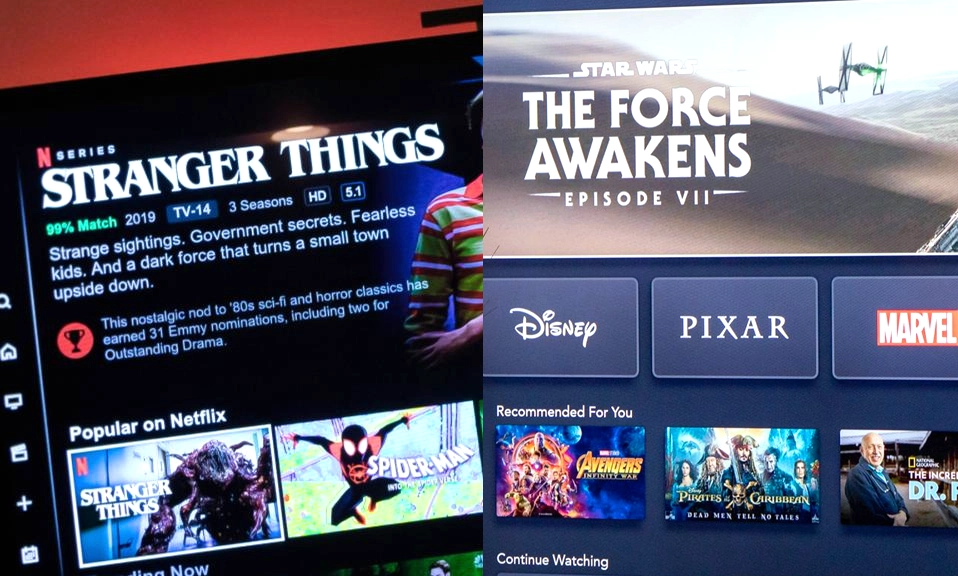
The streaming wars have entered a new, more pragmatic phase. Gone are the days of endless subscriber growth at any cost; 2026 is defined by a ruthless focus on profitability, engagement, and market share. The three titans—Netflix, Disney+, and Amazon Prime Video—are all fighting different battles, and each can claim a different kind of victory.
Here’s how the three streaming giants stack up in 2026.
📊 The Scorecard at a Glance
| Metric | Netflix | Amazon Prime Video | Disney+ |
|---|---|---|---|
| Subscribers / Reach | >325M paid members globally | ~250M Prime members (automatic access); 315M+ ad-tier MAU | 123.5M core subscribers; 215M+ across portfolio |
| Market Share (U.S. SVOD) | 19-20% (Q2/Q3 2026) | 17% (stable) | 14-15% (slight dip) |
| Revenue & Profitability | Q3 Revenue: $12.87B; Operating Margin: 34.6% | Profitable; “Tens of billions” in annualized revenue | SVOD Revenue: $5.5B**; Operating Profit: **$700M (up 116%) |
| Content Spend (Approx.) | $17B annually | $22.4B (video & music) | $24B (across Entertainment & Sports) |
👑 Netflix: The Undisputed Revenue King
Netflix remains the platform to beat, but its reign is defined by financial maturity rather than explosive growth. It is the most profitable pure-play streamer, with an operating margin of 34.6% in Q3 2026 and a full-year revenue guidance of $51.1 billion.
While its U.S. market share saw a slight slip to 19% in Q3, it maintains a commanding global lead, with viewership projected to be 269.3 million ahead of Prime Video and a massive 542.7 million ahead of Disney+. Netflix’s strategy is clear: it is no longer just a content library, but a diversified entertainment engine. Its ad-supported tier is growing rapidly, with member growth up 80% year-over-year, and it continues to invest heavily in live events, sports, and localized programming to maintain its global edge.
However, the market demands more than just stability. Netflix’s stock dipped after its Q3 earnings due to softer-than-expected Q4 guidance and a trimmed free cash flow target, a sign that investors are now scrutinizing growth vectors beyond subscriber counts.
🏰 Disney+: The Profitability Turnaround Story
Disney+ has completed its transformation from a loss-making growth project to a profitable cornerstone of Disney’s business. In fiscal 2026, its direct-to-consumer segment reported consecutive profitable quarters, with SVOD operating profit soaring 116% to $700 million on revenue of $5.5 billion. CEO Bob Iger confidently stated, “we have turned the corner in our streaming business”.
This turnaround is built on a dual strategy of price increases and ad-tier adoption. Disney+ has successfully leveraged its unmatched library of franchise content (Marvel, Star Wars, Pixar) to raise prices, while its ad-supported tier now accounts for more than 45% of all new sign-ups. Average revenue per user (ARPU) is growing, particularly in international markets where it surged 32%.
The challenge for Disney+ is maintaining this momentum. Its U.S. market share has dipped slightly to 14-15%, and it faces the dual pressures of a declining linear TV business and the need to fuel future growth through international expansion and a major new sports streaming joint venture with ESPN, Fox, and Warner Bros. Discovery.
🚀 Amazon Prime Video: The Ecosystem Behemoth
Amazon plays by different rules. Prime Video is not a standalone business but a crucial flywheel for the entire Amazon ecosystem. CEO Andy Jassy confirmed that the service is now “profitable in its own right,” generating annualized revenue in the “tens of billions of dollars”.
Amazon’s advantage lies in its massive built-in audience: an estimated 250 million Prime members worldwide who get the service automatically. This gives Prime Video unparalleled reach, with its ad-supported tier boasting over 315 million monthly active users globally. Its strategy is a volume play, offering the most “value” per dollar. Prime Video is the leader in providing a vast quantity of movies and TV shows, including a high number of “excellent” (8+ IMDb score) titles per dollar spent.
Despite its strengths, Amazon faces challenges. It has a higher churn rate than its competitors and is perceived by some critics as prioritizing quantity over prestige quality. However, with hits like The Boys, Fallout, and Reacher, and a powerful live sports portfolio including NFL’s Thursday Night Football, NBA, and UEFA Champions League, Amazon is using its ecosystem and deep pockets to remain a formidable force.
Three Winners, Three Different Races
In 2026, there is no single “winner” of the streaming wars. The competition has splintered into distinct races, and each platform is leading in its own category.
Netflix is winning the race for pure streaming profitability and global dominance. It is the most financially successful standalone streamer with the largest global subscriber base. Its challenge is to sustain growth in a mature market and prove to investors that its ad and live-event strategy can open new revenue streams.
Disney+ is winning the race for the most successful turnaround. It has achieved what many thought impossible: making its streaming business profitable while navigating the decline of traditional TV. Its challenge is to maintain that momentum, execute its international expansion, and successfully launch its massive sports streaming venture.
Amazon Prime Video is winning the race for ecosystem integration and reach. It has successfully used streaming to strengthen its core retail business and has built a massive, highly engaged ad-supported audience. Its challenge is to improve content prestige and reduce churn to ensure its video offering remains a compelling reason to stay in the Prime ecosystem.
Ultimately, the healthiest player is arguably Netflix for its singular focus and profitability, while Disney has shown the most dramatic improvement. But in terms of sheer scale and strategic integration, Amazon’s model remains uniquely powerful. The real winner is the consumer, who benefits from a market where three distinct, well-funded strategies are competing fiercely for their attention.