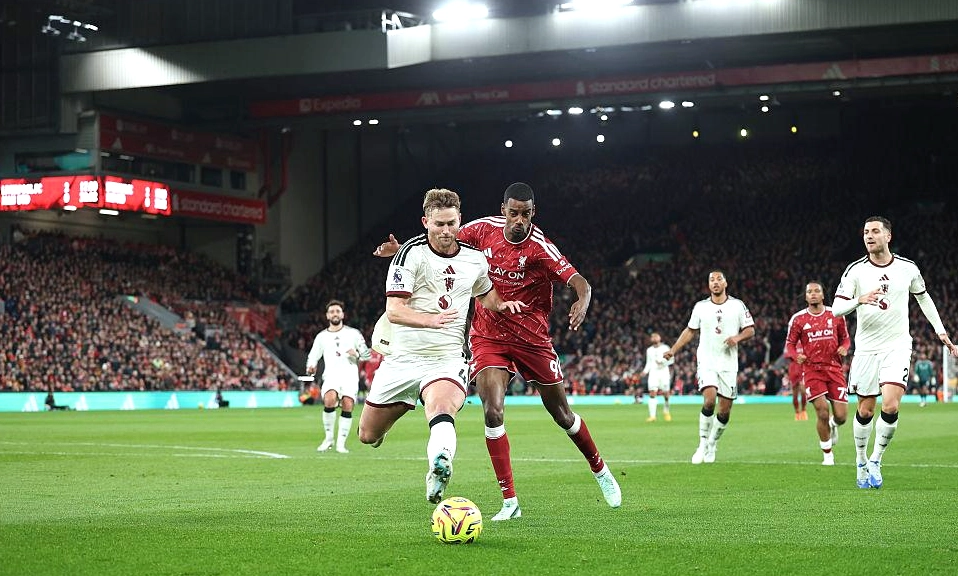
Mauricio Pochettino’s Manchester United tenure began with a result that will be remembered not for its tactical nuance, but for its sheer, unrelenting brutality. Liverpool’s 4–0 victory at Anfield on November 22, 2026, was a statement performance from Andoni Iraola’s side and a devastating reality check for a United team that sits 19th in the Premier League table, just one point off bottom, after 11 matches.
The scoreline flatters United. It could, and arguably should, have been far worse.
The Eight Minutes That Defined the Match
The game was over almost before it began. In the eighth minute, United defender Leny Yoro was shown a straight red card for denying a clear goalscoring opportunity, hauling down Alexander Isak after a catastrophic defensive error from Matthijs de Ligt allowed a long clearance to reach the striker. It was, as Football365 put it, “a disastrous combination of back-to-back catastrophe-exacerbating mistakes” from two defenders who were supposed to provide the foundation of Pochettino’s new project.
From that moment, the contest was a damage-limitation exercise. Dominik Szoboszlai thrashed the resulting free-kick past Senne Lammens within seconds of the restart. Three minutes later, Florian Wirtz improvised a volley from a Rio Ngumoha cross that went in off the underside of the crossbar. By the 13th minute, Liverpool were 2–0 up, and United had already been reduced to a shape that Pochettino had never planned for: a 4–4–1 low block that eventually became a 5–3–1 after Harry Maguire was introduced for Bryan Mbeumo in the 22nd minute.
The second half was less a contest and more a procession. Rio Ngumoha added a third in the 66th minute after a lightning-fast run from Bradley Barcola, and substitute Víctor Muñoz curled in a fourth with eight minutes remaining. The statistics are damning: Liverpool registered 28 shots, 11 on target, and nine big chances, with an expected goals total of 4.38 against United’s 0.64. Roy Keane, watching from the Sky Sports studio, was apoplectic. “Liverpool probably should have scored eight, probably eight or nine,” he said. “I feel like swearing. I thought United were desperate. So bad”.
Iraola’s Tactical Masterclass
For Liverpool, the performance was the signature Anfield win that Andoni Iraola’s tenure had been missing. The Spaniard set up in a highly flexible 4–2–3–1 that morphed into a 3–2–5 during build-up, with full-backs pushing high and the wide forwards—Barcola and Ngumoha—tucking inside to create central overloads. The front four were fully interchangeable: Isak dropped deep to drag defenders out of position, Szoboszlai arrived late in the box, and Wirtz operated as the “tactical heartbeat,” constantly finding pockets of space in the right half-space.
Liverpool dominated possession with 64% of the ball and completed 509 accurate passes at an 88% success rate. Their defensive work was primarily counter-pressing, winning the ball back quickly in the final third to prevent United from ever finding Bruno Fernandes in transition. It was, as Goal.com described it, a “tactical masterclass”.
The individual performances were equally emphatic. Ngumoha was the standout, scoring one and assisting another to become the youngest Liverpool player in history to record a goal involvement against Manchester United. Wirtz earned a 10/10 from one outlet, with another noting that he “won over even his biggest critic”. Jamie Carragher, who had been critical of Liverpool’s attack this season, admitted he had finally seen what he was looking for: “It’s not just one of them playing well, all four of them playing well”.
What It Means for Liverpool: Momentum, Belief, and a New Benchmark
Liverpool remain fourth in the table with 21 points, but the victory lifts them to within a point of second place. More importantly, it provides a template. Carragher framed the performance as the standard his former club must now meet. “Performances such as Sunday’s convincing display should serve as the benchmark if the Reds are able to challenge champions Arsenal for the Premier League title under Iraola”.
The concern is consistency. Liverpool had struggled to create big chances at home before this match, and the challenge now is to replicate this level of attacking fluency against opponents who are not reduced to ten men inside eight minutes. But the attacking quartet of Isak, Wirtz, Barcola, and Ngumoha—costing a combined £364 million—showed what they are capable of when they click. If that becomes the norm rather than the exception, Liverpool’s season could be transformed.
What It Means for Manchester United: A Crisis Beyond Tactics
For United, the defeat is not merely a bad start for a new manager. It is the continuation of a structural collapse that has been years in the making. United sit 19th with eight points from 11 games, level on points with the relegation zone and only above Crystal Palace on goal difference. Pochettino accepted “full responsibility” for the defeat, but he also pointed to the circumstances—the early red card, the game plan rendered obsolete within eight minutes.
The deeper problem is the squad. Keane’s fury was directed not at the manager but at the players. “This team two years ago finished 15th,” he said. “We’re blaming the board, blaming ownership, blaming managers. When do the players take responsibility for some decision-making?”. Gary Neville suggested that the defensive chaos on display “wouldn’t even be seen in League Two”. Paul Robinson, speaking on BBC Radio 5 Live, noted that Pochettino “can’t write this game off” and that the fragility of the team was laid bare: “They are a team that can be got at and as soon as Liverpool did that early in the game there was only ever going to be one winner”.
The red card will be debated. Daniel Sturridge, a former Liverpool striker, felt it was the correct decision: “For me it’s a penalty and Yoro should have been sent off”. But the officiating is a distraction from the larger issue. United were already being overrun before the dismissal, and the collapse that followed was as much psychological as it was tactical. This is a team that does not believe in itself, and a new manager—no matter how accomplished—cannot fix that overnight.
A Derby That Redefined Both Seasons
Liverpool’s 4–0 win was not just a derby victory. It was a defining moment for two clubs heading in opposite directions. For Liverpool, it was proof that Iraola’s ideas can produce the kind of performance that Anfield demands—a fluid, aggressive, technically superior display that overwhelms a rival and announces a team’s arrival as a genuine force. For Manchester United, it was a humiliation that exposed the hollowness of a squad that has spent years accumulating expensive talent without building a coherent team.
The table tells the story. Liverpool are fourth, a point off second, building momentum. United are 19th, one point off bottom, staring at a relegation battle that no one at Old Trafford would have predicted in August. Pochettino has a monumental task ahead of him. Iraola, for the first time, has the signature win that validates his project. The Premier League is a long season, and one result does not define it. But this one felt like more than three points. It felt like a turning point—for both clubs, and for the stories their seasons will tell.