Could They Transform GPS and Unlock Secrets of Dark Matter?
For 70 years, the world’s most precise timekeepers have counted the oscillations of electrons. Now, two independent teams have built clocks that count the oscillations of atomic nuclei — and they could change everything from satellite navigation to the search for the universe’s most elusive substance.
On October 7, 2026, two research groups — one at the Vienna University of Technology in Austria, the other at Tsinghua University in Beijing — published papers in Nature announcing the first working prototypes of nuclear clocks. It’s a milestone that scientists have pursued for decades, and one that could open doors to entirely new realms of physics.
“This field is moving at breakneck speed,” said Eric Hudson, a physicist at UCLA who was not involved in the research.
How a Nuclear Clock Works
To understand why this matters, you first need to understand what makes a nuclear clock different from the atomic clocks that currently define the second.
An atomic clock works by tuning a laser to a precise frequency that causes an electron to jump between two energy levels within an atom. A nuclear clock goes deeper. It focuses the laser directly on the oscillations of the atomic nucleus, detecting its transition between energy states.
The nucleus is roughly tens of thousands of times smaller than the atom as a whole. Because it’s buried deep inside the electron cloud, it’s far less affected by external disturbances and electromagnetic fields. In theory, that makes a nuclear clock significantly more precise — and more robust — than its atomic counterpart.
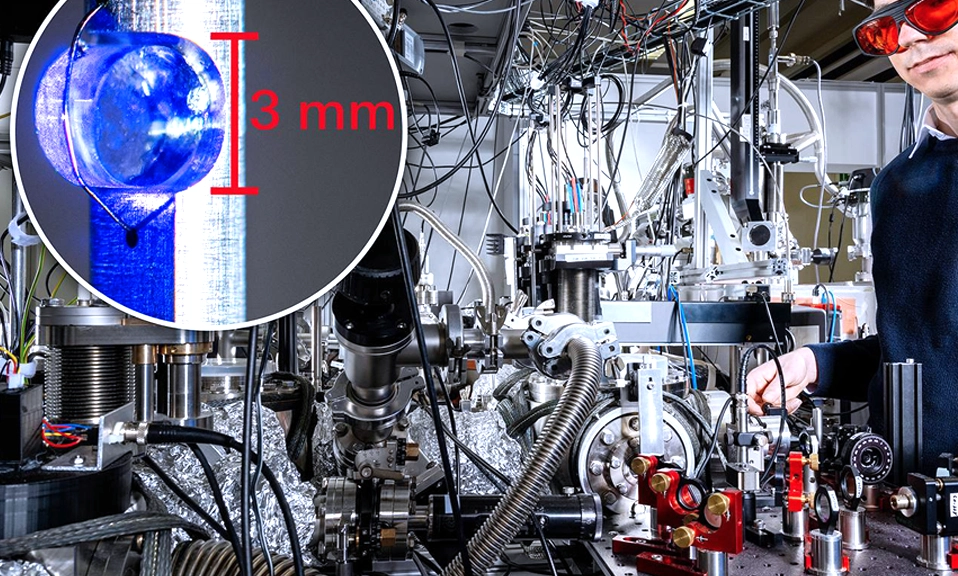
“The basic idea is simple: you have a laser and thorium. The laser changes the energy state of the thorium nuclei, while the nuclei themselves provide feedback — they stabilize the frequency of the laser,” explained Professor Thorsten Schumm of the Vienna University of Technology.
The key ingredient is thorium-229. Normally, changing the state of an atomic nucleus requires enormous amounts of energy and high-energy radiation. But thorium-229 is a unique natural exception. Its nucleus can be shifted between energy levels using relatively accessible ultraviolet lasers. The transition energy is so low because the strong nuclear force and the electromagnetic force nearly cancel each other out — which also makes the clock highly sensitive to any slight changes in these fundamental forces.
Two Teams, Two Approaches
The Vienna and Beijing teams both embedded thorium-229 nuclei in calcium fluoride crystals, but their experimental paths were entirely different.
The Beijing team, led by Associate Professor Shiqian Ding, had only one microgram of thorium-229 to work with. To compensate, they developed a way to make a powerful 148-nanometer frequency laser using a heated gas of cadmium — solving a problem that had stumped researchers for years: no one had ever made a continuous-wave laser with a frequency that high.
The Vienna team, led by Professor Thorsten Schumm, lacked such a powerful laser but secured access to thorium-rich crystals. Their clock was the first to publish a stabilization system similar to those used in conventional atomic clocks.
In early tests, the Chinese version proved approximately six times more stable than the Austrian one.
The Current State: Prototypes, Not Yet Champions
It’s important to be clear about what these clocks are — and what they aren’t.
They are first-generation prototypes. They currently accumulate an error of about 1 second every 30 million years. That’s about 10 times worse than modern cesium standards, which officially define the length of a second on Earth. The best optical atomic clocks are about 10,000 times more reliable, losing one second only every 100 billion years.
But that’s not the point. The point is that the architecture is proven. The physics works. And the path to improvement is clear: better thorium crystals and more powerful lasers.
Could Nuclear Clocks Transform GPS?
The atomic clocks that underpin GPS satellite navigation and the global internet demonstrate impressive accuracy — an error of just 1 second in 300 million years. Nuclear clocks could push those limits to billions of years.
The implications for navigation are significant. More precise clocks mean more precise positioning. But perhaps more importantly, nuclear clocks could be more compact and portable than current optical atomic clocks, which are large and extremely sensitive to environmental disturbances.
“Future nuclear clocks could potentially make these systems even more precise while offering compact, robust alternatives to some existing technologies,” according to researchers.
A portable nuclear clock could revolutionize everything from military navigation to autonomous vehicles to financial trading networks, all of which rely on ultra-precise time synchronization.
The Dark Matter Connection
Perhaps the most exciting application of nuclear clocks is in the search for dark matter — the invisible substance that makes up roughly 83% of the matter in the universe.
The thorium-229 nucleus is uniquely sensitive to changes in the fundamental forces of nature. Some theories suggest that ultralight dark matter may cause these constants to fluctuate as it passes through Earth. If a particle of dark matter passed through the thorium nuclei in a nuclear clock, it could register as a wobble in the clock’s otherwise steady ticktock.
The Vienna team tested this directly. They ran their nuclear clock alongside a ytterbium atomic clock. Because the two clocks react differently to fluctuating physics constants, any change in their relative tick rates could reveal the presence of dark matter.
The experiment found no signal. But it demonstrated that the nuclear clock can already perform precision measurements competitive with the best atomic clocks — and it went beyond previous measurements in constraining how dark matter might couple to the strong nuclear force.
“The clocks thus offer a new window into dark matter’s effect on the nucleus,” said Elina Fuchs, a theoretical particle physicist at Leibniz University Hannover who was not involved in the studies.
The Road Ahead
The next challenge is to make nuclear clocks accurate, stable, and practical enough to leave the laboratory. Researchers are convinced that as the quality of thorium crystals improves and laser power increases, each new generation of nuclear chronometers will become more accurate, eventually surpassing atomic clocks.
“We can expect really exciting measurements in the near future,” Schumm said.
For now, the world’s first nuclear clocks are ticking quietly in Vienna and Beijing. They’re not the most precise timekeepers on Earth — not yet. But they represent something more important than a record: a new way of measuring time, a new tool for probing the universe, and a new window into the fundamental forces that shape reality.
The atomic clock era isn’t over. But the nuclear clock era has begun.