For more than a quarter century, a mysterious chemical signature sat buried in the Hubble Space Telescope’s archives. When a young astronomer finally cracked it, she found something no one had ever seen before: a planet that may have been born from the ashes of a dead star.
A Cold Case in the Hubble Archives
In 1999, the Hubble Space Telescope observed a white dwarf star called HS 0209+0832, located about 270 light-years from Earth in the constellation Cetus. The data contained roughly 100 chemical features that could not be identified. The mystery sat dormant for decades.
Then Jamie Williams, a doctoral candidate at the University of Warwick, went back to those archival records armed with an updated chemical database. She found that one element matched many of the mystery features: niobium.
Niobium is used on Earth in jewelry and medical imaging devices. But in astronomy, it is extraordinarily special. Unlike common elements like carbon or oxygen, niobium is not formed in the cores of stars through normal thermonuclear fusion. It can only be synthesised in the exotic, fleeting conditions inside a dying star during its red giant phase, through a nuclear reaction called the s-process.
“We’ve never observed anything in the universe that’s this niobium-rich before,” Williams said. “We were quite confused at first.”
What Is a Second-Generation Planet?
To understand why this matters, you have to understand how planets normally form.
Earth and the other planets in our solar system are first-generation planets — they formed from material left over from the Sun’s birth. When a Sun-like star dies, it first expands into a red giant, shedding its outer layers of gas and dust into space. It then collapses into a white dwarf — a dense, hot core that slowly cools over billions of years.
A second-generation planet is a world that forms after the star has already died — condensed from the material the dying star ejected into space. The idea has been theorised for over 15 years, and astronomers have suspected such worlds might exist around pulsars — the ultra-dense remnants of massive supernovae. But no one had ever found one around a white dwarf. Until now.
The Chemical Evidence: A Signature of Death, Not Birth
What made HS 0209+0832 so unusual was not just the presence of niobium — it was the absence of the elements you would expect from a normal planet.
Most white dwarfs that are “polluted” with planetary debris show high levels of rock-forming elements like silicon and iron. HS 0209+0832 showed the opposite. Its atmosphere was strongly enriched in trans-iron elements including zinc, copper, and niobium, but depleted in silicon and iron.
“This pattern of elements is a telltale sign of the ‘s-process,’ a nuclear reaction that builds heavy elements inside dying stars during their bloated red giant phase,” explained Nicholas Stone, a theoretical astrophysicist at the University of Wisconsin–Madison and a member of the research team. “It’s a chemical signature no ordinary, ‘first-generation’ planet should carry, which told us that this new planet was something different.”
The Planet Itself: A Jupiter-Sized World Boiling Away
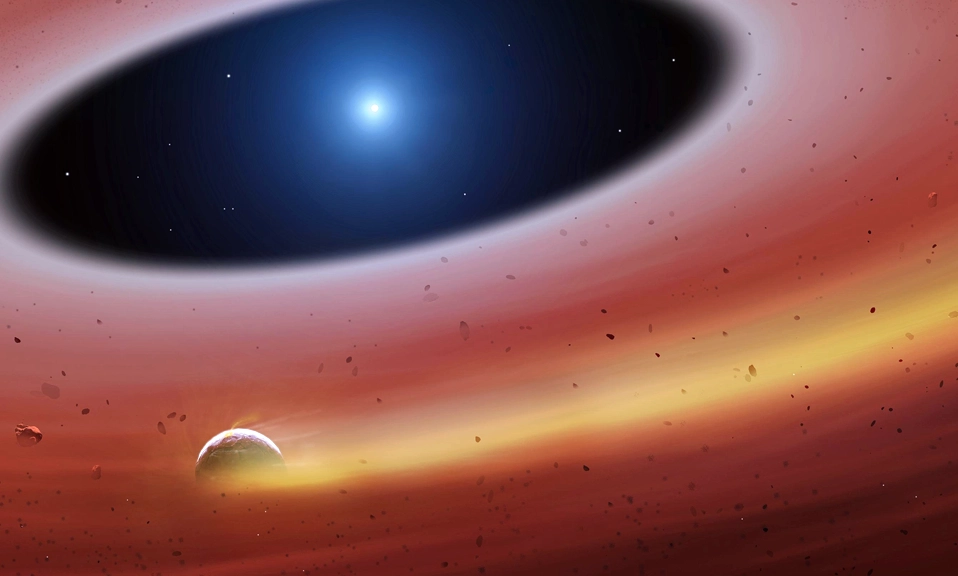
The team believes the most likely explanation is that HS 0209+0832 is feeding off a newly formed, second-generation giant planet — one that condensed out of a new disc of material formed during the star’s death. Because that disc was made from the star’s own expelled material, it would naturally be rich in the unusual heavy elements now showing up in the white dwarf’s atmosphere.
Data from NASA’s TESS satellite provided further evidence. Researchers detected a faint, regular brightness signal repeating every 4.4 days, consistent with a Jupiter-sized gas giant tidally locked in a tight orbit. At such a close distance from the white dwarf, the planet’s outer atmosphere is expected to be boiling away under the intense radiation, with that escaping material raining down onto the white dwarf’s surface — producing the unusual chemical signature.
Why This Discovery Matters
A New Chapter in Planetary Evolution
“Rather than the white dwarf stage being a kind of epilogue to the story of a star and its planets, this research points to the systems we are familiar with only being the first chapter of a potentially much longer tale, with some new characters showing up,” Williams said.
The discovery demonstrates that planetary systems can have a second act — that the death of a star doesn’t necessarily mean the end of its planetary story.
A Rare Gift: Forming a Disc Around a Dying Star
What makes second-generation planets so rare? Williams explained: “Forming the protoplanetary disc in this situation is not easy. A single, isolated star dies and sheds mass in a roughly symmetrical way. To form a disc of material necessary to birth a planet, HS 0209+0832 likely required a companion star that pulled the ejected material back into orbit, rather than letting it escape”.
That companion star — invisible in the data but inferred from the dynamics — may have been the crucial ingredient that allowed a new world to form from the wreckage of the old one.
What It Means for Our Own Solar System
The discovery has profound implications for the far future of our own solar system. When our Sun becomes a white dwarf in roughly 8 billion years, it will first expand into a red giant, potentially engulfing Mercury, Venus, and Earth. What remains — Mars, Jupiter, Saturn — would orbit a cooling stellar remnant.
The question is whether those surviving remnants could seed a second generation of planets. The discovery of HS 0209+0832 suggests the answer might be yes.
“What’s interesting about planets orbiting close to white dwarfs is that because white dwarfs cool over time, their habitable zone is very stable,” Williams said. “A second-generation planet could form and then be in the habitable zone for tens of billions of years.”
That kind of long-term stability could, in theory, provide ideal conditions for life. But Williams was careful to temper the speculation: “It’s not a confirmed planet. It’s only a candidate for now”.
What Comes Next
The discovery opens a new way to search for similarly “reborn” worlds. Astronomers can now look for the same niobium and heavy-element signature in the light of other dead stars.
“This is the first time we’ve seen evidence for that process,” said planetary scientist Zifan Lin of Washington University in St. Louis, who was not involved in the work. Before this, the formation of second-generation planets was “more like a hypothesis, more like speculation”.
Williams, who found the niobium signature while re-examining decades-old data, offered a fitting summary: “What Hubble is showing us in this white dwarf system is something we haven’t seen before”.
A dead star.
A chemical fingerprint that shouldn’t exist. A planet that may have risen from the ashes of the very star it now orbits.
HS 0209+0832 is not just a cold case solved. It’s a new chapter in the story of how worlds are born — and a reminder that the universe still has surprises hidden in plain sight, waiting for someone to look at old data with new eyes.
The planet isn’t confirmed yet. But the evidence is compelling, the chemistry is unmistakable, and the implications are extraordinary. If second-generation planets can form around white dwarfs, then the death of a star may not be an ending at all.
It may be a beginning.
The study, “Discovery of a second-generation planet candidate accreting onto a white dwarf,” was published October 5, 2026, in Nature Astronomy.