For nearly a century, the Bangka slow loris existed only in the margins of scientific literature — a name in a 1930s catalogue, a species presumed lost. It took a local rescue centre, a decade of unrecorded rescues, and a chance conversation in Java to bring it back.
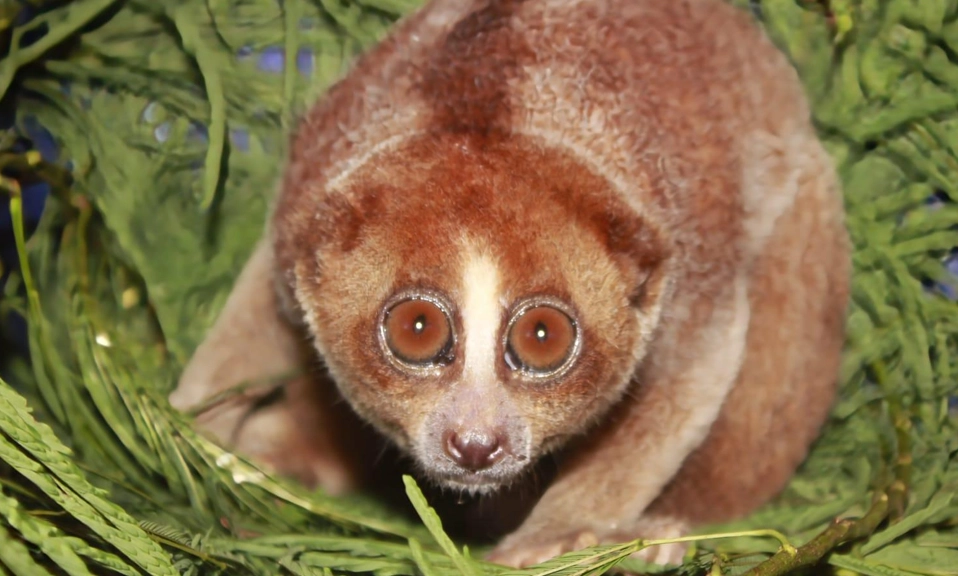
The Bangka slow loris (Nycticebus bancanus) is one of the most extraordinary primates on Earth. It is small and nocturnal, with reddish-brown fur, distinctive facial markings, and enormous eyes. It moves slowly and deliberately through the trees — a stark contrast to the quick, acrobatic monkeys and apes most people picture when they think of primates.
And it is venomous. One of the only venomous primates known to science.
For decades, the species was listed as critically endangered and possibly extinct. The last reliable scientific records dated to the early 1930s, between 1930 and 1932. In 2020, the IUCN Red List formally classified it as critically endangered (possibly extinct), and it was placed on conservation group Re:wild’s list of “lost primates.”
But the Bangka slow loris was never lost to the people of Bangka.
The Rediscovery: Hiding in Plain Sight
The species was rediscovered not by a scientific expedition, but by a local wildlife rescue centre that had been quietly doing the work for years.
Between 2015 and 2025, the Alobi Wildlife Rescue Center on the Indonesian island of Bangka rescued and cared for more than 90 Bangka slow lorises. Residents found the animals in backyards, along roadsides, on power lines, and in gardens — and called Alobi for help. Most were returned to the wild after recovery.
Those encounters, however, had never made their way into the scientific record. The breakthrough came when Timon Glaw, a graduate student at the Haus des Meeres Aqua Terra Zoo in Vienna, learned from a conservationist that the Bangka slow loris was on Re:wild’s “most wanted lost primates” list. He was connected to Alobi, and discovered that the rescue centre possessed something the scientific literature did not: documented evidence of the species’ survival.
The resulting study, published in the journal Spixiana, was co-authored by Alobi, the Haus des Meeres Aqua Terra Zoo, and the Taman Safari Prigen Conservation Breeding Ark. It confirms that the Bangka slow loris still survives across much of the island.
“The Bangka slow loris is still alive,” Glaw said.
What the Rescues Reveal
The data from Alobi’s decade of work paints a picture of a species that is more resilient — and more widespread — than anyone had realised.
The rescued animals came from all four regencies of Bangka and the city of Pangkal Pinang, suggesting the species may still live across much of the island despite extensive habitat destruction. Of the more than 90 individuals rescued, 86 recovered and were released at seven carefully chosen sites on Bangka, focusing on larger forest fragments that can still provide good habitat and have some level of legal or practical protection.
“What I find particularly astonishing is that such a charismatic and distinctive primate has received so little scientific attention for nearly a century,” Glaw said. “Its rediscovery also offers hope that other species feared to be extinct may still survive in places where scientists have not looked for decades. After all, Bangka is just about an hour flight from Jakarta, one of the largest cities in the world.”
The Venom: A Rare Trait Among Mammals
The Bangka slow loris is not just notable for its rediscovery. It is one of the only venomous primates known to science — a trait so rare among mammals that it has made the species a subject of fascination for decades.
The venom is produced in specialised glands near the animal’s elbows. When threatened, the slow loris raises its arms and licks the glands, mixing the secretion with saliva. It then delivers the venom through a bite, using a toothcomb — a set of forward-projecting lower teeth used for grooming, gouging tree bark, and venom delivery.
“The venom can cause severe allergic reactions in humans, potentially even life-threatening ones,” Glaw said. Research on other slow loris species suggests the venom is used primarily in conflicts with other lorises, though it may also serve defensive functions against predators and parasites.
The species also possesses a specialised second tongue beneath its main tongue, a detail that adds to its remarkable evolutionary distinctiveness. In the primate family tree, the Bangka slow loris is more closely related to the lemurs of Madagascar and the galagos of Africa than to monkeys, apes — or humans.
The Threats: Still Close to Extinction
The rediscovery is a triumph of scientific record-keeping. It is not a guarantee of survival.
The Bangka slow loris remains critically endangered. Its habitat on Bangka has shrunk significantly due to illegal tin mining and massive land clearing for oil palm plantations. Roads, human settlements, and power lines pose additional threats, and the species is also vulnerable to the pet trade.
“We are glad to contribute to the scientific record to show that the Bangka slow loris is not lost, but the species is still very close to extinction,” said Langka Sani, director of the Alobi Wildlife Rescue Center. “Its natural habitat on Bangka Island has shrunk significantly because of illegal tin mining and massive land clearing for oil palm plantations. We ask people around the world to support us in saving the Bangka slow loris while we still can.”
“Bringing the Bangka slow loris back onto the scientific radar is only the first step,” Glaw added. “We now know the species has survived in several parts of Bangka, and we urgently need a long-term conservation strategy built on population surveys, genetic studies and, above all, protection of its remaining habitat.”
Science Doesn’t Know Everything
The story of the Bangka slow loris is a reminder of something that is easy to forget in an age of satellite imagery and genomic sequencing: science does not know everything. Species can disappear from the scientific record without disappearing from the world.
Benji Barca, Re:wild’s exploration program manager, put it best: “A species can disappear from the scientific record without disappearing from the lives of the people who share its home.”
The Bangka slow loris was never lost to the people of Bangka. They saw it in their gardens and on their roads. They called the rescue centre. They cared for it. And now, thanks to their knowledge and Alobi’s decade of quiet work, the rest of the world knows it is still here.
That is the real story of this rediscovery: not a lone scientist heroically finding a lost species, but a community that never stopped paying attention — and a scientific establishment that finally caught up.