If you’ve ever traveled to Europe, you’ve probably noticed something strange in the bakeries and cafes: eggs sitting casually in baskets on the counter, completely unrefrigerated.
Yet, if you walk into a grocery store in the United States, Canada, Japan, or Australia, those same eggs are tucked away in the chilled dairy aisle.
So, who is doing it right? Do eggs actually need to be refrigerated, or is it just a massive, collective habit we’ve all fallen into?
The short answer is: If you live in the US, Canada, Japan, or Australia, yes, absolutely put them in the fridge.
But the why behind this rule is a fascinating mix of food science, geography, and a little thing called the “bloom.” Here is everything you need to know about storing your eggs safely.
🥚 1. The Science of the “Bloom” (The Cuticle)
To understand egg storage, you have to look at the eggshell. An eggshell is not completely solid; it has thousands of tiny pores.
When a hen lays an egg, it is naturally coated in a protective, invisible layer called the cuticle (or the “bloom”). This natural barrier seals the pores, keeping moisture in and bacteria (like Salmonella) out.
In many parts of the world, this bloom is left completely intact. But in the US and a few other countries, commercial egg producers are required by the USDA to wash and sanitize eggs before they hit the market. This is done to remove any dirt or fecal matter.
The catch? Washing the egg also washes away the protective bloom. Without it, the porous shell is vulnerable to bacteria. Refrigeration becomes mandatory to slow down any potential bacterial growth and keep the egg safe to eat.
🌍 2. The Geography Factor: Why Europe Does It Differently
In the European Union and the UK, commercial egg washing is actually banned.
Why? European food safety authorities believe that washing damages the cuticle and can actually pull bacteria through the porous shell if the wash water isn’t perfectly temperature-controlled.
Instead of washing, European countries focus on preventing Salmonella at the source by vaccinating hens against the bacteria. Because the bloom is left intact and the hens are vaccinated, the eggs are considered safe to store at room temperature.
(Note: Even in Europe, once an egg is refrigerated at the store, it must stay refrigerated. But most aren’t).
❄️ 3. The Golden Rule: Consistency is Key
Here is the most critical rule of egg storage, regardless of where you live: Never let a refrigerated egg sit at room temperature for long.
If you take a cold egg out of the fridge and leave it on the counter, condensation will form on the shell as it warms up. Because the US egg’s protective bloom has been washed away, that moisture can act as a bridge, allowing bacteria on the outside of the shell to seep through the pores and into the egg.
If your eggs have ever been refrigerated, they must stay refrigerated until the moment you crack them.
🧊 4. How to Store Eggs for Maximum Freshness (and Safety)
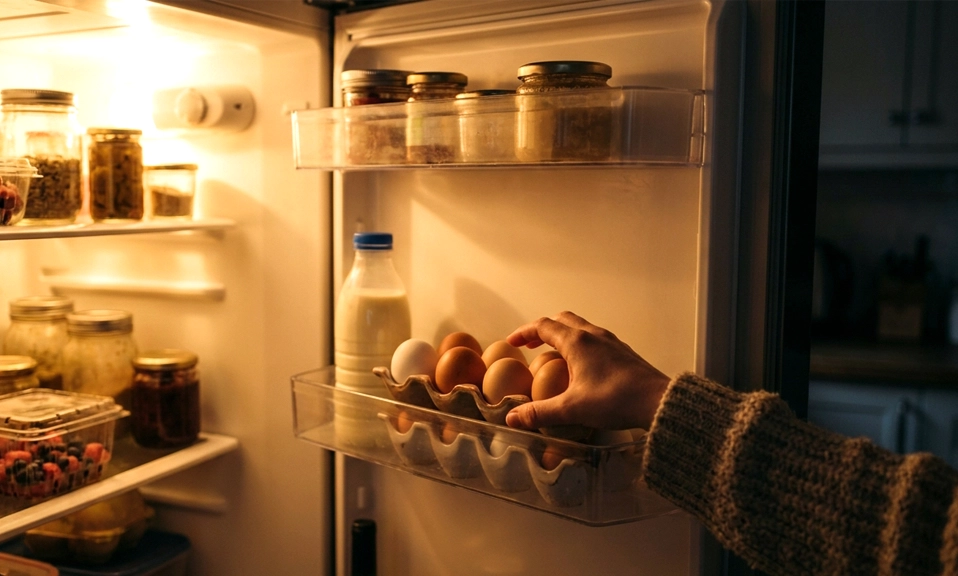
If you’re keeping your eggs in the fridge (and you should be, if you’re in North America), you might be making a common mistake: storing them in the refrigerator door.
The door is the warmest part of the fridge and experiences the most temperature fluctuations every time you open it. These swings can degrade the egg’s quality and increase the risk of condensation.
The Best Practices:
- Keep them in the main body of the fridge: Store them on a middle or lower shelf, where the temperature is coldest and most stable.
- Leave them in the original carton: The cardboard carton isn’t just for marketing. It protects the eggs from absorbing strong odors from other foods (eggs are porous and will absorb the smell of onions or leftover garlic!), and it shields them from light and moisture loss. Plus, the carton has the expiration date printed on it!
- Pointy end down: Storing eggs with the pointed end facing down helps keep the yolk centered and the air cell at the top, which can slightly extend their freshness.
⏱️ 5. How Long Do They Actually Last?
The “Best By” date on the carton is a guideline for peak quality, not a hard safety deadline.
If stored properly in the main body of the refrigerator at or below 40°F (4°C), raw eggs in their shells can safely last for 3 to 5 weeks past the pack date.
The Water Test: Unsure if an egg is still good? Drop it in a bowl of cold water.
- If it sinks and lays flat on its side: It’s very fresh.
- If it stands upright on the bottom: It’s older, but still safe to eat (great for hard-boiling).
- If it floats to the top: Toss it. As eggs age, moisture escapes through the shell and is replaced by air. A floating egg has gone bad.
When in Doubt, Chill It Out
Unless you are buying unwashed, farm-fresh eggs directly from a local farmer who keeps the bloom intact (and you live in a region where that is the norm), the refrigerator is your egg’s best friend.
Refrigeration preserves the egg’s texture, prevents it from absorbing weird fridge smells (if kept in the carton!), and most importantly, keeps harmful bacteria at bay.
So, skip the cute ceramic egg holder on the kitchen counter. Your eggs belong in the cold, dark, stable environment of the main fridge shelf.