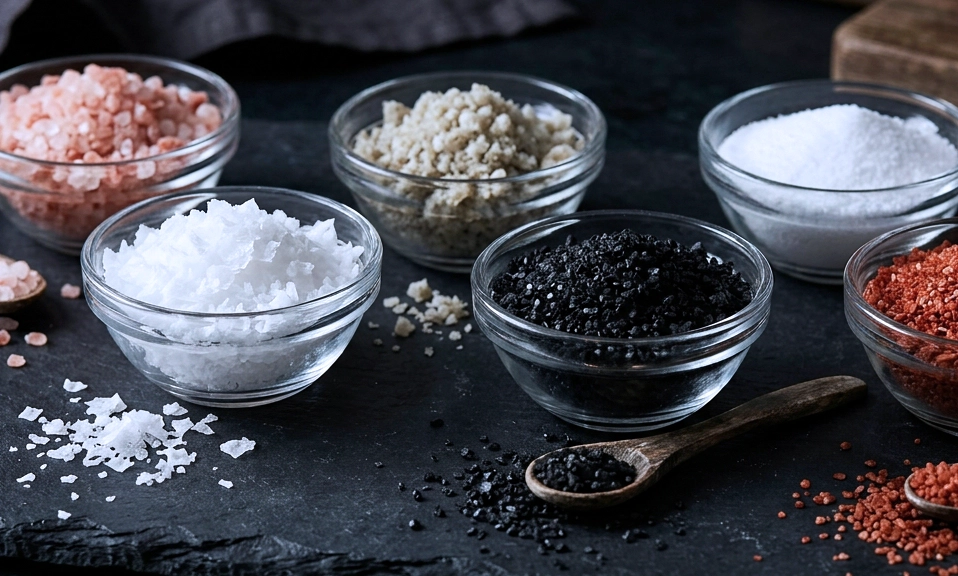
Walk into the spice aisle of any modern grocery store, and you won’t just find salt. You’ll find a rainbow of it.
There’s pink salt, gray salt, black salt, flaky salt, and smoked salt. For the average home cook, it can be incredibly overwhelming. Is Himalayan pink salt actually healthier? Why do professional chefs refuse to use the salt shaker? And does it really matter which one you toss into your pasta water?
The short answer is: Yes, it matters immensely.
While almost all culinary salt is roughly 98% to 99% sodium chloride, the remaining 1% to 2%—along with the size and shape of the crystals—completely changes how the salt tastes, how it dissolves, and how it behaves in your food.
Here is the ultimate breakdown of the 6 most common types of salt, what makes them unique, and exactly when you should be using them.
🧂 1. Table Salt: The Fine & Functional Standard
What it is: This is the classic, ultra-fine salt found in diner shakers and the back of most home pantries. It is mined from underground salt deposits and heavily refined to remove impurities and trace minerals. It almost always contains anti-caking agents (so it doesn’t clump in humid weather) and is fortified with iodine (a public health initiative started in the 1920s to prevent goiters). Texture & Flavor: Very fine, dense grains with a sharp, straightforward, and sometimes slightly metallic taste (due to the iodine). Best Use: Baking and pasta water. Because the grains are so tiny, table salt dissolves rapidly and evenly, making it perfect for baking breads and cookies, or salting a massive pot of boiling water. Pro Tip: Avoid using it for seasoning meat by hand; its fine texture makes it very easy to accidentally over-salt.
🔪 2. Kosher Salt: The Chef’s Darling
What it is: Despite the name, not all kosher salt is certified kosher. The name actually refers to the “koshering” process, where the large, coarse flakes were historically used to draw blood out of meat. Today, it is the undisputed king of professional kitchens. Texture & Flavor: Large, coarse, irregular flakes. It has a clean, pure salt flavor without the metallic tang of iodine. Best Use: Everyday cooking and seasoning meat. Because the flakes are large, it is incredibly easy to pick up with your fingers and “pinch” into dishes, giving you total control over your seasoning. It also adheres beautifully to the surface of steaks and chicken. Crucial Cooking Note: Because the flakes are large and irregular, a teaspoon of Kosher salt contains less actual salt than a teaspoon of fine table salt. (Brand matters too: Diamond Crystal is lighter and flakier than Morton, so you actually need twice as much Diamond Crystal to equal the saltiness of Morton!).
🌊 3. Sea Salt: The Versatile All-Rounder
What it is: Just like it sounds, this salt is made by evaporating seawater. Because it is less refined than table salt, it retains trace minerals from the water (like magnesium, calcium, and potassium), which can subtly alter its color and flavor depending on where it was harvested. Texture & Flavor: It can range from fine to coarse. It generally has a brighter, more complex, and slightly “briny” flavor compared to the flat taste of mined table salt. Best Use: General cooking and finishing. Medium-grind sea salt is a fantastic everyday replacement for table salt. A flaky, coarse sea salt (like Maldon) is incredible sprinkled over roasted vegetables, chocolate chip cookies, or a freshly seared steak right before serving to add a satisfying crunch.
🏔️ 4. Himalayan Pink Salt: The Aesthetic Mineral
What it is: Mined primarily from the Khewra Salt Mine in Pakistan, this ancient sea salt gets its signature rosy hue from trace amounts of iron oxide (rust). It is often marketed as the “purest” salt on earth. Texture & Flavor: Available in fine or coarse grinds. It tastes very similar to standard sea salt, though some palates detect a very faint, earthy minerality. Best Use: Cooking and presentation. It works perfectly as an everyday cooking salt. However, its biggest claim to fame is its physical form: it is often carved into massive “salt blocks” used to grill seafood, or sold in beautiful, coarse crystals for use in aesthetic salt grinders.
🌸 5. Fleur de Sel: The Luxury Finishing Salt
What it is: Translating to “flower of salt,” this is the crème de la crème of the salt world. Harvested by hand using traditional wooden rakes off the coast of Brittany, France, it is only collected when the sun and wind create a very specific, delicate crust on the surface of salt ponds. Texture & Flavor: Moist, delicate, and slightly gray (due to the clay lining the salt ponds). It has a complex, oceanic flavor and a distinct, crunchy texture that dissolves slowly on the tongue. Best Use: Finishing only. Never cook with Fleur de Sel; heat will destroy its delicate texture and waste your money. Use it as a final garnish over high-end steaks, sliced heirloom tomatoes, salted caramel, or fresh salads.
🪵 6. Smoked Salt: The Flavor Illusionist
What it is: This is usually a coarse sea salt that has been slow-smoked over real wood fires (like hickory, applewood, mesquite, or alder) for up to two weeks. Texture & Flavor: Coarse and dry, with a deep, intense, campfire-like aroma and flavor. Best Use: Adding depth to vegetarian dishes and BBQ. If you are making a vegan chili or roasting root vegetables and want a bacon-like, smoky depth without using meat, a pinch of smoked salt is magic. It’s also incredible rubbed onto pork ribs or used to rim the glass of a spicy margarita or a Bloody Mary.
⚠️ The “Health” Myth: Is Pink Salt Actually Better for You?
Let’s bust a massive wellness myth right now: Himalayan pink salt, sea salt, and kosher salt are not “healthier” than table salt.
Marketers love to highlight the “84 trace minerals” found in pink salt. While technically true, those minerals exist in such microscopic amounts that you would have to eat a lethal amount of salt to get any real nutritional benefit from them.
Furthermore, by weight, all of these salts contain roughly the exact same amount of sodium. The only reason a teaspoon of coarse kosher salt has less sodium than a teaspoon of table salt is because the large flakes take up more physical space (volume), leaving room for air.
Choose your salt based on texture, flavor, and culinary application, not based on the illusion that it will cure a disease. (Though if you don’t eat much seafood or dairy, you may want to ensure you are getting enough iodine, which is only reliably found in standard iodized table salt!).
Salt is a Tool, Not Just a Seasoning
Once you understand that salt is a culinary tool with different physical properties, your cooking will instantly improve.
Keep a cheap box of fine table salt for your baking and pasta water. Keep a large tub of Kosher salt next to your cutting board for everyday cooking and pinching. And keep a small, fancy tin of flaky sea salt or Fleur de Sel on the counter for those final, magical finishing touches.
Master the salt, and you master the flavor.
What is your go-to salt in the kitchen? Are you a Diamond Crystal Kosher loyalist, or do you love the crunch of flaky Maldon sea salt on your chocolate chip cookies? 🧂🍳🥩