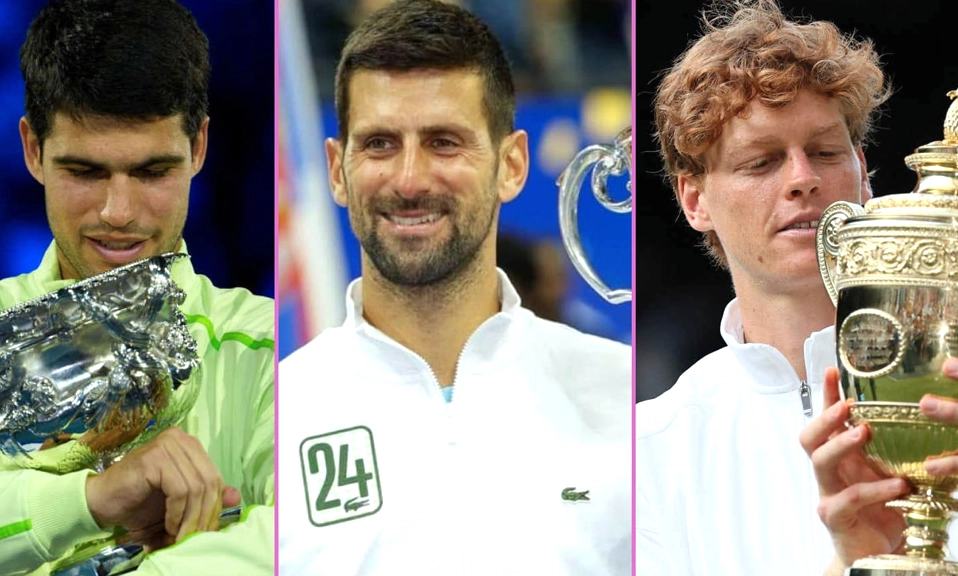
The era of Federer, Nadal, and Djokovic is over. Men’s tennis has spent years searching for its next defining rivalry, and for a while, it seemed to have found it in Carlos Alcaraz and Jannik Sinner. But 2026 tells a more complicated story—one where a single champion has seized control, a rival is fighting to keep pace, and a wave of young challengers is arriving faster than anyone expected.
This is the new era of men’s tennis: not a Big Three, not even a stable Big Two, but a fascinating, unsettled moment where the throne is occupied, the heir apparent is injured, and the next generation is knocking louder than ever.
The Big One: Jannik Sinner’s Year of Dominance
If you look only at the rankings, the state of men’s tennis is clear. Jannik Sinner ends 2026 as the world No. 1, holding a commanding 10,950 points—nearly 900 clear of Alexander Zverev in second and almost double Carlos Alcaraz’s 5,610 in third. That gap is not a quirk of scheduling; it reflects a season in which Sinner separated himself from the field.
Sinner’s 2026 has been a masterclass in consistency at the highest level. He successfully defended his Wimbledon title, defeating Zverev in the final, and in doing so extended his lead over Alcaraz in “Big Titles” to 17-15. More remarkably, he became the first player since 1990 to win the first five ATP Masters 1000 events of a season—Indian Wells, Miami, Monte Carlo, Madrid, and Rome—completing the career Golden Masters in the process. He has now won 10 Masters 1000 titles compared to Alcaraz’s eight, and his average of one Big Title every 4.2 tournaments is the best on tour.
The numbers paint a picture of a player who has not just reached the top but has built a sustained, almost mechanical excellence. At 25, Sinner is no longer a prospect. He is the benchmark.
The Challenger: Alcaraz’s Injury-Interrupted Year
Carlos Alcaraz remains the only player with a winning head-to-head record against Sinner (10-7), and when healthy, he is still the most electrifying talent in the sport. But 2026 was a year of what-ifs.
Alcaraz began the season in spectacular fashion, completing his career Grand Slam by winning the Australian Open in February. It was the moment he seemed poised to reclaim the No. 1 ranking and resume the rivalry that defined 2025, when he and Sinner met in three consecutive Grand Slam finals. Then, a right-wrist injury sidelined him for four and a half months, forcing him to miss both Roland Garros and Wimbledon.
By the time he returned, Sinner had built an almost unassailable lead. The two did not meet at a single major in 2026; their only encounter was in the Monte Carlo final, which Sinner won in straight sets. Alcaraz’s ranking dropped to third, and although he remains the most dangerous player on tour when fully fit, the gap between him and Sinner has widened in the standings.
The rivalry is far from over. Alcaraz is expected to return in 2027, and the tennis world is already anticipating the next chapter. But the dynamic has shifted: Sinner is no longer the challenger. He is the one being chased.
The Disruptors: Who Else Can Break Through?
Beyond the top two, the field is not standing still. Several players have the tools to make the next few years more than a two-man race.
Alexander Zverev finally shed the “best player without a Slam” label by winning Roland Garros in 2026, defeating Flavio Cobolli in five sets. At 29, he is no longer a young pretender, but the breakthrough—and his No. 2 ranking—makes him a genuine factor at every major. Lorenzo Musetti reached a career-high No. 5 in January 2026 but has since slipped to No. 26, battling form and injury; his talent is undeniable, but consistency remains elusive. Ben Shelton won his second consecutive Canadian Masters title and climbed to No. 6, establishing himself as the leading American contender. Holger Rune, once ranked No. 4, suffered a torn Achilles and has struggled in his comeback, falling outside the top 150—a reminder of how fragile a career at the top can be.
Then there is the generation that has not yet peaked.
The Next Wave: Fonseca, Mensik, and the Class of 2026
The most exciting development in men’s tennis is the emergence of a cohort that is not waiting for permission to challenge the establishment.
João Fonseca announced himself at Roland Garros, saving two sets to defeat Novak Djokovic in a five-set epic—becoming the first teenager to beat Djokovic at a major. He reached the quarterfinals, climbed to No. 25, and became the first Brazilian since Gustavo Kuerten to record 10 Masters 1000 wins in a season. At 19, he has the game and the charisma to become a global star.
Jakub Mensik, still only 20, won the Miami Masters in 2025 by defeating Djokovic in the final, and reached a career-high No. 12 in 2026. Learner Tien, the 20-year-old American, has climbed to No. 12 and earned praise from Zverev as “the most intelligent” player of the new generation. Rafael Jodar, a 20-year-old Spaniard, reached the Shanghai Masters final in October 2026, compiling a 43-17 tour-level record and rising to No. 11.
Djokovic himself identified Fonseca, Mensik, and Tien as “the generation” that will push the sport forward. And there are more coming: Moise Kouame, Federico Cina, Rei Sakamoto, and others are climbing the Next Gen ranks, ensuring that the pipeline of talent is not drying up.
A Sport in Transition
So who will dominate after the Big Three? The honest answer is that no single player has replaced them, and perhaps no one will. The Big Three era was an anomaly—three all-time greats whose careers overlapped in a way that may never be repeated.
What we have instead is a layered, competitive landscape. Sinner is the current king, a relentless, precise champion who has turned consistency into a weapon. Alcaraz is the rightful heir, a generational talent whose rivalry with Sinner remains the sport’s most compelling storyline, even as injuries have interrupted its rhythm. Zverev has broken through, and Shelton and Musetti have the tools to contend. And beneath them, Fonseca, Mensik, Tien, and Jodar are arriving with the confidence of players who believe they belong.
Men’s tennis is not searching for its next Big Three. It is entering an era of plural contenders, where dominance may be measured in seasons rather than decades, and where the next great rivalry could emerge from any direction. The throne is occupied. But the queue of challengers has never been longer.