For the first few years of the AI revolution, the battle was fought in the realm of software. It was about who had the smartest chatbot, the most elegant interface, or the best marketing.
But as we navigate 2026, the software war has given way to something much heavier, much more expensive, and much harder to replicate.
The AI boom is no longer just a tech story. It is a trillion-dollar global infrastructure race.
We are talking about a historic capital expenditure (CapEx) surge. The world’s largest tech companies are collectively spending hundreds of billions of dollars every year on data centers, custom silicon, power grids, and cooling systems.
But in a gold rush, the people who get rich aren’t always the ones digging for gold. They’re the ones selling the picks, shovels, and land. So, as the dust settles, who is actually positioned to win this unprecedented infrastructure race?
Let’s break down the contenders, the bottlenecks, and the dark horses.
👑 1. The Silicon Kings: Nvidia and TSMC (For Now)
The Play: Control the absolute bottleneck of compute.
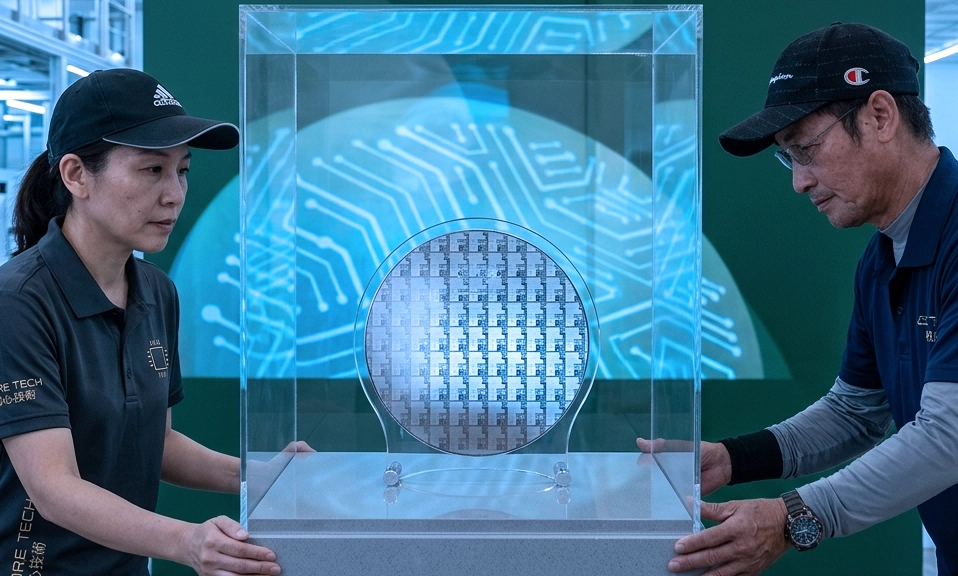
The Reality: Nvidia is the undisputed face of the AI boom, capturing the vast majority of AI accelerator revenue. But the real kingmaker is TSMC (Taiwan Semiconductor Manufacturing Company).
The Reality: Nvidia is the undisputed face of the AI boom, capturing the vast majority of AI accelerator revenue. But the real kingmaker is TSMC (Taiwan Semiconductor Manufacturing Company).
You can design the most brilliant AI chip in the world, but if TSMC doesn’t have the capacity to manufacture it and package it using advanced techniques like CoWoS (Chip-on-Wafer-on-Substrate), it’s just a PowerPoint slide. TSMC’s near-monopoly on advanced node manufacturing and advanced packaging makes it the most critical company in the global AI supply chain.
Will they win? Yes, in the short-to-medium term. But their margins are so high that they are actively incentivizing every other player on this list to find a way around them.
🏢 2. The Hyperscaler Rebellion: Microsoft, Google, Amazon, and Meta
The Play: Escape the “Nvidia Tax” by building custom, in-house silicon and proprietary data center architectures.
The Reality: The Big Four tech companies are not happy being mere customers. They are spending billions to design their own AI accelerators (like Google’s TPU/Axion, Amazon’s Trainium, Microsoft’s Maia, and Meta’s MTIA).
The Reality: The Big Four tech companies are not happy being mere customers. They are spending billions to design their own AI accelerators (like Google’s TPU/Axion, Amazon’s Trainium, Microsoft’s Maia, and Meta’s MTIA).
Why? Because when you are training models with hundreds of thousands of GPUs, saving even 15% on cost or power consumption per chip translates to billions of dollars in savings. Furthermore, custom silicon allows them to tightly integrate their hardware with their specific software stacks (like Azure or AWS), creating a moat that pure-play chipmakers can’t easily cross.
Will they win? They will win the application layer. By controlling the full stack (chip + cloud + model), they will capture the most sustainable, long-term enterprise value.
⚡ 3. The Physical Enablers: Energy, Cooling, and Real Estate
The Play: Provide the literal power and space required to keep the servers from melting.
The Reality: This is the most overlooked sector of the AI race, and arguably where the most explosive, unexpected growth is happening. You cannot run a trillion-parameter model on vibes. You need gigawatts of electricity.
The Reality: This is the most overlooked sector of the AI race, and arguably where the most explosive, unexpected growth is happening. You cannot run a trillion-parameter model on vibes. You need gigawatts of electricity.
- Power Providers: Tech giants are signing unprecedented, direct power-purchase agreements (PPAs) with nuclear energy providers (including Small Modular Reactors), geothermal plants, and massive solar farms. Companies that can guarantee 24/7, carbon-free baseload power are becoming as valuable as the chipmakers.
- Thermal Management: Traditional air cooling is dead for high-density AI racks. Companies specializing in direct-to-chip liquid cooling and immersion cooling are experiencing explosive demand.
- Data Center REITs: Land with access to high-voltage power lines and fiber-optic backbones is now the most coveted real estate on the planet.
Will they win? Absolutely. While tech companies fight over market share, the companies providing the power and cooling are collecting tolls from everyone.
🌍 4. The Geopolitical Wildcard: “Sovereign AI”
The Play: Nations building their own AI infrastructure to avoid reliance on the US or China.
The Reality: AI is now viewed as a matter of national security. Countries across the Middle East (like the UAE and Saudi Arabia), Europe, and parts of Asia are pouring billions into building “sovereign AI” clouds. They are buying up GPU clusters and building local data centers to ensure their data never leaves their borders and their AI capabilities aren’t subject to foreign export controls.
The Reality: AI is now viewed as a matter of national security. Countries across the Middle East (like the UAE and Saudi Arabia), Europe, and parts of Asia are pouring billions into building “sovereign AI” clouds. They are buying up GPU clusters and building local data centers to ensure their data never leaves their borders and their AI capabilities aren’t subject to foreign export controls.
Will they win? They won’t “win” the global race, but they are creating a massive, parallel, government-subsidized market that will keep infrastructure demand artificially high for the next decade, regardless of consumer software trends.
📉 The Great Vulnerability: The Bottlenecks That Could Derail the Race
No infrastructure race is without its roadblocks. The trillion-dollar buildout faces three massive threats:
- The Grid Wall: In the US and Europe, getting permission to build new high-voltage transmission lines can take 5 to 10 years. Data centers are ready to be built, but the local substations simply don’t have the capacity to power them.
- The Memory Crunch: AI chips are useless without HBM (High Bandwidth Memory). The production of HBM is incredibly complex and currently dominated by just two companies: SK Hynix and Samsung. Any yield issues here throttle the entire industry.
- The ROI Reckoning: As discussed in previous analyses, if the software layer fails to generate hundreds of billions in new revenue to justify this infrastructure spend, Wall Street will eventually force a brutal CapEx crackdown.
The Bottom Line: It’s Not a Winner-Take-All Game
So, who wins the trillion-dollar AI infrastructure race?
The answer is that it’s an ecosystem, but the power dynamics are shifting.
In 2023, the winner was clearly the company making the GPU. By 2026 and beyond, the winners will be the companies that solve the physical and systemic bottlenecks.
The ultimate victors will be:
- The Hyperscalers who successfully vertically integrate their custom silicon to lower costs.
- The Energy and Infrastructure providers who can reliably deliver gigawatts of clean power to remote data centers.
- The Advanced Packaging leaders (like TSMC) who hold the keys to physical production.
The AI revolution was born in software, but it will be won in concrete, copper, and silicon. The companies that understand they are now in the heavy industry business—not just the software business—will be the ones standing when the dust settles.
Do you think the hyperscalers can successfully break Nvidia’s monopoly with their own custom chips? And should we be worried about the massive energy demands of AI data centers?