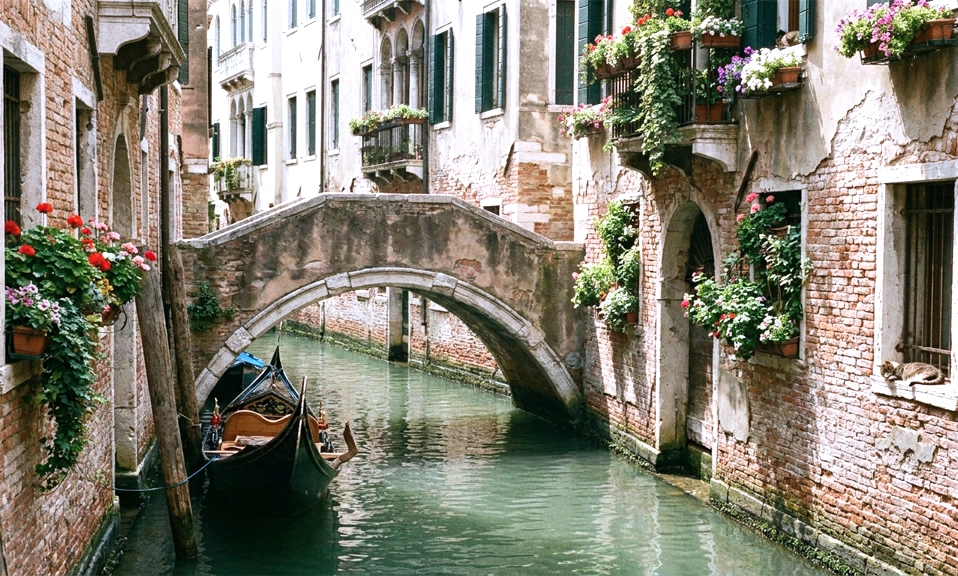
Imagine a bustling metropolis. It has hundreds of thousands of residents, millions of annual tourists, thousands of businesses, and a massive, complex infrastructure.
Now, imagine it has absolutely zero cars.
No traffic lights. No parking garages. No honking horns. No drive-thrus. No paved roads.
Welcome to Venice, Italy.
To the modern mind, conditioned by centuries of automobile-centric urban planning, a major city without cars sounds like a logistical nightmare. How do people commute? How do they get groceries? How do ambulances and fire trucks work?
But Venice hasn’t just survived without cars for over a millennium; it has thrived. It is a masterclass in human-scale urban design. Here is the fascinating reality of how a city where cars are useless actually functions.
🗺️ 1. The Geography of Impossibility
To understand why cars are useless here, you have to understand the map. The historic center of Venice isn’t a single landmass; it is composed of 118 small islands, separated by 150 canals and connected by over 400 bridges.
The “streets” are made of water. The “sidewalks” are narrow, winding pedestrian alleys called calli. There are no right angles, no grid systems, and no wide boulevards. Bringing a standard automobile into historic Venice wouldn’t just be illegal; physically, there is nowhere to put it.
(Note: Cars do exist in the greater Venice municipality, but they are restricted to the mainland district of Mestre and the far western edge of the islands at Piazzale Roma. Once you cross that bridge, the car era ends.)
🚶♂️ 2. The Ultimate Public Transit: Your Own Two Feet
In Venice, walking isn’t just a way to get around; it is the primary mode of transportation. The city is incredibly compact. You can walk from one end of the historic center to the other in about 45 to 60 minutes.
But navigating it is an art form. Because the streets were built organically in the Middle Ages, they are designed to confuse invaders. Locals joke about navigain (getting lost). You don’t navigate by street names; you navigate by landmarks. “Go straight until you hit the bakery, turn left at the well, cross the bridge, and it’s the third door on the right.”
Walking here is a sensory experience. Without the roar of engines, the city sounds like water lapping against stone, footsteps echoing on brick, distant church bells, and the hum of human conversation.
🚤 3. The Water Highways: Vaporettos and Water Taxis
When walking isn’t enough, Venetians take the bus. Except their buses float.
The vaporetto (water bus) is the lifeblood of the city. Operated by ACTV, these large, double-decker boats run on set routes along the Grand Canal and through the lagoon to the outer islands. They are the equivalent of the London Underground or the NYC Subway. Locals buy monthly passes, scan them at the dock, and commute to work, school, or the market just like anyone else.
For those who need speed, privacy, or are carrying heavy loads, there are water taxis. These are sleek, powerful, mahogany-trimmed speedboats. They are expensive, but they provide point-to-point service, dropping you off at the literal front door of your hotel or home.
📦 4. The Hidden Logistics: How a City Eats and Survives
This is the part that blows tourists’ minds. If there are no delivery trucks, how does Amazon get your package? How do restaurants get their food? How do they build things?
The Cargo Barges: Everything enters Venice by water. Large cargo barges navigate the canals, delivering everything from pallets of Prosecco to construction materials.
The Hand Carts (Carelli): Once the goods are unloaded at the dock, they are transferred onto specialized, heavy-duty hand carts. Local delivery workers push these carts through the narrow alleys, navigating over hundreds of bridges to deliver groceries, furniture, and packages directly to shops and apartments. It is hard, physical labor, and it is the only way the city’s supply chain functions.
🚑 5. Emergencies and Trash: The Unseen Water Fleet
What happens when there’s a fire or a medical emergency?
Venice has a highly specialized fleet of emergency boats.
- Ambulances: Specially designed, enclosed speedboats with shock-absorbing hulls to transport patients safely over the choppy water. When an ambulance boat is called, its siren echoes hauntingly across the water, and everyone on the sidewalks immediately steps back to the edge to let it pass.
- Fireboats: The Vigili del Fuoco (fire department) uses heavily equipped fireboats with massive water cannons. Because buildings are packed tightly together and made of historic masonry, rapid water response is critical.
- Trash Collection: Yes, even garbage is collected by boat. In the early hours of the morning, workers roll bins to the docks, where specialized garbage barges collect the waste and transport it to processing facilities on the mainland.
🛶 6. The Gondola Myth vs. Local Reality
Let’s address the elephant in the room: Gondolas.
Tourists see them everywhere and assume they are the local equivalent of a taxi. In reality, gondolas are highly regulated, incredibly expensive luxury tourist experiences. A local would never take a gondola to go grocery shopping.
However, locals do use gondolas in a highly practical way: the Traghetto. These are large, unornamented gondolas used strictly to ferry pedestrians across the Grand Canal at specific points where there are no bridges. For just a few euros, locals stand shoulder-to-shoulder in a gondola for a two-minute crossing. It’s the most authentic, everyday use of the iconic vessel.
🧠 7. The Psychological Shift: A City Built for Human Senses
Living in or visiting a car-free city fundamentally changes your psychology.
In a car-centric city, your environment is a blur. You move from an air-conditioned box (home) to a rolling box (car) to a climate-controlled box (office). You are insulated from the weather, the smells, and the sounds of your community.
In Venice, you are entirely exposed to the environment. You feel the humidity in the summer. You smell the salt water and the espresso. You hear the rhythm of the tides. The city forces you to slow down to the speed of a human stride. It is deeply intimate, occasionally frustrating, and undeniably magical.
A Blueprint for the Future?
As modern cities grapple with congestion, pollution, and the loss of public space, urban planners are increasingly looking at Venice not as a quaint relic, but as a profound lesson.
Venice proves that a dense, vibrant, economically thriving city does not require the internal combustion engine. It proves that when you remove cars, you don’t lose a city’s lifeblood; you give the space back to the people.
Cars are useless in Venice because the city was built for something much more enduring: human beings.