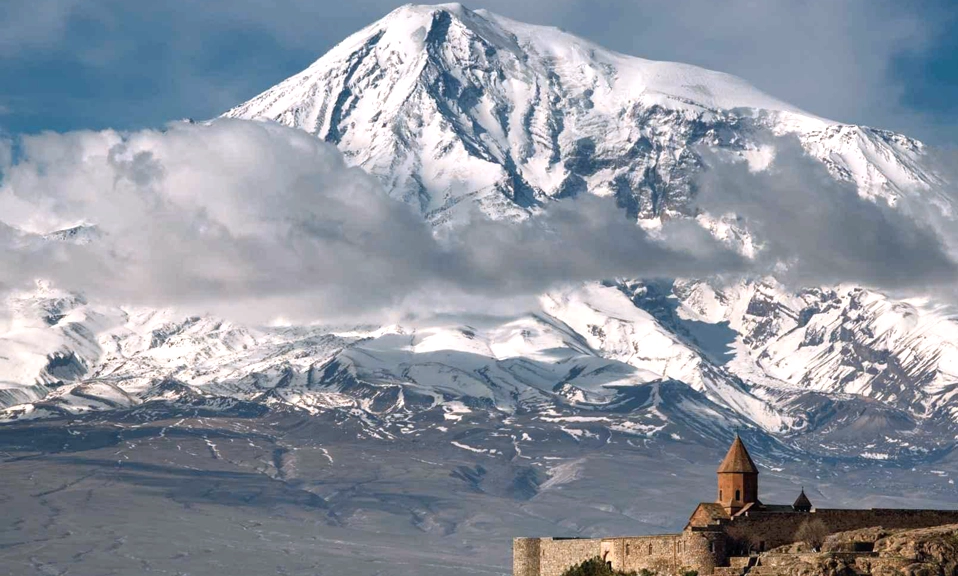
What Researchers Found Beneath Mount Ararat
For decades, the Durupınar formation has been dismissed by geologists as a natural quirk of the landscape — a boat-shaped mound of rock that happens to look like a ship. But new drilling, deeper radar scans, and a growing pile of soil samples are challenging that assumption. Something is buried beneath Mount Ararat. And researchers are finally starting to figure out what it might be.
The Site That Refuses to Be Explained
The Durupınar formation sits about 18 miles south of Mount Ararat in eastern Turkey. It’s a 515-foot-long, boat-shaped mound — roughly the dimensions the Bible gives for Noah’s Ark (300 cubits long, 50 cubits wide, 30 cubits high). It was first identified in 1959 when a Turkish Army captain spotted its ship-like outline in aerial survey photographs.
For most of the last century, the scientific consensus has been clear: Durupınar is a natural geological formation. A 1996 study concluded it was “a completely natural rock formation”. The skeptics had a simple explanation: it’s just a solid lump of rock that happens to look like a boat.
That explanation is now being tested like never before.
What Researchers Found Beneath the Surface
Underground Corridors and Chambers
In 2026, Dr. Khosrow Bakhtar — a veteran scientist who previously worked for the U.S. Department of Defense — brought a high-tech subsurface scanner called “BakhtarRadar” to the site. The technology is designed to filter out geological noise like rocks and dirt, revealing only the anomalies beneath.
What it found was startling. Bakhtar claims to have detected “massive underground corridors and chambers” running through the formation. Five prominent anomalies appeared to form a possible tunnel system stretching roughly 151 feet, with an average structural height of more than 14 feet. Other anomalies measured approximately 26 feet, 39 feet, and 23 feet high.
“This is the most significant finding for 40 years of my career,” Bakhtar said. “I have never seen this kind of anomaly before”.
He described a “very strong interface” — a dark line going all the way down — and noted that the signature strength remained consistent regardless of depth. “We can quantify the repeated anomalies that, when you connect them, form corridors,” he said. “I am a hundred per cent sure that they come from the same original object”.
A Three-Deck Structure?
The scans also identified a thick underground layer that appeared to divide into three parts. The research team compared this to the biblical description of the Ark being built with three decks — an observation they found difficult to dismiss as coincidence.
Organic Material and Decayed Wood
The drilling didn’t just reveal voids. It brought up soil. And the soil inside the formation contained carbon levels roughly 40% higher than samples taken outside it. According to the research team, that difference could be associated with a higher concentration of organic material — including, potentially, decayed wood.
Andrew Jones, founder of Noah’s Ark Scans, said the team recovered “layers of rich organic material that we believe could be the decayed top-tier remains of the Ark”. Previous soil testing in the area had already shown “extremely high levels of potassium, consistent with massive amounts of decomposed lumber”.
Crucially, the team did not encounter any solid block of rock while drilling. “We were hitting mainly soil,” Jones said. “We’re still studying our results, but we believe that this should give skeptics pause when they say this is a rock formation”.
Pottery Fragments Nearby
The team also discovered pottery fragments in the broader area surrounding the formation. The pottery dates from the Chalcolithic (Copper Age) through the Iron Age — a period potentially relevant to the traditional Noah’s Ark timeline. However, none of the fragments were found inside the formation itself.
Jones suggested the pottery could be connected to ancient settlements that once existed near the site. “You can connect the dots,” he said. “If this is Noah’s Ark, we have people living right beside it”.
The Drilling Project: A First for the Site
The 2026 field season marked the first time researchers have physically drilled into the Durupınar formation. An international team of around 20 researchers from five countries collected hundreds of soil samples from both inside and outside the formation, with some samples taken from depths of approximately 60 feet.
The team used an “underground robot built to go where a person cannot” equipped with a high-resolution camera to explore the interior.
“With hundreds of soil samples from both inside and outside the formation, some reaching 60 feet in depth, experts said analysis will show if man-made activity or decaying wood sit in the soil”.
The samples are now undergoing laboratory analysis over the winter. Radiocarbon dating will be needed to determine whether any organic material is old enough to match the biblical timeline.
The Skeptics: Extraordinary Claims, Ordinary Evidence?
The scientific community remains deeply skeptical.
A 1996 study by geologist Lorence Collins and explorer David Fasold concluded that Durupınar was “a completely natural rock formation,” calling the theory that it contained the Ark’s remains “bogus”. That conclusion has never been overturned by peer-reviewed research.
Geologists insist that extraordinary claims require extraordinary evidence — and so far, the evidence remains preliminary. The radar readings are not photographs of actual rooms or passageways. They show how radar waves reacted to different materials and boundaries beneath the ground. The organic material has not been confirmed as wood, and nothing has been scientifically dated to 4,300 years ago.
Even Dr. Bakhtar himself has said he remains “open-minded about what actually made the mysterious outline”.
The team’s own vice president, Andrew Jones, acknowledged that “the evidence has not definitively identified the formation as the biblical vessel”.
The field work for 2026
is complete. The samples are now in laboratories, undergoing the analysis that will determine whether the organic material is decayed wood — and if so, how old it is.
The full scan is expected to be completed in November 2026, with laboratory results to be released later.
“What excites me most is that questions debated for decades can now be investigated using physical samples from documented locations and depths,” Jones said.
Those results will be decisive. If the organic material is ancient wood, and if the structure beneath the surface matches the dimensions and layout described in the Bible, the case for Durupınar as Noah’s Ark will become much harder to dismiss. If the material turns out to be nothing more than natural sediment and decomposed plant matter, the skeptics will have their answer — and the search will continue elsewhere.
For now, the world waits. The mountain holds its secrets. And the drill has only just begun to scratch the surface.