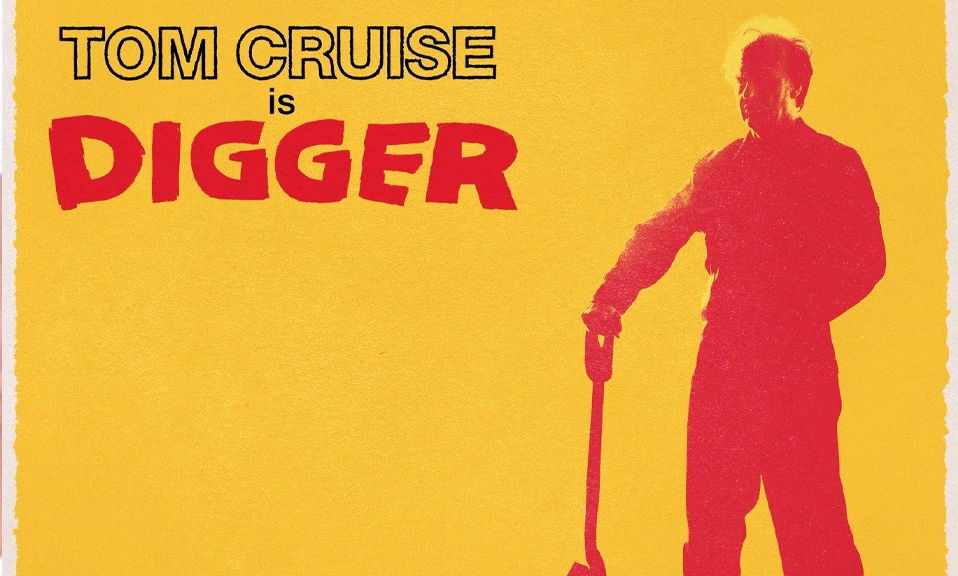
Inside Hollywood’s Most Unexpected Film
He has hung off the side of a plane, scaled the Burj Khalifa, and jumped a motorcycle off a cliff. But for his latest role, Tom Cruise did something far scarier: he disappeared.
In Digger, Alejandro G. Iñárritu’s “comedy of catastrophic proportions,” Cruise is not the ageless, athletic hero audiences have come to expect. He is Digger Rockwell, a balding, paunchy, gravel-voiced oil tycoon whose arrogance triggers a global climate disaster — and who then frantically tries to position himself as the only man capable of saving the world he broke. It is the “weirdest film” Cruise has ever made, and it is unlike anything in his filmography.
The film opened on October 2, 2026, and it has already become one of the most polarising releases of the year. Here’s everything you need to know about Hollywood’s most unexpected movie.
The Plot: A Disaster of His Own Making
Cruise plays Digger Rockwell, described as “the most powerful man in the world” — an oil billionaire who has built an empire on reckless extraction. When one of his drilling operations in Antarctica cracks a glacier in two, an iceberg “the size of a small country” breaks off and drifts toward northern Europe, threatening to submerge major cities within days.
Digger’s response to the crisis is the film’s satirical engine. He feigns ignorance, laughs off the problem, rants about the jobs he’s created, and passes the buck to his underlings. Then, when reality becomes undeniable, he pivots to a new strategy: convincing the world that the man responsible for the catastrophe may also be the only one capable of stopping it.
The ensemble cast includes Riz Ahmed as Ganesh, Sandra Hüller as Digger’s half-sister and a green-energy entrepreneur, John Goodman as a blowhard US president, and Jesse Plemons, Michael Stuhlbarg, and Emma D’Arcy in supporting roles.
The Transformation: Tom Cruise, Unrecognisable
The most immediate thing you notice about Digger is that it doesn’t look like a Tom Cruise movie. It doesn’t look like Tom Cruise, period.
With a mountain of prosthetic make-up — including a balding grey wig, a prosthetic pot belly, and subtle changes to his facial volume — Cruise is virtually unrecognisable as the paunchy Texan oil baron. The transformation was achieved by Academy Award-winning make-up artist Kazu Hiro, whose work has been praised for making “the prosthetic just disappear into the transformation”.
Cruise has spoken about the gruelling process, which originally took six hours to complete. He worked with the team to bring it down to under an hour. “The make-up was taking so long,” he said, comparing the precision needed to a Formula 1 pit stop.
The result is a performance that reviewers have called “fascinating,” “searing,” and “one of the most interesting” of his career — a reminder, as one critic put it, that Cruise “was once one of the most talented and interesting leading men in Hollywood”.
The Director: Iñárritu’s Boldest Swing
Digger is directed by Alejandro G. Iñárritu, the Mexican filmmaker behind Birdman, The Revenant, and Amores Perros. Iñárritu co-wrote the screenplay with Sabina Berman, Alexander Dinelaris, and Nicolás Giacobone — the same writing team behind Birdman.
Iñárritu has described the film as a satire about “climate change, corporate overlords and propaganda,” and he has been candid about its flaws. “The movie is not perfect,” he admitted. But he has also defended its polarising reception, saying he “prefers that to the lukewarm reception”.
The director’s vision was uncompromising from the start. Digger was shot entirely in VistaVision, a widescreen 35mm format introduced by Paramount in 1954 that runs film horizontally across eight perforations per frame. It is a notoriously difficult format to work with, and Iñárritu chose it deliberately to give the film a distinct, textured visual language.
The cinematographer is Emmanuel “Chivo” Lubezki, a three-time Oscar winner and Iñárritu’s longtime collaborator. Together, they have created a film that “delivers in scale, ambition and reach at a theatrical screen level,” according to fellow director Guillermo del Toro, who publicly defended the film against “petty” coverage.
The Reviews: A Love-It-or-Hate-It Divide
The critical response to Digger has been almost evenly split, with some reviewers hailing it as a masterpiece and others calling it an “insufferable” misfire.
The BBC gave it four stars, calling it “the weirdest film Cruise has ever made” and praising his performance as “the biggest risk of his career”. CBC News said Cruise is “fantastic,” delivering “searing, complex, southern-inflected line after line”.
But the New York Post was scathing, calling it a “laugh-free turd” that “will have audiences stampeding out”. The Telegraph India argued that while Cruise “goes all in,” Iñárritu’s “wild satire goes too far”.
The divide is the point, according to Iñárritu. “This is not like an ice cream,” he said. “It’s a film that asks something of you”.
The Ending: A Twist That Reframes Everything
Digger contains a twist so significant that it changes the meaning of the entire film — and it’s the reason the movie is not a straightforward climate satire.
Major spoilers ahead.
The story of Digger Rockwell is revealed to be a play within the film. Tom Cruise is not playing Digger Rockwell. He is playing an actor named Curtis Markson, who is portraying Digger Rockwell on stage. The events of the film — the disaster, the scramble, the attempts to save the world — are part of a theatrical production called “Fossil Fools”, depicting events that occurred decades prior.
The play’s final scene shows Digger dying by suicide, stepping off his oil platform. The audience erupts in applause. Curtis, the actor, learns that his daughter is safe.
The twist transforms Digger from a climate satire into a story about storytelling itself — about whether telling a story about a disaster can make the real disaster disappear, and about the gap between fiction and truth. It is, as one analysis put it, “a dark mirror for Cruise’s savior persona” — a reflection on the roles he has played and the myth of the hero who fixes everything.
The Box Office: A Historic Flop
There is no way to soften the numbers. Digger is one of the biggest box office bombs of Tom Cruise’s career.
Against a production budget of $160–$180 million and a marketing spend of around $100 million**, the film opened to just **$8 million domestically and $20 million globally. It finished fifth in North America, behind Verity, Resident Evil, Heart of the Beast, and Primetime.
Industry projections suggest the film is on track to lose between $150 million and $250 million theatrically — a loss that would make it one of the biggest flops of 2026.
Cruise, for his part, has refused to judge the film by its opening weekend. “When I am making [movies], I’m not going, ‘Opening weekend!'” he said in an interview published the same day the film opened. “I feel very much like we’re going to make something that is a lasting piece of cinema”.
He has compared Digger to Ridley Scott’s Blade Runner, a film that was savaged on release and later recognised as a masterpiece. “They transcend… you just hope you can make a film that can last”.
Digger is not a
movie for everyone. It is a hectoring, conceptually challenging, visually extraordinary eco-satire that asks its audience to sit with discomfort — and then pulls the rug out from under them with a twist that redefines everything they’ve just watched.
It is also, unquestionably, the boldest artistic risk of Tom Cruise’s career. He is not saving the world. He is not running from explosions. He is a balding, paunchy oil tycoon in prosthetics, delivering “searing, complex” monologues about power and denial. And in the end, he is not even that.
Whether Digger is a misunderstood masterpiece or an indulgent misfire will be debated for years. What is certain is that Tom Cruise — the last true movie star, the man who does his own stunts, the embodiment of Hollywood’s blockbuster machine — made a film that no one expected him to make.
And that, in itself, is worth something.
Digger is in theaters and IMAX now.