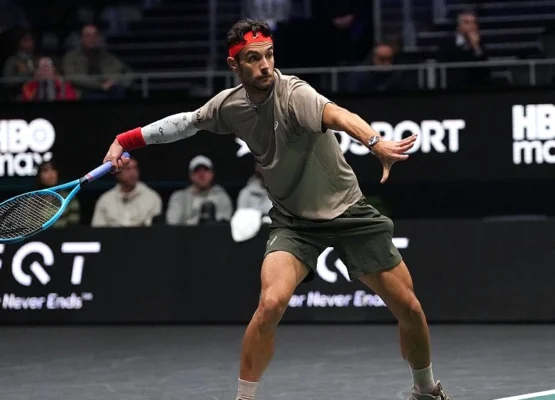
Rinky Hijikata almost didn’t take the court. His neck was cooked. He’d barely slept. And for a set and a half, it looked like he shouldn’t have bothered. Then he started hitting forehands, and the greatest player of his generation couldn’t touch him.
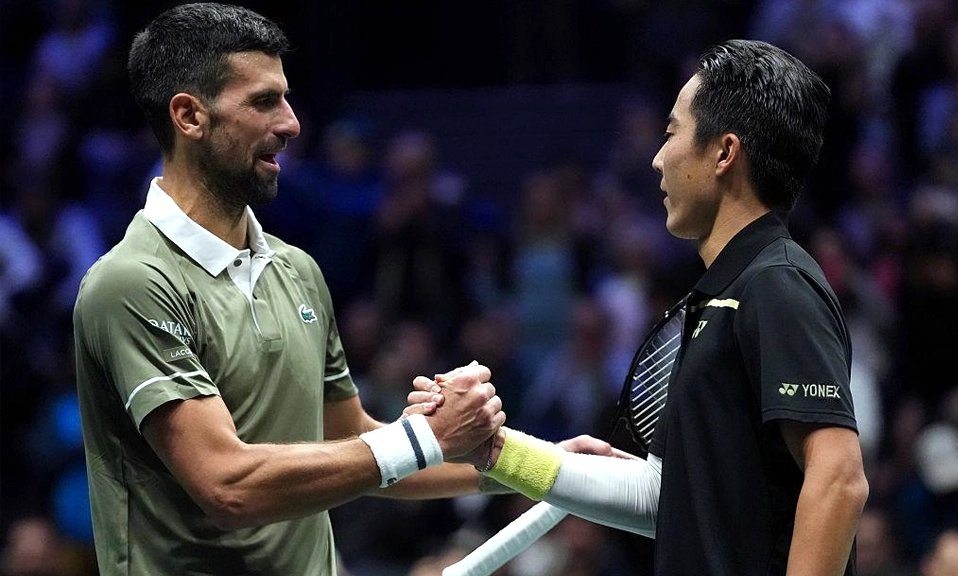
World No. 83. A qualifier. A 25-year-old Australian who had never beaten a top-20 player before this season. And on Wednesday night in Paris, he beat Novak Djokovic — 24-time Grand Slam champion, seven-time Paris Masters champion, the man who has spent two decades turning impossible comebacks into routine — 2-6, 6-3, 6-3 in two hours and 13 minutes.
It was the biggest win of Hijikata’s career. It may also be the moment the ATP Finals race — and the final chapter of Djokovic’s 2026 season — was decided.
The Match: From Hopeless to Unplayable
Djokovic was imperious in the first set. Hijikata admitted he “wasn’t even close to his level” — the Serbian was serving well, controlling the baseline, and looking every bit the player who had reached the Australian Open final in January and won his 102nd tour-level title in Beijing just last month.
Then the match turned.
Hijikata broke Djokovic in the eighth game of the second set and served it out to force a decider. In the third, he broke again at 3-3, then broke once more to seal the match in style.
The statistics tell the story of the turnaround. Hijikata finished with 37 winners, including 29 forehand bullets — the last of which, fittingly, came on a second serve to close out the biggest victory of his life.
Djokovic was gracious in defeat, and unsparing in his self-assessment.
“He was just playing out of his mind, honestly. He was not missing, keeping the ball low. It was a terrific performance. Nobody loves losing. It’s just another match, but I should’ve won this match. I played well in the first set and then completely lost control”.
The Quote That Says Everything
Hijikata’s own account of the match was disarmingly honest.
“I wasn’t even close to his level in that set. I couldn’t touch his serve either, he was acing me for fun. I knew I just had to really hang tough, and take it to him and play aggressive, impose myself, and I guess in the end I was glad I could maintain my level for as long as I did and trust myself in the big moments”.
He also revealed just how close he came to withdrawing.
“I just cooked my neck a bit yesterday and, to be honest, it wasn’t feeling great last night or this morning. But I guess a bit of adrenaline kicked in and I was going to do whatever I could”.
The Significance: A Career-Defining Win — and a Season-Ending Loss
For Hijikata, the victory is a career milestone. It was his fourth top-20 win of 2026 — and his first ever, before this season. He became just the fourth Australian to beat Djokovic, joining Alex de Minaur, Nick Kyrgios, and Lleyton Hewitt. And he became the lowest-ranked player to defeat Djokovic this year.
For Djokovic, the defeat is more consequential. He needed a run to the Paris semi-finals to keep his hopes of qualifying for the ATP Finals alive. The loss ended those hopes — and denied him the chance to earn a record 19th qualification for the season-ending championship he has won seven times.
It is not the end of Djokovic’s career. But it is a reminder that at 39, every match now carries the weight of a season’s worth of effort — and that the margins at the top of men’s tennis are thinner than they have been in years.
The Follow-Up: This Wasn’t a One-Off
The most impressive thing about Hijikata’s win isn’t the upset itself. It’s what he did next.
On Thursday, he backed it up, beating Tomas Martin Etcheverry — the Argentine who had just knocked out Alex de Minaur — 2-6, 6-3, 7-5 to reach his first ATP Masters quarter-final. He will climb into the world’s top 60 for the first time in his career, and could rise to No. 48 if he wins again.
He will face Frenchman Luca Van Assche in the quarter-finals, with the home crowd behind his opponent.
Many underdogs pull off a shock and then fade. Hijikata didn’t. He kept playing aggressive tennis, kept trusting his forehand, and kept winning.
Rinky Hijikata is not a
household name. He may never be. But on a Wednesday night in Paris, he did something that only three other Australians have ever done: he beat Novak Djokovic. And then he proved it wasn’t a fluke.
Djokovic will rest, regroup, and return. He always does. But the 2026 season ended for him in Paris — not with a title, but with a loss to a qualifier who almost didn’t play.
Hijikata, meanwhile, is into the quarter-finals of a Masters 1000 for the first time, inside the top 60 for the first time, and playing the best tennis of his life.
The biggest win of his career was just the beginning.