If you ask a room full of people who invented the airplane, 99% of them will give you the same two-word answer: The Wright Brothers.
And technically, they aren’t wrong. Orville and Wilbur Wright are universally credited with achieving the first successful, powered, controlled, and sustained flight of a heavier-than-air aircraft on December 17, 1903, in Kitty Hawk, North Carolina.
But the true story of the airplane’s invention isn’t a simple “eureka!” moment by two bicycle mechanics. It’s a messy, fascinating, and highly contested relay race that spans centuries, continents, and countless brilliant (and sometimes tragic) minds.
So, who really invented the plane? Let’s untangle the history of human flight.
📜 1. The Early Dreamers: Drawing the Blueprint
Long before engines existed, humans were obsessed with the sky.
- Leonardo da Vinci (15th Century): The ultimate Renaissance man sketched designs for “ornithopters” (machines with flapping wings) and parachutes. While none were built in his lifetime, his anatomical studies of bird flight laid the early conceptual groundwork.
- Sir George Cayley (Early 1800s): Known as the “Father of Aerodynamics,” this English baronet was the first to separate the problems of lift, drag, and thrust. He built the first successful human-carrying gliders and correctly deduced that a fixed-wing aircraft with a separate propulsion system was the key to flight.
🪂 2. The Glider Pioneers: Learning to Fall with Style
Before you could add an engine, you had to master unpowered flight.
- Otto Lilienthal (1890s): This German pioneer, known as the “Glider King,” made over 2,000 successful flights in his hang gliders. He proved that human flight was possible and published crucial data on wing shapes (airfoils). Tragically, he died in 1896 when his glider stalled and crashed, but his data became the foundation for future inventors—including the Wrights.
- Octave Chanute: An American civil engineer who compiled all the world’s knowledge on aviation up to 1894 in his book Progress in Flying Machines. He became a crucial mentor and correspondent to the Wright Brothers, freely sharing his research.
🚲 3. The Breakthrough: Why the Wright Brothers Get the Credit
So, if others were building gliders and experimenting with engines, why do Orville and Wilbur get the crown?
Because they solved the hardest problem in aviation: Control.
Earlier inventors focused almost entirely on making an engine powerful enough to lift a plane. The Wrights realized that a powerful engine was useless if the pilot couldn’t steer the aircraft once it was in the air.
Through meticulous wind tunnel testing in their bicycle shop in Dayton, Ohio, they developed a revolutionary three-axis control system:
- Roll (wing-warping, later replaced by ailerons)
- Pitch (an elevator at the front of the plane)
- Yaw (a rear rudder)
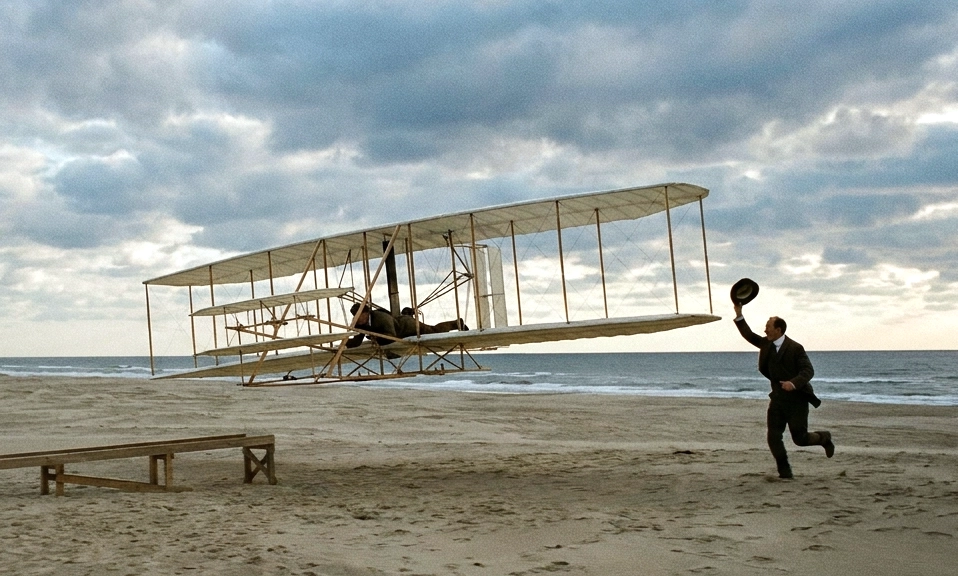
This system allowed the pilot to actively balance and steer the aircraft in all directions. On December 17, 1903, the Wright Flyer stayed aloft for 12 seconds and covered 120 feet. Later that day, Wilbur flew it for 59 seconds over 852 feet. It was the first time in history a machine carrying a human had raised itself by its own power, moved forward, and landed safely under the pilot’s control.
🌍 4. The Contenders and Controversies
History is rarely clean, and the title of “first inventor” has been fiercely debated, especially outside the United States.
- Gustave Whitehead: A German immigrant in Connecticut who claimed to have flown a powered aircraft in 1901, two years before the Wrights. While some modern enthusiasts champion his cause, the majority of aviation historians dismiss his claims due to a lack of credible photographic evidence or contemporary documentation.
- Richard Pearse: A New Zealand farmer who allegedly flew a homemade, engine-powered monoplane in early 1903. While he was undoubtedly a brilliant, ahead-of-his-time inventor, his flights were likely uncontrolled hops, and he never claimed to have achieved sustained, controlled flight.
- Alberto Santos-Dumont: In Brazil and much of Europe, Santos-Dumont is considered the true father of the airplane. In 1906, he flew his 14-bis aircraft in Paris. Why does he get so much credit? Because the Wright Brothers conducted their early flights in secret, trying to patent their technology and sell it to governments. Santos-Dumont’s 1906 flight was the first public, officially witnessed, and verified powered flight in the world, done without catapults or rails.
🏆 5. The Real Answer: Invention is a Relay Race
The truth is, no single person “invented” the airplane.
Cayley defined the physics. Lilienthal proved the gliding concepts. Langley and Maxim experimented with heavy, under-controlled steam and gas engines. Chanute shared the data. And the Wright Brothers synthesized all of this knowledge, added their own genius for mechanical control, and crossed the finish line first.
Even after 1903, the airplane continued to evolve rapidly. Glenn Curtiss improved on the Wrights’ designs (and fought them in brutal patent wars), Igor Sikorsky invented the first practical helicopter, and Frank Whittle and Hans von Ohain independently developed the jet engine.
The Genius of Iteration
If you want a simple answer for a trivia night: The Wright Brothers.
But if you want the real answer, the invention of the airplane was a global, collaborative, and iterative process. It was built on the failures, data, and dreams of dozens of pioneers who refused to accept that the sky was the limit.
The Wright Brothers didn’t pull an airplane out of thin air. They stood on the shoulders of giants, added a bicycle mechanic’s understanding of balance, and gave humanity the wings it had been dreaming of for centuries.