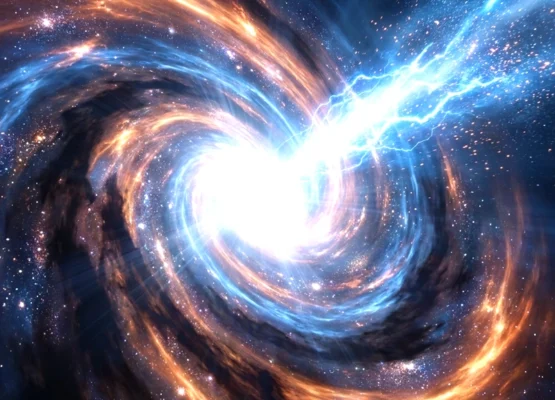
Have you ever scrolled through space photos and thought, “I wish I could visit places like that”?
What if I told you that you don’t need a rocket ship or a multimillion-dollar space tourism ticket to walk on alien terrain? Our own planet harbors landscapes so surreal, so utterly bizarre, that they could easily pass for Mars, Venus, or a moon of Jupiter.
From neon-colored geysers to mirror-like salt flats, from glowing caves to blood-red waterfalls, Earth is home to some of the most otherworldly landscapes in the known universe. These places are so extreme, so visually stunning, that NASA actually uses them to train astronauts and test rover technology.
Pack your bags (no spacesuit required). Here are 10 places on Earth that look like they belong to another planet.
1. Socotra Island, Yemen – The Alien Archipelago
Looks Like: A sci-fi fantasy planet
Often dubbed “the most alien-looking place on Earth,” Socotra Island is a UNESCO World Heritage site that boasts surreal landscapes and unique biodiversity found nowhere else on the planet.
The island’s claim to fame? The Dragon’s Blood Trees—bizarre, umbrella-shaped trees that look like giant green mushrooms sprouting from the rocky soil. When cut, they ooze a deep red resin that looks like blood (hence the name).
About 37% of Socotra’s plant species, 90% of its reptiles, and 95% of its land snails exist nowhere else on Earth. It’s so isolated and unique that it feels like stepping onto a planet that evolved completely independently from the rest of Earth.
Where: Arabian Sea, Yemen (best visited October-April)
2. Salar de Uyuni, Bolivia – The World’s Largest Mirror
Looks Like: An infinite white void or icy moon
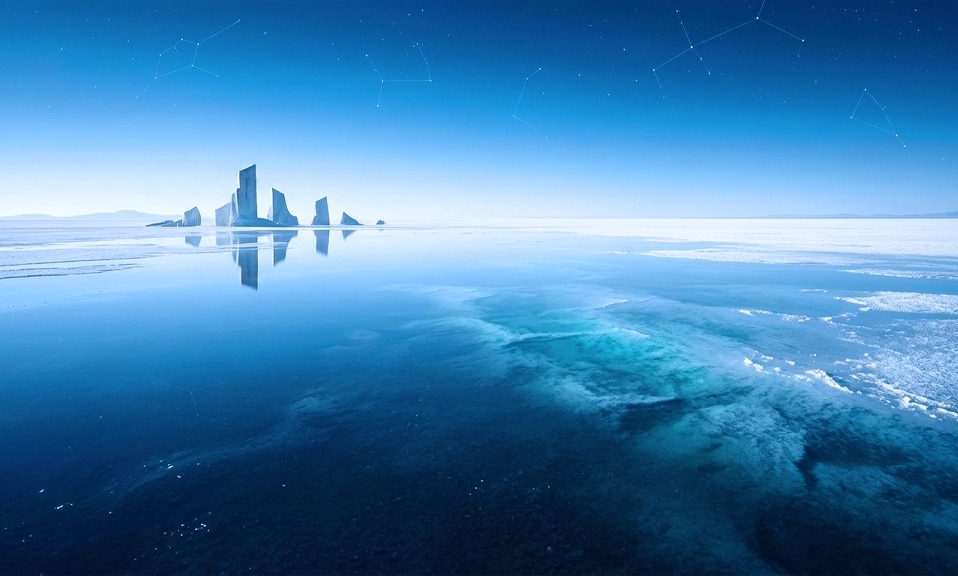
The Salar de Uyuni is the world’s largest salt flat, covering over 4,000 square miles of southwestern Bolivia
. During the dry season, it’s a blindingly white hexagonal-tiled desert that stretches to the horizon. But during the rainy season, a thin layer of water transforms it into the world’s largest natural mirror, perfectly reflecting the sky above.
. During the dry season, it’s a blindingly white hexagonal-tiled desert that stretches to the horizon. But during the rainy season, a thin layer of water transforms it into the world’s largest natural mirror, perfectly reflecting the sky above.
The effect is so disorienting that it becomes impossible to tell where the earth ends and the sky begins. It’s like walking on clouds—or perhaps the frozen surface of Europa, one of Jupiter’s moons.
Fun Fact: The salt flat contains an estimated 10 billion tons of salt and holds much of the world’s lithium reserves.
Where: Southwest Bolivia, near the Andes (visit November-March for the mirror effect)
2. Salar de Uyuni, Bolivia – The World’s Largest Mirror
Looks Like: An infinite white void or icy moon
The Salar de Uyuni is the world’s largest salt flat, covering over 4,000 square miles of southwestern Bolivia
. During the dry season, it’s a blindingly white hexagonal-tiled desert that stretches to the horizon. But during the rainy season, a thin layer of water transforms it into the world’s largest natural mirror, perfectly reflecting the sky above.
. During the dry season, it’s a blindingly white hexagonal-tiled desert that stretches to the horizon. But during the rainy season, a thin layer of water transforms it into the world’s largest natural mirror, perfectly reflecting the sky above.
The effect is so disorienting that it becomes impossible to tell where the earth ends and the sky begins. It’s like walking on clouds—or perhaps the frozen surface of Europa, one of Jupiter’s moons.
Fun Fact: The salt flat contains an estimated 10 billion tons of salt and holds much of the world’s lithium reserves.
Where: Southwest Bolivia, near the Andes (visit November-March for the mirror effect)
3. Dallol (Danakil Depression), Ethiopia – Acidic Hellscape ☠️
Looks Like: Venus or a volcanic moon
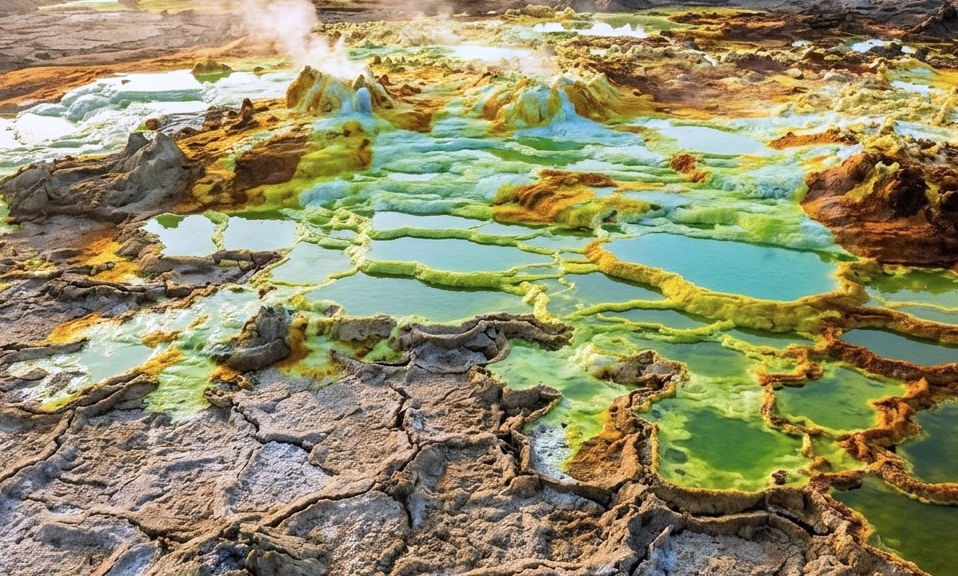
The Danakil Depression is one of the hottest, most inhospitable places on Earth—and one of the most visually stunning. At Dallol, geothermal activity creates neon-yellow sulfur springs, acidic pools, and salt formations in shades of green, orange, and red that look like they were painted by a mad artist.
Temperatures regularly exceed 120°F (49°C), and the air is thick with toxic gases. The landscape is so extreme that scientists study it to understand what life might look like on other planets—or whether life could exist in such conditions at all.
Warning: This is not a casual tourist destination. You need guides, and the area is genuinely dangerous.
Where: Afar Region, Ethiopia
4. Lake Hillier, Australia – The Bubblegum Pink Lake 💗
Looks Like: An alien chemical spill or exotic ocean world
Lake Hillier is a salt lake on Middle Island off the coast of Western Australia that defies logic. The water is a shocking, permanent bubblegum pink—so vivid it looks like someone dumped food coloring into it.
What causes the color? Scientists believe it’s a combination of salt-loving bacteria (halophiles) and algae that produce carotenoid pigments. The pink contrasts starkly with the deep blue of the Southern Ocean and the green eucalyptus forest surrounding it, creating a color palette that looks digitally altered.
Despite its unnatural appearance, the water is actually safe to swim in (though getting there requires a boat or helicopter).
Where: Recherche Archipelago, Western Australia
5. Wadi Rum, Jordan – The Valley of the Moon 🌙
Looks Like: Mars (literally)
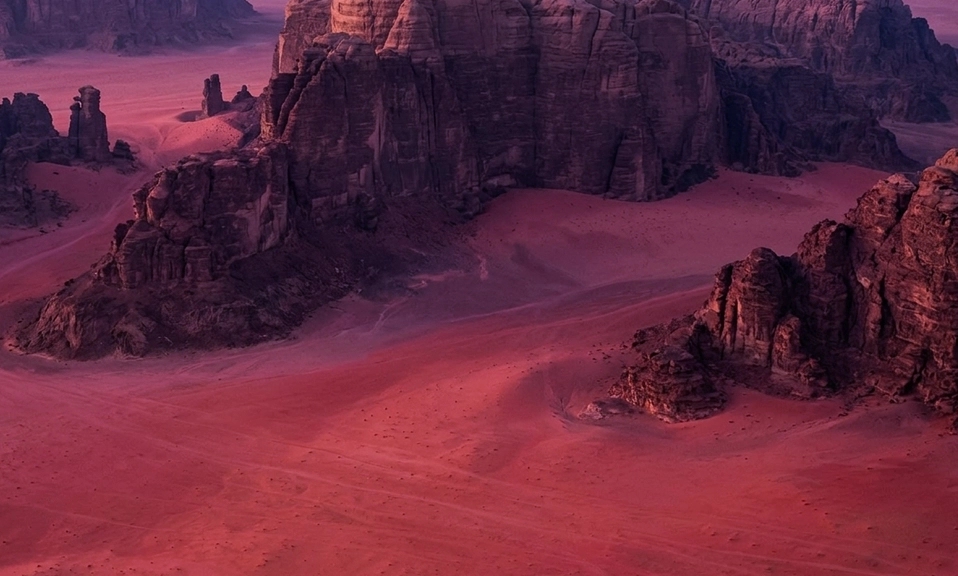
Wadi Rum’s dramatic desert landscape of red sand, towering sandstone cliffs, and narrow canyons looks so much like Mars that NASA used it to test Mars rover technology. It’s also where they filmed The Martian, Rogue One: A Star Wars Story, and Dune.
The desert’s rust-colored sand, dramatic rock formations, and vast, empty horizons create an eerily silent, otherworldly atmosphere. At night, the lack of light pollution makes the Milky Way so bright it looks like you could reach out and touch it.
Where: Southern Jordan (best visited March-May or September-November).
6. Waitomo Glowworm Caves, New Zealand – The Underground Galaxy ✨
Looks Like: A bioluminescent alien world
Deep underground in New Zealand’s Waitomo region, thousands of tiny glowworms (Arachnocampa luminosa) create a living starfield on cave ceilings. The effect is so mesmerizing that it feels like floating through space or diving into a nebula.
These aren’t your average worms—they’re actually the larval stage of a fungus gnat unique to New Zealand. They produce a blue-green bioluminescent light to attract prey, and when you see thousands of them clustered together, the effect is pure magic.
The best way to experience it? A silent boat ride through the Glowworm Grotto, where you can only hear the dripping water and see the living stars above.
Where: North Island, New Zealand
7. Zhangye Danxia, China – The Rainbow Mountains 🌈
Looks Like: A psychedelic alien planet
The Zhangye Danxia Landform in China’s Gansu Province looks like someone took a giant paintbrush and striped the mountains in vivid shades of red, orange, yellow, green, and purple. The surreal colors come from mineral deposits—iron, sandstone, and other minerals—that have been layered and folded over 24 million years.
The result is a landscape that looks so impossibly colorful that visitors often assume the photos are Photoshopped. They’re not. These mountains are 100% real and 100% mind-blowing.
Where: Gansu Province, China (UNESCO World Heritage Site)
8. Pamukkale, Turkey – The Cotton Castle 🤍
Looks Like: A frozen alien waterfall or icy moon
Pamukkale, which means “cotton castle” in Turkish, is a natural wonder of travertine terraces formed by mineral-rich thermal waters. The brilliant white calcium carbonate deposits cascade down the mountainside in a series of pools and waterfalls that look like they’ve been frozen in time.
The thermal waters have been used as a spa since ancient times—the Greco-Roman city of Hierapolis sits right on top of the terraces. Today, you can walk barefoot across the white terraces and swim in the antique pool, surrounded by submerged Roman columns.
It’s a landscape that feels both ancient and futuristic, like discovering a Roman spa on an alien world.
Where: Denizli Province, Turkey
9. Fly Geyser, Nevada, USA – The Accidental Alien Art 🎨
Looks Like: A colorful geothermal alien world
Fly Geyser is a stunning accident. In 1964, a geothermal drilling attempt went wrong, and mineral-rich water began spewing from the ground
. Over decades, the minerals built up into a surreal, multi-colored formation of cones and terraces in vivid greens, reds, and oranges.
. Over decades, the minerals built up into a surreal, multi-colored formation of cones and terraces in vivid greens, reds, and oranges.
The geyser sits on private property (the Fly Ranch) but is visible from Highway 447. It’s become one of Nevada’s most photographed—and most mysterious—landscapes. The colors come from thermophilic algae that thrive in the hot, mineral-rich water, creating a living, growing sculpture.
Where: Washoe County, Nevada, USA (on private land, but visible from the road).
10. Dead Vlei, Namibia – The Skeleton Forest 💀
Looks Like: A desolate alien wasteland
Dead Vlei is a white clay pan surrounded by some of the world’s tallest sand dunes, reaching up to 1,000 feet high.
. The pan is scattered with the blackened skeletons of 900-year-old camel thorn trees that died when a shifting dune blocked the river that once fed them.
. The pan is scattered with the blackened skeletons of 900-year-old camel thorn trees that died when a shifting dune blocked the river that once fed them.
The contrast is stark: brilliant white salt pan, blood-red sand dunes, jet-black dead trees, and an impossibly blue sky. The trees are so well-preserved in the arid climate that they look like they could have died yesterday, creating a haunting, timeless landscape that feels like the aftermath of an alien apocalypse.
Where: Namib-Naukluft National Park, Namibia
Bonus: The Richat Structure (Eye of the Sahara), Mauritania 👁️
While not quite making the top 10, the Richat Structure deserves an honorable mention. This massive circular geological formation is so large it can only be seen from space, and its concentric rings have led some to speculate it’s the lost city of Atlantis. Scientists now believe it’s a naturally eroded dome, but it’s still one of the most mysterious and alien-looking features on Earth.
Why Do These Places Matter?
These landscapes aren’t just pretty photo ops. They’re critical to our understanding of planetary science. NASA and other space agencies study places like the Danakil Depression, Wadi Rum, and Iceland’s glaciers to understand what conditions might be like on Mars, Europa, or Enceladus.
By exploring these extreme environments on Earth, scientists learn:
- How life might survive on other planets
- What geological processes shape alien worlds
- How to design equipment for space exploration
In a very real sense, visiting these places is the closest most of us will ever get to space tourism.
You don’t need a SpaceX
ticket to explore alien worlds. Earth is home to landscapes so bizarre, so beautiful, and so utterly unique that they rival anything we’ve seen in our solar system.
From the pink waters of Lake Hillier to the mirror-like expanse of Salar de Uyuni, from the neon hellscape of Dallol to the glowing caves of Waitomo—these places remind us that our own planet is still full of wonders that defy explanation.
So the next time you’re scrolling through Mars rover photos, remember: the most alien landscapes in the universe might be closer than you think. All you need is a passport, a sense of adventure, and the willingness to believe that Earth still has secrets to reveal.
Which of these otherworldly places would you visit first? And do you know of any alien-looking landscapes we missed? 🌍👽✨