Apple’s First Foldable Faces Samsung’s Foldable King
Apple just showed up to a party Samsung has been hosting for seven years. The question isn’t whether the iPhone Duo is good — it’s whether it’s $100 better than the device that defined the category.
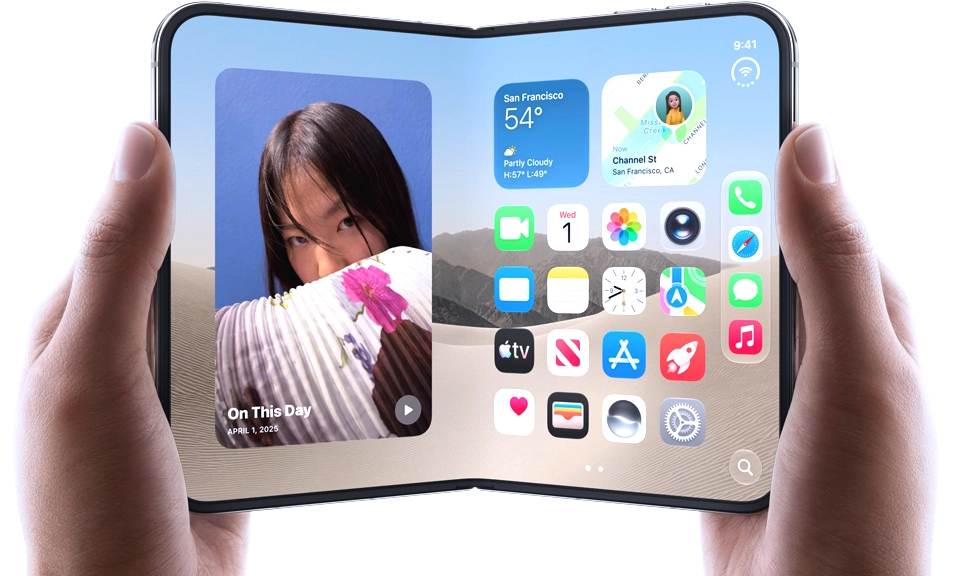
On September 9, 2026, at Apple Park, new CEO John Ternus unveiled the iPhone Duo — Apple’s first foldable, and the most expensive iPhone ever made. Seven years after Samsung launched the original Galaxy Fold, Apple has finally entered the arena. And it’s entering with a device that looks eerily similar to Samsung’s latest: the Galaxy Z Fold 8, a passport-style foldable that Samsung released just weeks earlier in July.
Both phones fold horizontally into a wide, squat rectangle. Both have 7.6-inch inner displays. Both cost north of $1,800. They’re competing for the same buyers, with the same form factor, at the same moment.
So which one is actually worth your money? Here’s how they stack up.
Design: Titanium vs. Flex Titanium
The iPhone Duo is built from Grade 5 titanium, with a precision hinge containing more than 100 components, and a custom nano-texture finish designed to reduce glare and crease visibility. It measures 5.2mm unfolded and 11.3mm folded, weighing a hefty 254 grams. It’s roughly the size of a passport when closed, with rounded edges and flat titanium sides.
The Galaxy Z Fold 8 is thinner and lighter. It measures 4.5mm unfolded and 9.7mm folded, weighing just 201 grams — 53 grams lighter than the Duo. Samsung’s “Flex Titanium” structural approach adds a titanium alloy layer beneath the flexible OLED, strengthening display support and reducing crease visibility. The Fold 8 has sharper, more squared-off corners, which CNET’s reviewer found slightly more polished than the Duo’s rounded edges.
Both devices are IP-rated, but the Duo has an edge: IP68 versus the Fold 8’s IP48. That means the Duo is better protected against dust and water immersion.
Winner: Galaxy Z Fold 8. It’s significantly lighter and thinner, and the difference is immediately noticeable in the hand. The Duo’s 254-gram weight puts it closer to a small tablet than a phone.
Display: Same Size, Different Approach
Both devices have 7.6-inch inner displays and similar cover screens — 5.4-inch on the Duo, 5.5-inch on the Fold 8. Both run at 120Hz.
But the experience differs. Apple’s inner and outer Super Retina XDR displays share the same aspect ratio, allowing content to scale proportionally as you switch between screens. The nano-texture finish on the inner display reduces glare and makes the crease less visible. CNET noted that the Duo’s software makes content shift “smoothly” between the cover and main display “in a way that makes other foldables feel unrefined”.
The Fold 8 uses a 4:3 aspect ratio on its inner display — a squatter, wider format that Samsung designed specifically for video consumption and reading. The cover screen hits 3,000 nits of brightness. Samsung’s display is Dynamic AMOLED 2X, and CNET praised the minimized crease and overall quality.
Winner: Tie. The Duo has a better software experience for switching between screens and a superior nano-texture finish. The Fold 8 has a brighter cover screen and a form factor optimized for media. It comes down to whether you prioritize polish or purpose.
Performance: A20 Pro vs. Snapdragon 8 Elite Gen 5
The iPhone Duo runs on Apple’s A20 Pro chip — a 2-nanometer processor with a six-core CPU, seven-core GPU, and dual 16-core Neural Engine designed for on-device AI workloads. Apple claims up to 35% higher sustained performance than the iPhone 17 Pro, supported by a custom vapor chamber for thermal management.
The Galaxy Z Fold 8 runs on Qualcomm’s Snapdragon 8 Elite Gen 5 “for Galaxy” — the same chip Samsung has used across its entire Z8 lineup. It ships with 12GB of RAM as standard, with a 16GB option available at the higher storage tiers. In practice, both devices deliver flagship-level performance. The Fold 8 has been praised for “quick performance” and smooth multitasking, while the Duo’s A20 Pro is expected to set a new benchmark for mobile sustained performance.
Winner: iPhone Duo (on paper). Apple’s 2nm chip and vapor chamber give it a theoretical edge, but real-world differences will be minimal for most users.
Battery: A Surprising Upset
This is where the Duo’s weight suddenly makes sense.
Apple says the iPhone Duo offers up to 31 hours of video playback on the inner display and 44 hours on the outer display, thanks to a dual-battery architecture and the A20 Pro’s efficiency. Independent spec comparisons list the Duo’s battery at 5,800mAh.
The Galaxy Z Fold 8 has a 4,800mAh battery, a modest increase from the Z Fold 7’s 4,400mAh. It supports 45W fast charging — hitting 67% in about 30 minutes — and 20W wireless charging. CNET’s review noted “longer battery life than Z Fold 7” and “nearly 17 hours of battery life” in their testing.
Winner: iPhone Duo. A 5,800mAh battery versus 4,800mAh is a significant gap. The Duo’s extra weight buys you real endurance. If battery life is your priority, Apple wins this round decisively.
Camera: 48MP vs. 50MP — But It’s Not That Simple
The iPhone Duo carries a 48MP Fusion main camera and a 48MP Fusion ultra-wide, with sensor-shift optical image stabilization and support for 4K 120fps video and 4K Dolby Vision HDR time-lapses. It has a front-facing external lens, two rear lenses, and an internal lens — all of which can be used simultaneously when the device is fully open.
The Galaxy Z Fold 8 has a 50MP wide camera and a 50MP ultra-wide, with 8K video recording at 30fps. It has 10MP selfie cameras on both the cover and main displays.
Here’s the catch: the Fold 8 has no telephoto lens. CNET listed “No telephoto lens” as a con, and PCMag flagged the same omission. The Duo doesn’t have a dedicated telephoto either, but its 48MP sensor enables 12MP optical-quality 2x zoom. Samsung’s AI capabilities for camera processing were described as “spotty” by CNET.
Winner: Tie (with a caveat). Both are excellent in good light. Neither has a true telephoto, which is disappointing at this price point. The Duo’s simultaneous multi-lens shooting is a genuinely useful feature for creators.
Software and AI: The Real Differentiator
This is where the two devices diverge most sharply.
The iPhone Duo runs iOS 27, which Apple redesigned specifically for the foldable form factor. The headline feature is Split View — the ability to run two apps side by side on an iPhone for the first time, including two windows of the same app. Apple Intelligence and Siri AI are built in, with Siri AI rolling out as a beta starting September 14.
The Galaxy Z Fold 8 runs Android 17 with One UI 9, featuring Gemini Intelligence and app automation. Samsung’s AI features have been praised as “genuinely helpful” by PCMag, though CNET noted they “can be spotty”. The Fold 8 also supports DeX, Samsung’s desktop-mode software that turns the phone into a productivity machine when connected to a monitor.
Winner: Galaxy Z Fold 8. Samsung has had seven generations to refine foldable software. DeX is a mature, powerful feature that Apple doesn’t have an answer for. Gemini Intelligence is more integrated into daily workflows than Siri AI, which is still in beta. Apple’s Split View is welcome, but it’s playing catch-up.
Price and Availability: The $100 Question
The iPhone Duo starts at $1,999 for 256GB, with options up to 2TB. Pre-orders begin October 16, with availability starting October 23 in more than 70 countries. It comes in Star White and Night Sky.
The Galaxy Z Fold 8 starts at **$1,899** for 256GB with 12GB RAM, with a 16GB/1TB option at $2,499. It’s available now, having launched on August 7. It comes in Lavender, Graphite, Cream, and Pistachio.
Winner: Galaxy Z Fold 8. It’s $100 cheaper at base, and it’s been available for over a month. Samsung also offers a wider range of colors and a more established trade-in ecosystem. Apple’s storage pricing climbs steeply — the 2TB Duo costs $3,200.
The Verdict: Which Foldable Should You Buy?
If you’re already in the Apple ecosystem — iPhone, AirPods, Apple Watch, Mac — the iPhone Duo is the obvious choice. It’s the most polished foldable Apple could have made on its first attempt, with superior battery life, a lighter software experience, and the seamless integration that only Apple can deliver. The 254-gram weight is a real trade-off, but the 5,800mAh battery justifies it.
If you’re platform-agnostic, or if you’ve been waiting for a foldable that genuinely feels like the future, the Galaxy Z Fold 8 is the better device. It’s lighter, thinner, cheaper, and backed by seven generations of refinement. Samsung’s DeX mode makes it a legitimate laptop replacement in a way no iPhone can match. And the 4:3 aspect ratio is genuinely better for the way most people consume content — wide, not tall.
Apple’s first foldable is impressive. But Samsung’s eighth is still the king.
The iPhone Duo doesn’t beat the Galaxy Z Fold 8. It matches it in some areas, loses in others, and wins on battery life. For a first-generation product going up against a seventh-generation one, that’s not a failure — it’s a statement of intent.
The real question is what happens next. If Apple’s second foldable is as refined as its first, Samsung’s head start might not matter for much longer.