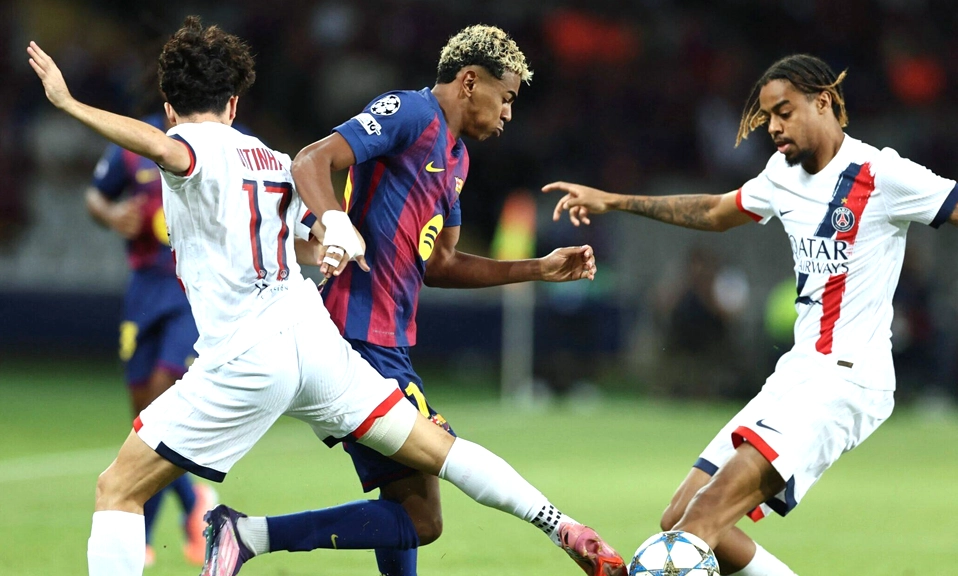
PSG 4-2 Barcelona. A six-goal thriller at the Parc des Princes that ended Barcelona’s perfect start to the season and confirmed Paris Saint-Germain as the team to beat in this Champions League. But the scoreline only tells part of the story. This was a tactical victory as much as a clinical one—a night when Luis Enrique’s blueprint outshone the attacking brilliance of Hansi Flick’s side.
Here are the five reasons Paris won.
1. The Press That Broke Barcelona’s Build-Up
Barcelona arrived in Paris on an 11-match winning streak, having swept aside every opponent in their path. They left with their first defeat of the season—and the primary cause was PSG’s relentless high press.
Luis Enrique built his game plan around disrupting Barcelona’s fluid build-up play. His attacking players—Ousmane Dembélé, Désiré Doué, Khvicha Kvaratskhelia—didn’t just attack. They defended from the front, suffocating the supply line to Barcelona’s creative technicians and forcing errors high up the pitch.
“The forwards did a great job defensively; we were superior in winning back possession in the opposition’s half,” Enrique said after the match. The statistics back him up. Barcelona’s attempts to play through pressure repeatedly handed PSG opportunities close to goal. Pedri lost possession before Kvaratskhelia hit the post early on. The opening goal came directly from a turnover—Yamal tried to move the ball through a pressured right-sided combination, João Neves intercepted, and Doué finished.
This wasn’t a lucky press. It was a coordinated, rehearsed trap—and Barcelona walked into it again and again.
2. Midfield Dominance: Neves, Ruiz, and the Art of Off-Ball Movement
The scoreline will remember Vitinha’s stunning volley and Fabián Ruiz’s late tap-in. But the foundation of PSG’s victory was laid by the off-ball movement of João Neves and Fabián Ruiz—a tactical battle that Barcelona never solved.
Neves’ positioning between the lines consistently caused problems for Barcelona’s defence. His late runs caught out the offside trap, his movement occupied Barcelona’s right-back and created space for Kvaratskhelia, and his timing—dashing forward from central areas to complement attacks down the flanks—was described as the most impressive aspect of his performance.
Fabian, meanwhile, roamed towards the right wing to overload that area, supporting Doué and Hakimi. His runs behind Barcelona’s defence created chance after chance, and his late arrival in the box for the fourth goal was the culmination of a performance that underlined why PSG’s midfield is arguably the best in the world.
“Against teams of your level or higher, you have to know how to adapt,” Enrique said. Adapt they did—not by abandoning their principles, but by executing them with greater precision than their opponents.
3. Clinical Finishing and a Chasm in Expected Goals
The raw numbers tell a story of superiority, not luck.
PSG took 22 shots, 14 of them on target, and generated 3.73 expected goals (xG). Barcelona took 18 shots, put just five on target, and generated 2.19 xG. Joan Garcia, Barcelona’s goalkeeper, had to make ten saves—and still conceded four.
This wasn’t a game where PSG rode their luck. They created better chances, took them more frequently, and forced Barcelona’s defence into repeated errors. The score was level twice—through Xavi Espart and Lamine Yamal—but the contest was never equally comfortable. PSG could generate shots through multiple routes while keeping enough players capable of responding to the next phase. Barcelona increasingly depended on their goalkeeper at one end and exceptional individual actions at the other.
In a game of fine margins, the team with the sharper edge won. PSG’s finishing was the difference between a thriller and a rout.
4. Squad Depth and Tactical Flexibility
Luis Enrique made bold calls—and they paid off. Lucas Hernandez, rarely a starter in the Champions League in recent months, was handed a starting role and responded with a vital headed goal in the 72nd minute to restore PSG’s lead.
When Marquinhos was forced off with an injury in the 59th minute, Illia Zabarnyi came on and slotted seamlessly into the back line. When Dembélé and Kvaratskhelia were lost to injury either side of half-time, PSG didn’t collapse—they adapted.
“We controlled the first half well, but in the second half we had 10 or 15 minutes of suffering,” Enrique admitted. During that spell, Barcelona equalised twice. But PSG weathered the storm, regrouped, and finished the stronger side. That is the mark of a team with genuine depth—not just a starting XI, but a squad capable of absorbing pressure and striking when it matters.
Bixente Lizarazu summed it up: PSG proved once again that their collective is “stronger than its individualities”.
5. The Late Surge: Vitinha, Ruiz, and the Will to Win
With the game poised at 2-2 after Lamine Yamal’s brilliant 79th-minute equaliser, the momentum seemed to be shifting. Barcelona had clawed their way back twice. The Parc des Princes was tense.
Then Vitinha produced the moment of the match.
A half-volley from outside the box, struck through a crowd of players, kept low to defeat Joan Garcia. It was a goal of pure technique and nerve—the kind of finish that separates champions from challengers. “The technical heartbeat of the side,” Goal.com called him. “His crowning moment”.
Five minutes later, Fabián Ruiz sealed it. A far-post tap-in from Hakimi’s cross, and the game was over. Two goals in five minutes, both from midfielders arriving late in the box—the culmination of a tactical plan executed to perfection.
“Four goals in this second half from 15 shots, some truly excellent finishing on show,” The Athletic’s live report noted. It was chaotic, breathless, and ultimately decisive. PSG didn’t just win the thriller. They owned the moments that decided it.
PSG’s 4-2 victory was not a fluke
. It was a tactical masterclass—a high press that suffocated Barcelona’s build-up, midfield movement that carved open spaces, clinical finishing that punished every mistake, and squad depth that absorbed injuries without losing shape.
Barcelona will point to the two equalisers and the 15-minute spell of dominance after half-time. They will note that the game was closer than the scoreline suggests. They are right. But PSG were superior in the moments that mattered—and in a Champions League thriller, that is all that counts.
“I’m a Barca fan, but I’m a professional and I enjoy the team’s victories,” Enrique said. On Tuesday night, the professional enjoyed a very good one.
PSG remain perfect in Europe. Barcelona have their first defeat. And the Champions League has its first genuine statement of intent.