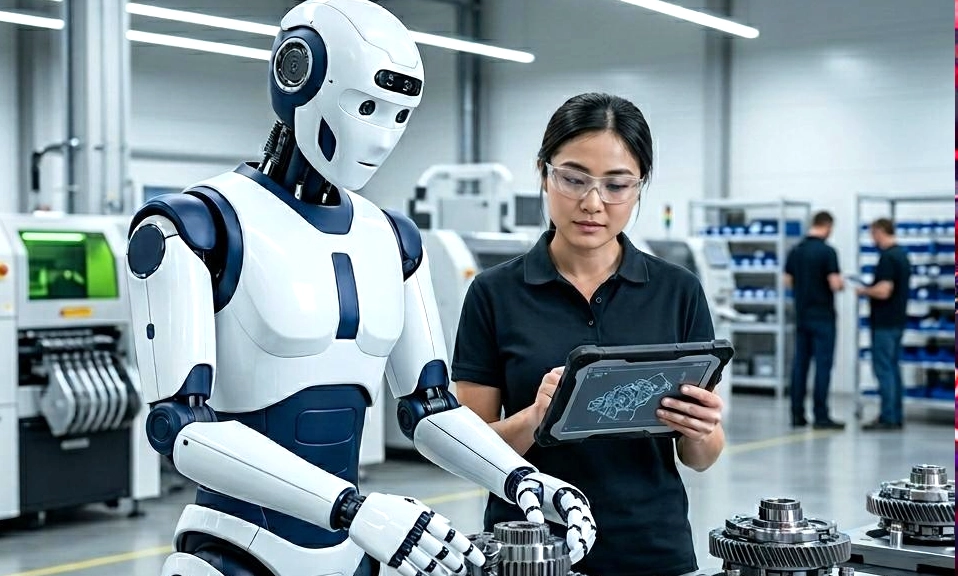
The robot revolution is no longer a distant sci-fi scenario. It is happening now—in warehouses, hospitals, farms, and even offices—and it is accelerating faster than most experts predicted. But the question that matters most is not whether robots will transform our jobs. It is how, and whether we are prepared for the scale of the change.
In 2026, the global stock of industrial robots has surpassed 4.5 million units, with annual installations exceeding 600,000 for the third consecutive year, according to the International Federation of Robotics. But the more significant shift is in intelligent machines—robots equipped with AI that allows them to perceive, reason, and adapt. These are not the blind, caged arms of the past. They are mobile, collaborative, and increasingly capable of tasks that were once considered exclusively human.
The result is a transformation of work that is more nuanced than the “robots will take all our jobs” narrative suggests. Some roles are being displaced. Others are being augmented. And entirely new categories of work are emerging. The challenge is managing the transition—and ensuring that the benefits are shared.
The Physical Frontier: Where Robots Are Already Working
The most visible impact is in sectors that rely on repetitive, physically demanding, or dangerous tasks.
Manufacturing remains the largest adopter. Automotive giants like Tesla, BMW, and Toyota are deploying humanoid robots for tasks ranging from parts handling to quality inspection. Tesla’s Optimus program has moved from demonstration to limited production, with units performing repetitive tasks in Tesla’s own factories. BMW’s Spartanburg plant has tested Figure’s humanoid robots for logistics and assembly support. These are not replacements for entire shifts; they are supplements that take on the most ergonomically punishing roles.
Logistics and warehousing are being reshaped by autonomous mobile robots (AMRs) and robotic arms. Amazon now operates over 750,000 mobile robots across its fulfillment network, and its Sequoia system uses a combination of robotic arms and storage pods to reduce order processing time by up to 25%. The company has also begun testing Agility Robotics’ Digit humanoid for repetitive tote-handling tasks. The effect on jobs is mixed: Amazon has created hundreds of thousands of jobs during the same period, but the nature of those jobs has changed—fewer pickers, more robot technicians and system operators.
Healthcare is seeing a quieter but equally profound transformation. Robotic surgical systems like Intuitive’s da Vinci are now standard in many hospitals, and AI-powered robots are being used for patient transport, disinfection, and medication delivery. In elder care, companion robots and exoskeletons are helping caregivers lift patients safely. These are not replacements for nurses or doctors; they are tools that reduce physical strain and free up time for direct patient interaction.
Agriculture is adopting autonomous tractors, robotic harvesters, and drones for crop monitoring. John Deere’s autonomous tractor is commercially available, and robotic strawberry pickers are being tested in California and Europe. These technologies address acute labor shortages in seasonal work, but they also raise questions about rural employment.
The Cognitive Frontier: Robots That Work with Information
The line between “robot” and “AI agent” is blurring. In 2026, software robots—often called robotic process automation (RPA) or digital workers—are handling a growing share of cognitive, rule-based tasks. From processing invoices to onboarding employees to generating reports, these agents can work 24/7 without error.
The impact on office jobs is real but uneven. Data entry clerks, basic bookkeepers, and administrative assistants are among the roles most exposed. But the same technology is creating demand for AI trainers, prompt engineers, automation specialists, and data annotators. The net effect is not mass unemployment; it is a shift in the skills that are valued.
The “Augmentation” Effect: Where Robots Make Humans Better
The most optimistic—and increasingly well-documented—story is one of augmentation. Robots are not just replacing humans; they are making humans more capable.
In manufacturing, collaborative robots (cobots) work alongside human operators, handling heavy lifting while humans perform precision tasks. In surgery, robotic systems give surgeons enhanced dexterity and visualization, improving outcomes without replacing the surgeon’s judgment. In construction, exoskeletons allow workers to lift heavier loads with less fatigue, extending careers and reducing injuries.
A 2025 study by the Boston Consulting Group found that companies that deployed robots collaboratively—rather than as full replacements—saw productivity gains of 20-30% with minimal net job losses. The key variable was not the technology itself, but how it was integrated into the workflow.
The Displacement Risk: Who Is Most Vulnerable?
None of this means displacement is not happening. It is. The workers most at risk are those in routine, repetitive, and predictable roles—the same roles that have been vulnerable to automation for decades. The difference is that AI-powered robots can now handle tasks that require some variability and judgment, expanding the frontier of what can be automated.
The World Economic Forum’s Future of Jobs Report 2025 projected that by 2030, 92 million roles could be displaced by automation and AI, while 170 million new roles could be created—a net positive, but one that masks significant churn and transition costs. The workers who lose their jobs are not always the ones who get the new ones.
Geography matters too. Manufacturing-heavy regions are more exposed than service-oriented economies. And within countries, workers without post-secondary education or digital skills face the steepest adjustment.
The Policy Response: Reskilling, Safety Nets, and New Rules
The acceleration of robot adoption is forcing governments and companies to confront difficult questions.
Reskilling is the most common prescription. Germany’s dual-training system and Singapore’s SkillsFuture program are frequently cited as models. Companies like Amazon and Siemens have committed billions to upskilling their workforces. But reskilling at scale is expensive, slow, and often mismatched with the pace of technological change.
Social safety nets are being debated in new terms. The idea of a universal basic income (UBI) has moved from fringe to mainstream in some policy circles, though no country has implemented it at scale. More modest proposals—wage insurance, portable benefits, and expanded unemployment protections—are gaining traction.
Regulation is also evolving. The EU’s Machinery Regulation and AI Act impose safety and transparency requirements on robotic systems. In the US, OSHA is updating workplace safety rules to account for human-robot collaboration. The question of liability—who is responsible when a robot causes harm—remains unsettled in many jurisdictions.
Transformation, Not Apocalypse
The robot revolution is real, and it is accelerating. Intelligent machines are transforming jobs across manufacturing, logistics, healthcare, agriculture, and office work. Some roles are disappearing. Others are being reshaped. New ones are being created.
The outcome is not predetermined. It depends on choices made by companies, governments, and workers themselves. If robots are deployed purely as cost-cutting replacements, the displacement will be severe. If they are deployed as collaborative tools—augmenting human capabilities, taking on dangerous and repetitive tasks, and freeing people for higher-value work—the result can be shared prosperity.
The most important job of the next decade may not be building better robots. It may be building better systems for managing the transition—systems that protect workers, spread the gains, and ensure that the robot revolution benefits everyone, not just the owners of the machines.
The robots are coming. The question is what kind of world they will arrive in.