For nearly a decade, the second-generation Tesla Roadster has been the automotive world’s most tantalizing promise—a car announced in 2017, delayed repeatedly, and almost written off as vaporware. On October 15, 2026, at a SpaceX test facility in McGregor, Texas, Tesla finally unveiled it. And it was worth the wait. This is not just an electric supercar. It is a machine that blurs the line between road and sky.
The new Roadster is extraordinary for reasons that go far beyond its specs sheet. It represents a fundamental rethinking of what a car can be when you stop assuming it has to stay on the ground. Here are seven things that make it unlike anything else on the road—or above it.
1. It Uses Actual SpaceX Rocket Thrusters
The Roadster’s headline feature is a suite of cold-gas thrusters developed in collaboration with SpaceX, Elon Musk’s rocket company. Unlike conventional rocket propulsion that burns propellant, these thrusters use compressed air stored at extremely high pressure, expelled through nozzles to generate thrust.
The system is controlled by all-electric actuators that can make micro-adjustments to stabilize the vehicle during aerial maneuvers. The technology is derived directly from SpaceX’s spacecraft attitude-control systems, adapted for a four-wheeled vehicle. As Musk put it, the collaboration produced something “better than any James Bond car”.
2. It Accelerates Faster Than You Can Comprehend
The acceleration figures are genuinely difficult to process. Tesla offers the Roadster in three configurations, each more extreme than the last.
The Performance version, which is road-ready and seats two, accelerates from 0 to 60 mph in under 1.6 seconds—already quicker than almost any production car in history.
The Thrust version adds rear-mounted cold-gas thrusters and drops that time to under 0.9 seconds.
And the Rocket version, the range-topping, single-seat, invite-only configuration, is claimed to achieve 0 to 60 mph in under 0.59 seconds. During the livestream reveal, a pre-production model was timed at 0.81 seconds, a figure that Tesla says will be representative of the final car.
To put that in perspective: the fastest production cars in the world today, like the Rimac Nevera, complete the sprint in around 1.7 seconds. The Roadster Rocket is operating in a different universe entirely. As Tesla explained, the thrusters generate four to five times the force the tires can, meaning the car’s acceleration is no longer limited by grip—it is limited only by physics.
3. It Can Briefly Fly (and Flip)
The Rocket variant is not just fast. It is, by Tesla’s own description, capable of flight. During the reveal, Tesla demonstrated the Roadster driving up a curved ramp until it was completely upside down, launching into the air, performing a mid-air flip, and landing safely under the control of its thrusters. It also hovered over a lineup of other Tesla vehicles while moving.
The Rocket’s perimeter-mounted thruster system—10 thrusters in total—enables forward and upward acceleration as well as lateral rotation. This is not a car that merely drives fast. It is a car that can leave the ground, change orientation in the air, and return to the pavement under control. Tesla’s official description of the Rocket configuration is refreshingly direct: “So…yes, it can fly”.
4. It Sticks to the Road Like Nothing Else
The ability to fly is remarkable, but the Roadster’s ground-game is equally extraordinary. The Performance and lower trims feature a multi-mode fan and ground-sealing system that pulls air from beneath the car, creating enough suction to generate enormous downforce.
Tesla claims this system can produce up to 2G of grip—double the gravitational force—holding the car to the pavement even when stationary or upside down. Active aerodynamics, including a retractable rear wing, adjust automatically to optimize traction and cornering. A Track Mode lowers the suspension to shift the center of gravity during high-speed cornering.
The combination of thrusters and suction is the core of the Roadster’s magic. The thrusters push the car forward with force that would otherwise overwhelm the tires. The suction system ensures the tires can handle it. It is a closed-loop system of extraordinary engineering.
5. The Interior Is a Cockpit, Not a Cabin
The Roadster’s cabin is a radical departure from conventional automotive design. Tesla removed adjustable seat mechanisms entirely, opting for a fixed seating position that reduces mass and centralizes the driver within the cockpit. The seat is integrated into the chassis, with manually adjustable seatbacks and movable pedals to accommodate different drivers without the weight of powered mechanisms.
A steer-by-wire yoke replaces the traditional steering wheel, eliminating the mechanical steering column and delivering direct road feedback. The dashboard centers on a large primary touchscreen, supplemented by two smaller forward displays that present vital telemetry data. The interior is finished in Tesla’s Ultrawhite theme with grey microsuede bolsters designed to maximize seat grip during high-performance driving.
This is not a luxury cabin. It is a driver’s cockpit, stripped of anything that adds weight without adding to the experience.
6. The Design Is Aerospace-Grade
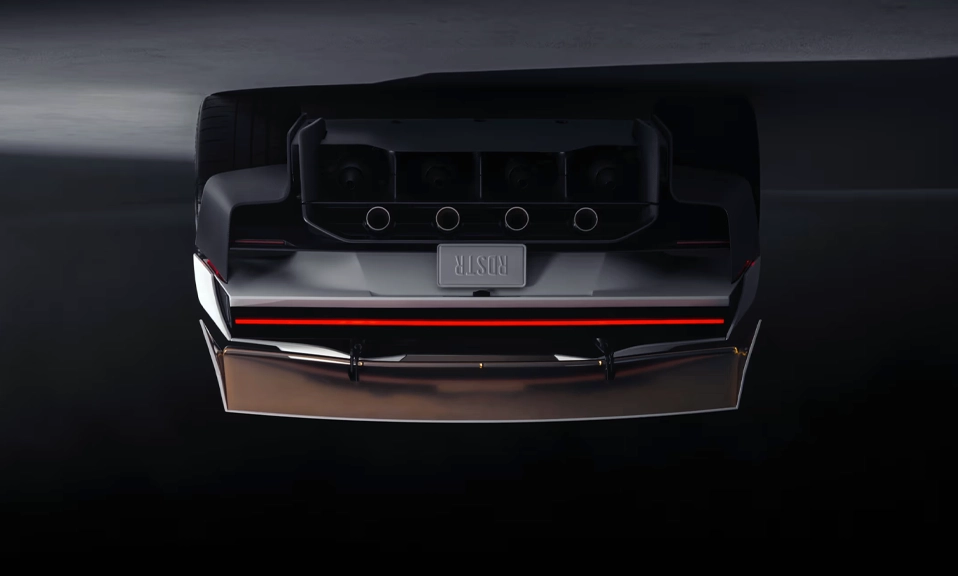
The exterior is defined by hidden LED headlamps, flush-mounted body panels, and a full-width rear light bar that give the car a sleek, almost monolithic appearance. The Ano White paint draws on aerospace coatings designed to provide UV and cryogenic protection, alongside electrostatic dissipation and corrosion resistance. Gold-tinted glazing mimics the copper coating applied to space suits, while titanium accents complete the exterior.
The structure uses magnesium, titanium, and carbon fiber to reduce weight, and the car sits on a pushrod-style suspension. The roof is removable, with T-top panels that can be stored in the trunk—technically making it a targa rather than a true roadster, though the name has stuck. Even the aerodynamics are aerospace-inspired: the multi-mode fan system and active wings are designed to manage airflow with the precision of a spacecraft.
7. It Is a Statement About the Future of Driving
The Roadster is not meant to be a high-volume product. Analysts expect Tesla to sell around 2,000 units per year, a tiny fraction of the company’s overall output. Musk himself has downplayed its financial significance, calling it a “small potato situation” in 2023. But its symbolic weight is immense.
As Morningstar analyst Seth Goldstein noted, Tesla “does not currently have a halo car,” and the Roadster will fill that role—a high-performance luxury vehicle designed to showcase the automaker’s best engineering and technology. It is a proof of concept for what electric performance can be when you stop thinking about cars as cars and start thinking about them as machines that can move in three dimensions.
Musk has described the Roadster as “the last great human-driven car” , a sentiment that reflects Tesla’s broader pivot toward autonomy and robotics. The Roadster is a celebration of driving as an act of human skill and sensation, even as the company invests billions in vehicles that drive themselves. It is a paradox, and it is entirely deliberate.
The new Tesla Roadster
is extraordinary not because of any single specification, but because of what those specifications represent. It is a car that accelerates faster than the tires can theoretically allow, because it brings its own thrust. It is a car that can fly, because it was built with the help of people who build rockets. It is a car that strips away everything unnecessary—seats, steering columns, luxury—to focus entirely on the experience of motion.
Production is expected to begin in 2028, with reservations currently open for the Performance and Thrust versions (requiring deposits of $50,000 and $250,000 respectively) and the Rocket version available by invitation only. Pricing has not been finalized, though Tesla quoted a base price of $200,000 nearly a decade ago.
The Roadster is not for everyone. It is not practical, it is not affordable, and its flight capabilities are explicitly excluded from public-road use. But it is a statement of intent: that Tesla, for all its controversies and delays, can still build something that makes the world stop and stare. And in an era when so many cars feel like appliances, that is worth celebrating.